Showing posts with label Northern Pygmy Owl. Show all posts

Friday, March 17, 2017

Pygmy Owls and Desert Reptiles

Northern Pygmy Owl in Tooele County, Utah, USA

I was beginning a new work week in my Salt Lake County office this past Monday when I looked out the window and was struck with the majesty of  the snow-capped Wasatch Mountains under clear blue skies. Temperatures were expected to reach into the 70s for the first time of the new year. We'd been through a winter of heavy snowfall and it was finally looking AND feeling like spring. I checked my calendar for Tuesday and made a swift decision to take Tuesday off so I could spend some much-needed time in the outdoors. I sent a text to my friend Eric to see if he wanted to join me. He had no hesitation on his part since he already had the day off. We made plans to visit a number of places, but I was particularly hopeful that we'd locate a Northern Pygmy Owl and confirm that reptiles were beginning to emerge from their winter retreats in our nearby desert. I admit that seems like an odd pairing of objectives, but that's what I wanted to do.

We spent the early hours before dawn attempting to locate a Long-eared Owl, which we did. We were able to hear one calling from the dark at Warm Springs WMA near Goshen, Utah. We also found a pair of Great Horned Owls and listened to them hoot back and forth to each other. As I was recording their courting calls the male flew over to the branch where the female was perched. They quickly copulated and then the male flew to another tree. It seemed late for Great Horned Owl copulation since they begin breeding in January and February here in Utah, but perhaps they had a failed clutch and were trying for a repeat clutch. Who really knows? In the same general area we heard a male Short-eared owl hooting from the tall grass of a nearby field.


Encountering three owl species in a matter of hours was fantastic, but we still needed to locate a Northern Pygmy Owl. We made a drive through Chimney Rock Pass and then up to Fairfield and over to Ophir Canyon. I love the wide-ranging public lands we can wonder here in Utah and other western states. We saw a Prairie Falcon, Golden Eagle, and small groups of Pronghorns along the way.

We eventually made our way to Ophir Canyon in Tooele (too-willa) County where we would begin our earnest search of a Pygmy Owl. Pinyon Jays were flying from Juniper to Juniper and giving their laughing calls as we entered the canyon. Scrub Jays and Juniper Titmice were also present in the lower section of the canyon. We stopped in one location part way up the canyon and began to scour the trees. I noticed the silhouette of a small bird that popped up from the ground and then perched on the backside of some trees downhill from the road we were on. With my binoculars I was able to confirm that it was a Pygmy Owl so we sat in the truck and waited a while to see what it would do. It was in hunting mode-twitching its tail, bobbing its head, and staring intently at times toward the ground beneath its perch. We eventually ended up watching the tiny bird hunt from a very close vantage point.

Northern Pygmy Owl Tooele County, Utah, USA

Northern Pygmy Owl Tooele County, Utah, USA

The owl pictured above was most likely a male. It seemed a bit small, but size is hard to tell without a relative comparison.

After spending a little time with the Pygmy Owl we made our way up the canyon where we discovered a Clark's Nutcracker and Steller's Jays. We turned around and headed back down the canyon and just as we drove past the previous Pygmy Owl location a larger female flew up to and landed on the tree right next to the road. We were able to see both birds at the same time and compare the relative sizes so we believe the bird pictured below is the female of a breeding pair.

Northern Pygmy Owl Tooele County, Utah, USA

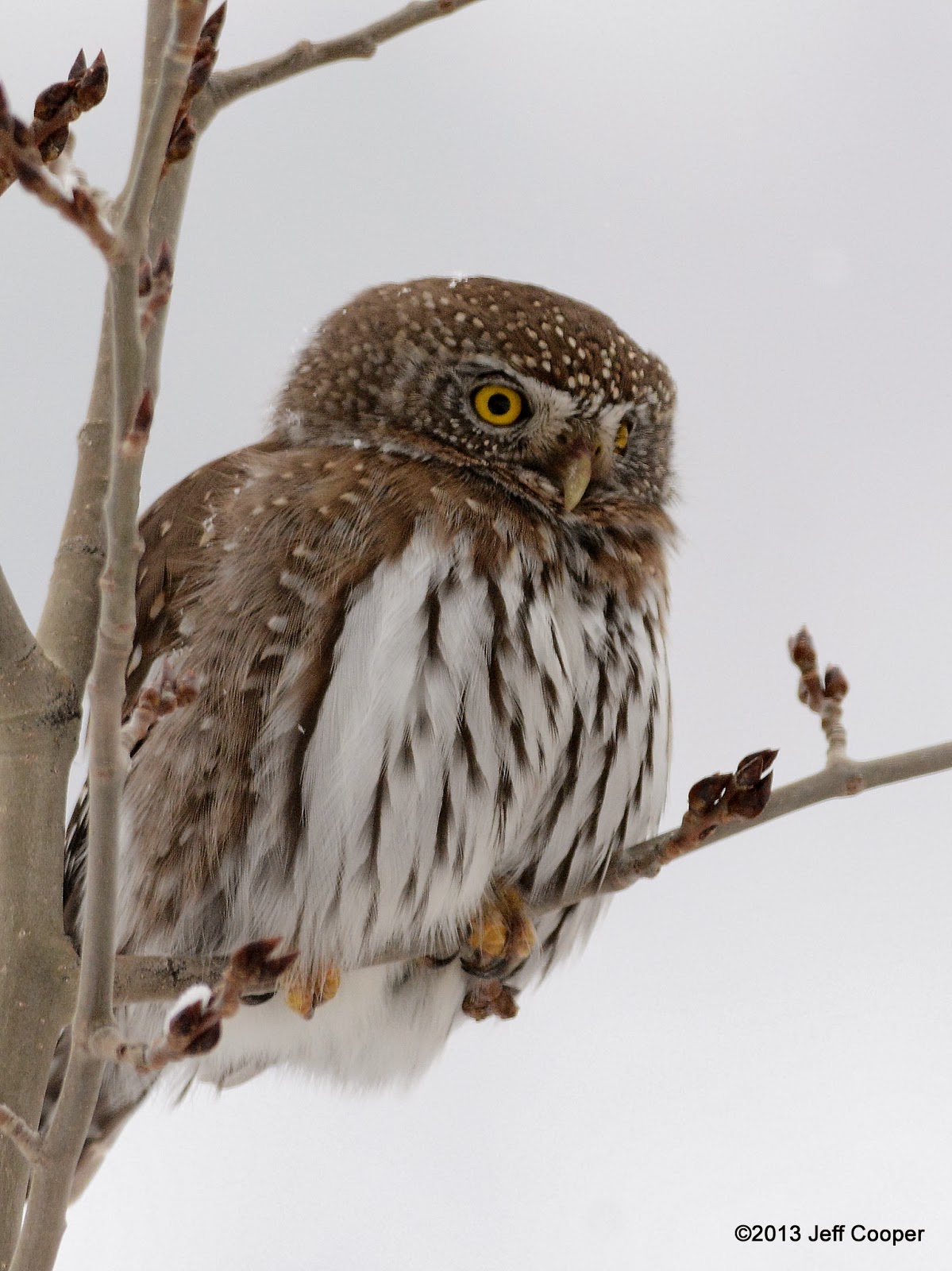
Northern Pygmy Owls are diurnal birds, most active from dawn to dusk, and just over six inches long from head to tip of tail. They generally perch hunt, meaning they perch, wait, and then seize prey that passes beneath or near their perch. They generally prey on small mammals, reptiles, amphibians, and even birds. When prey is seen they dive down and sink their sharp, powerful talons into the throat of the prey. If they take a bird they will pluck the feathers before consuming the insides of the skull and chest cavity.  You can see the sharp and relatively strong talons and hooked bill in most of the images I'm sharing. These birds seem rather cute unless you are on the wrong end of the food chain from them. From that perspective they are deadly beasts.

Northern Pygmy Owl Tooele County, Utah, USA

Northern Pygmy Owl Tooele County, Utah, USA

Northern Pygmy Owl Tooele County, Utah, USA


I never really plan on capturing video with my camera so consequently I'm never quite ready when the opportunity presents itself. The male owl was so accommodating while we were watching it so I decided to give video a  try. Unfortunately, it is hard to keep the lens steady without the use of a tripod when it is zoomed to 500mm. The first part of the video below was captured while using Eric's shoulder to steady the lens. Other parts were captured as I lay on my back away from the tree in which the owl was perched, rested the lens on my knees, and supported my head on the dried-out tree clump you see in the middle of the gravel area in the image to the right.

The video quality is best when viewed in HD.


On our way home we stopped at a friends house in Fairfield and observed a White-throated Sparrow, a rare bird for Utah. We also encountered a couple more roosting owls in Fairfield and a Golden Eagle that had a rather full crop that made us wonder what it had been eating, most likely one of the many jack rabbits that inhabit the sagebrush habitat surrounding Fairfield. We drove up and over Soldiers Pass at the south end of Lake Mountain and on the west side of Utah Lake. It is one of my local happy places. I have some great memories of camping with my sons and birding with friends at Soldiers Pass. We see coyotes, foxes, jack rabbits, reptiles, and unique summer birds that breed at Soldiers Pass during the spring and summer months. The desert habitat, lake, and distant mountains create beautiful landscapes that change with the seasons.

The View From Soldiers Pass Looking Over Cedar Valley to the West in Utah County, Utah, USA

We didn't spend much time birding Soldiers Pass. My objective there was primarily to check one of my favorite herping (reptile hunting) spots to see if the reptiles were surfacing for the season. I was delighted to see that several Common Side-blotched Lizards had emerged from their winter retreats. It felt good to be out enjoying the spring weather with the critters I had not seen since early fall of last year.

This Common Side-blotched Lizard Recently Emerged From a Winter Retreat at Soldiers Pass
Early Spring in Utah County, Utah, USA

Here is the final scene as Eric and I left Soldiers Pass and headed out to grab a late lunch of Mexican food before making our way home. Being in a desert, next to a lake, while surrounded by snow-capped mountains was refreshing and energizing. I can't wait to see what new discoveries will be made in the months to come.

The View From Soldiers Pass Looking East Across Utah Lake in Utah County, Utah, USA


Saturday, December 21, 2013

Northern Pygmy Owl at Aspen Grove: Images and Video

My birding friend, Carlos, agreed to help me cover a couple of count areas this morning as part of the annual Audubon Christmas Bird Count (CBC) for the Provo, Utah Count Circle. We started at 5:30 in the morning so we could attempt to locate a couple of owl species before sunrise. Snow was falling and it was about 24 degrees Fahrenheit, well below freezing. We struck out on our owl hunt. We verbalized that we must be crazy as we stood in falling snow and freezing temperatures while normal people were asleep in their warm beds.

We went to breakfast to wait for the sun to rise. We got off to a bang with our daylight census when we immediately saw a Sharp-shinned Hawk and a Cooper's Hawk. However, the steady snow fall kept most birds in hiding. We were struggling to see more than Starlings, Robins, and House Finches. We eventually made our way to Provo Canyon, our second count area, and quickly found an adult Bald Eagle. We had the fortune of finding a nice raptor or two in both of our count areas, but the bird sightings quickly went down hill thereafter. The weather conditions made this year's CBC the least productive I've ever experienced. Amid the challenging circumstances Carlos and I hatched a plan make the most of our circumstances. Since we were already in Provo Canyon and less than 15 minutes from ideal habitat for Pygmy Owls and a possible Northern Goshawk, we diverted our attention from the CBC temporarily to go on a hunt at Aspen Grove, a Brigham Young University-owned mountain resort.

Our first pass through Aspen Grove was bird-less. However, just after we turned to head out Carlos and I simultaneously spotted a Northern Pygmy Owl high above us on a dead tree top. Pygmy Owls are less than seven inches long so we were seeing a small fur ball with a short tail from our vantage point. The owl flew from its original perch while both of us were looking down at our camera gear. Neither of us saw where it went. Talk about searching for a needle in a haystack. Fortunately, we relocated it atop a conifer. Again the owl flew as we were trying to get a closer look. This time it dropped out of sight, but I observed its general direction and followed it around some buildings and up a small hill. I was able to relocate it in a short Aspen Tree, about 12 feet above ground, right next to some cabins where families were playing in the snow. Carlos and I spent about twenty minutes observing, photographing, and sharing the owl with those who passed by us.

Northern Pygmy Owl at Aspen Grove in Utah County, UT
The whitish look at the base of the owl's bill in this image is actually the result of a snowflake that was falling and in between me and the owl when the image was captured.

Northern Pygmy Owl at Aspen Grove in Utah County, UT
 We wanted to see the bird at eye level so we took a few images from one of the cabins next to the owl.

Northern Pygmy Owl at Aspen Grove in Utah County, UT
Back down on the ground I wanted to be some closer images to see what detail could be captured despite the overcast skies. Turning up the exposure compensation helped quite a bit. I shoot .jpg files and use Google's Picasa to manage my images. That's pretty basic compared to many serious nature photographers. Consequently, all I've done with each of these images is crop, slightly sharpen, and darken them so they don't look overexposed. The bright white background is a result of increasing the exposure compensation with the camera in the field. I like the little snow crystals/flakes gathering on the side of the owl's back and head.

Northern Pygmy Owl at Aspen Grove in Utah County, UT
The following images attempt to show basic traits of owls. I took the image below because I wanted to show the toes and talons of these fierce little owls. Owls have four toes. The outside toe for each foot can rotated from front to back as needed. By turning it back the owls can get a good grasp on its prey.

The Talons of a Northern Pygmy Owl at Aspen Grove in Utah County, UT
This shot was an attempt to include a little more of the owl's brown coloring. It was too high to get a full image from the back side.

Northern Pygmy Owl at Aspen Grove in Utah County, UT
With this image you see the eyelids of the owl. Owls and other birds have an extra eyelid called a nictitating membrane. You can see that membrane partially covering the eye in the second image below. The edge of the membrane is the dark line running mostly vertically on the eye. The main eyelid moves up and down, but the nictitating membrane moves more side to side. This membrane helps clean and protect the eyes.

Northern Pygmy Owl at Aspen Grove in Utah County, UT
 Here's a perch more common than seeing a Pygmy on an Aspen Tree. We often find them perched atop conifers or on horizontal branches that reach over top a road or other open space. Pygmy Owls like to watch for mice and other small mammals to come into the open spaces below them. Pygmy Owls will also eat other small birds.

Northern Pygmy Owl at Aspen Grove in Utah County, UT
Just before we left the area I decided to make my second attempt at using the video functionality on my Nikon D7100. Lighting was not great, but the video turned out okay. This clip is less than a minute long, but it shows the tiny owl perched and looking around. You can see its chest moving as it breaths and you can see it retract its body feathers just before it takes flight. I included a slow motion replay of the owl taking flight from it's perch.

I've noticed that the sharpness of the video image is better if you click on the settings icon in the bottom, right-hand corner of the YouTube screen and select an HD setting. Otherwise, the image is a little blurry if you watch it in full screen mode.


Carlos had to end his birding activities after we left Aspen Grove. I returned to our first count area to count more birds in our first area. Once again, the first bird I spotted was a  raptor, a Merlin. Once again, the bird sightings went down hill again. I finished my assignment with the CBC and went home feeling good about completing my assigned counts, but I was really thrilled with the close encounter we had with the Pygmy Owl. 

Wednesday, October 9, 2013

The Bird That Got Away: Technically Bad But Interesting Bird Images

I originally shared this post on Birding Is Fun!. I'm now sharing on my own blog.

Capturing a great nature shot--especially when the subject can fly, scurry, or run--is a combination of skill, determination, equipment, and plain old luck or timing. Photographers often sift through lots of bad images before they share their work with others. Thank goodness for digital images that can be captured and deleted at practically no cost in comparison to film.  I've heard some great photographers say they shoot from tens to hundreds of images to get the one they think is worth sharing.

I love capturing and sharing images of birds and other creatures and I typically share only my favorites unless the image is meant for functional purposes such as providing proof of a rare bird. This post, however, will be the exception to the rule. In other words, I'm sharing images that would have been really awesome had I been better prepared, had better equipment, lighting, timing, etc. I'll probably kill any chance I had for being published in National Geographic once this post gets out. What follows are images that could have been.

I was wandering around Silver Lake near Utah's Brighton Ski Resort one wintry morning when a Steller's Jay gave a call. I turned around just in time to fire off my shutter and capture the jay flying over head. It looks more like an x-ray than a bird in flight. The sky was gray so lighting, camera settings, and my preparedness were off for this one.

Steller's Jay at Brighton Ski Resort Near Salt Lake City, UT

I can't complain about the lighting for these images of a Red-shafted Northern Flicker that was coming in for a landing one sunny morning as I was strolling along American Fork Boat Harbor. I saw the bird coming, I've always wanted to capture an image showing the really cool salmon-colored feathers and this was my opportunity. Unfortunately, I didn't get a tight focus until right before it landed and the branches obscured what I was targeting.

Northern Flicker (slightly out of focus) American Fork, UT
Northern Flicker (missed opportunity) American Fork, UT
An Osprey caught me off guard once and left me with a slightly out of focus image of what would have been an awesome raptor shot. If I crop it any more than this you'll quickly see that the eyes were out of focus. When the subject's eyes are out of focus it just doesn't make the cut--unless your point is to show what can go wrong in nature photography. Which, I have to remind myself, is the point of this post.

Osprey in American Fork, UT
Several years ago my company moved me into a nice corner office on the top floor of our building which was right next to excellent habitat for birds, foxes, deer, marmots, and more. I had seen some Peregrine Falcons around the area so I kept my camera in my office in case the perfect opportunity arose. On the day the opportunity presented itself I had left my camera in my truck. I saw a Peregrine enjoying lunch on the balcony ledge outside my office. I ran to the elevator, dropped six floors, retrieved the camera  from the truck and then slightly opened the door while on my knees to get a direct line to the bird. I snapped what would have been very nice images if there weren't two metal wires running horizontally between me and the bird. Consequently, the falcon's chest and the lunch (a dove) were blurred.

Peregrine Falcon with Dove South Jordan, UT
I was quite "surprised" as I was driving through Surprise, Arizona on my way back to Utah one day. I saw a Greater Roadrunner, running rather greatly along the road. I suddenly veered to the shoulder of the road. I'm not sure if it was legal where I was driving, but my excitement about seeing a roadrunner up close for the first time overruled my concern for everything else going on around me. I scrambled to get the camera bag and turn on the camera. The excitement was so great I was fumbling with every move. The bird suddenly plucked a Round-tailed Squirrel from beneath the sand and proceeded to thrash it against the ground. Man, I wish I would have been on a higher shutter speed to get a clearer image. It was definitely a moment I'll always remember.

Greater Roadrunner With Round-tailed Squirrel Surprise, AZ
Speaking of roadrunners, I got some really nice images of two roadrunners near Lytle Ranch in southwestern Utah this spring. However, one image had a missed opportunity because I wasn't anticipating that the bird would leap from one branch of a Joshua tree to another. I guess you could use this image to study its feet. The tail doesn't look like much, but wait til you see the next image.

Jumping Greater Roadrunner Washington County, UT
I had an adult Sharp-shinned Hawk fly right passed me as it was pursuing its breakfast one morning in Tonaquint Nature Center in St George, Utah. I got some nice images of the bird perched, but this time, unlike the jumping roadrunner, this bird decided to dive down from a perch. Too bad people aren't more interested in seeing the undertail of Sharp-shinned Hawks.

Tail of Adult Sharp-shinned Hawk St George, UT
Townsend's Solitaires are often viewed as rather bland, gray birds. I've always wanted to get an image of a Townsend's Solitaire with it flashing it yellow wing patches. The bird below was actually perched and suddenly took flight. Unfortunately, the unexpected wing patch shot turned out to be more of the bird playing a mean joke on me. Not a bad shot of a branch however.

Townsend's Solitaire in Pleasant Grove, UT (it was perched when the image was framed)
Another unexpected jumping bird turned out to look like a Photoshop effort gone bad. I don't use Photoshop so this is probably just as good as if I did Photoshop the image all by myself. Trust me on this one.  It would have been a nice image if the bird would have sat still on the branch below it.

Jumping Townsend's Solitaire at Tibble Fork Reservoir Utah County, UT
How do you like this awesome Barn Owl shot? It was actually perched on a power line as I was driving to the grocery store. It started to fly when I pulled over for a photo. Apparently this owl doesn't know how to frame itself well for a photo. If you look closely you can see the little black spots on it underside. By the way, that's a beautiful snow-covered mountain in the background. Be honest now, doesn't it make you want to ski in Utah?

Missed Barn Owl Shot Pleasant Grove, UT
I was driving home from work a few years ago and saw not only my first Swainson's Hawk ever, but I saw several within minutes. They must have just gotten off the last flight from Argentina. That's where they come from you know. It was April and I think that is when flights from Argentina to Utah are heavily booked by Swainson's Hawks. I was also new to photography at the time and I think I had everything on my camera set to auto. Someone told me that was all I needed to do to get good photos. Must have been a poor job on the hawks part. I'm sure if it knew it was going to go viral on the Internet it would have focused itself and kept all of its body parts in the frame.

Swainson's Hawk Springville, UT

I don't know. Is this a bad image of a Killdeer? Nice colors I guess, but what did I do to scare it off in such a hurry?

Killdeer Spanish Fork, UT

When I saw this Pygmy Owl's eyes go wide and it mouth start to gape I knew a pellet was about to be ejected in some sort of projectile fashion. I pressed the shutter release and fired away in continuous shooting mode. It took longer for the bird to clear its throat than expected. Between the capacity of the camera's sensor and the memory card the frames per second choked and stalled right as the pellet came forth.

Northern Pygmy Owl Aspen Grove Lodge Utah County, UT
The best I could do was take a picture of the pellet after my friend traipsed through hip-deep snow to retrieve the pellet and place it on the road. The point of showing this image is to see if you can identify the species of bird or mammal inside.

Freshly Expelled Northern Pygmy Owl Pellet Aspen Grove Lodge Utah County, UT
Please don't give up on my work. I have desire and better equipment now. I'm getting better all the time. I promise I'll do better next time.

Saturday, February 9, 2013

Casting a Pellet AND Yard Bird Species #68: What's That All About?

I know.  It's a confusing title for a blog post, but it does allude to two birding highlights I experienced Friday.

I received a phone call from my birding and bird photography friend Eric Peterson Friday morning. He had just found a bird he knew I was trying to add to my species list for the new year--a Northern Pygmy Owl. It was perched on a power line near Aspen Grove, just above Sundance Ski Resort in the mountains above Provo Canyon in Utah County, Utah. I quickly grabbed my bag of gear and made the 30-minute drive into Provo Canyon and up the east end of Alpine Scenic Highway. Eric and the owl were right where they were when I got the call. The owl was content as it perched on the power line above the road. Eric and I took some photos and then followed the owl when it flew further up the canyon and back onto a power line.

Northern Pygmy Owls are about 6.5 inches long, are often active in daylight, and generally eat small birds and small mammals. It's one of the smallest carnivorous birds in North America. While these owls are residents to Utah and other mountainous western states and areas of the US, Canada, and Mexico, most sightings of this bird in Utah take place during the winter when their puffy little bodies are more easily seen as they perch on barren horizontal branches and wires along mountain roads. This vantage point allows them to keep watch over the open roads and spaces below them where unsuspecting birds and rodents pass and become easy prey.

While we were visiting and observing the owl we noticed that it opened its bill wide and started to heave. We knew it was getting ready to cast a pellet. For those who are not aware, birds of prey often eat their prey whole. They digest the meat and fluids of the prey and eventually regurgitate the remaining fur, feathers, bones, etc. in the form of a compact wad of leftover stuff.  We focused our lenses on the owl when it began to heave and started firing away with our digital cameras. Below is a series of images of the owl as it heaved and ejected the unwanted wad of stuff.  I missed the actual ejection with my captured images, but Eric has shared one image where the pellet was captured mid-air, just after being ejected.

Northern Pygmy Owl Near Aspen Grove in Utah County, UT (Photo by Jeff Cooper)
Isn't this how people look just as they realize they are about to lose their lunch, blow chunks, or toss their cookies?

Northern Pygmy Owl Preparing to Cast a Pellet Near Aspen Grove in Utah County, UT (Photo by Jeff Cooper)
Hack! This appears to be quite the process. The eyes are closing, a sign of intense focus, and the posture is beginning to lean forward.

Northern Pygmy Owl Preparing to Cast a Pellet Near Aspen Grove in Utah County, UT (Photo by Jeff Cooper)
And here's the image, courtesy of Eric Peterson, capturing the the projectile and the force behind it--the process consisted of multiple heaves, eyes going closed, fulling gaping mouth.

Northern Pygmy Owl Casting Pellet Near Aspen Grove in Utah County, UT (Photo courtesy of Eric Peterson)
And here is an image of the wet, blackish pellet (~1/2 inch) after Eric trudged through snow up to his thighs to retrieve it and placed it on the road. You should be able to make out some fur and a tiny bone or two. Probably the remains of a small bird and/or mouse or vole.

Freshly Ejected Norther Pygmy Owl Pellet Near Aspen Grove in Utah County, UT (Photo by Jeff Cooper)
As Eric and I parted I thanked him for calling me to see the owl. He asked me to call him if I found anything of interest. He was hoping to photograph a particular species. That brings us to yard bird species #68 and the second part of this post's title. It also shows that favors are returned among good friends.

I had just finished visiting with someone in my home and heard the trill of Cedar Waxwings coming from the backyard. I looked through the back door and began to scan, with the naked eye, a small flock of Waxwings. I was looking specifically for a larger, grayer Waxwing with rufous under the tail and around its dark mask. I was hoping for Bohemian Waxwings to be mixed in with the flock since we've had an irruption of them in the northern parts of Utah this winter. I'm not sure if that's the result of harsh winter conditions in Canada or a good breeding season that has the birds spreading farther to the south than usual.  Just as I was about to give up on my hopes for a Bohemian, a larger Waxwing flew into the Flowering Plum Tree near my back patio. Bingo! A Bohemian Waxwing! The bird Eric said he was hoping to photograph earlier in the day as we were observing the owl. I ran through the house locating my phone for Eric and my camera to document yard bird species #68 (according to my eBird records).  Eric arrived shortly after my call and we photographed the birds as we wandered around my backyard and the yards of two neighbors (permission granted of course--I called them prior to Eric's arrival).

You can see a comparison of the colors and sizes of Cedar and Bohemian Waxwings from one of my previous post by clicking here.  The images below were captured Friday afternoon.

Bohemian Waxwing Visits My Backyard in Pleasant Grove, UT (Photo by Jeff Cooper)

Bohemian Waxwing Visits My Backyard in Pleasant Grove, UT (Photo by Jeff Cooper)

Bohemian Waxwing Visits My Backyard in Pleasant Grove, UT (Photo by Jeff Cooper)

Bohemian Waxwing Visits My Backyard in Pleasant Grove, UT (Photo by Jeff Cooper)
You can see a comparison of Cedar Waxwings and Bohemian Waxwings from a previous post by clicking here.


Thursday, December 20, 2012

Test Your Knowledge of North American Owls

Great Horned Owl at Garr Ranch
Antelope Island State Park Davis County, UT
(Photo by Jeff Cooper)
Owls are mysterious birds because many people know they exist yet few people have seen or understand much about them. Most people I know are familiar with large owls such as Great Horned and Barn Owl, but they have no idea that a number of small owls exist around them.
Barn Owl on Provo Airport Dike Provo, UT
(Photo by Jeff Cooper)
I will pose some questions as a fun little test of your knowledge of North American Owls in this post, but let me start with a recent experience I had with owls and a non-birder who shares property with a pair of owls. I participated in one of the annual Audubon Christmas Bird Counts last Saturday (12/15/12) by counting bird species in a small area of the Provo Christmas Bird Count. I started before sunrise to include nocturnal birding in my census. I wanted to see if I could locate a Great Horned Owl, Western Screech Owl, and Barn Owl. Despite snowfall, I was able to locate a Great Horned Owl hunting from a tree-top perch within five minutes of starting my census. I saw the silhouette of the tell-tale signs of the Great Horned Owl, two ear tufts and a bulky body. An hour and a half later as the sun began to rise I was still trying to find a Screech Owl and a Barn Owl. Once the sun came up I knew I was not likely to find a Screech Owl because they are strictly nocturnal and very secretive. However, I knew of some abandoned silos and farm buildings in my count area so I knocked on a few doors to obtain permission from property owners to check their buildings. I spoke with one lady and let her know I was doing a bird census for the Audubon Society and that I suspected she may have Barn Owls based on the abandoned buildings and silos near agricultural fields (preferred habitat and hunting areas for Barn Owls). She said, "I don't know if we have Barn Owls, but we have heard some Screech Owls." I suspected that what she was really hearing was the territorial scream (or screech) of Barn Owls. A few minutes into my search of the buildings I found what I was hoping for, an abundance of wash (white excrement) often found beneath an owl roost. I peeked up the shoot of the silo and saw a pair of Barn Owls. Both turned to look down at me and I was able to see the tawny color of the female's face next to her mate's much whiter face. I love following the clues that lead to such discoveries.

Now to the test. Here are a few questions to check your knowledge of North American Owls. I'll present the answers as I have them from one of my favorite books on owls, Owls of the United States and Canada by Wayne Lynch, at the end of the post (after the images).

1. How many species of owl are recognized in North America?
2. Which four species have dark, rather than yellow, eyes?
3. How many species of Screech Owl can be found in North America?
4. Which is the heaviest owl in North America?
5. Which species has the longest tail relative to its body size and hunts mainly during the day?
6. Which North American species is the smallest owl in the world?
7. Name the species for some of our smaller owls presented below.

This owl was photographed in the mountains of Utah during the summer. It is just under 7 inches tall.


This owl often perches conspicuously and hunts during the day. It was photographed in Provo Canyon in Utah. It is just under 7 inches tall.


This owl was photographed in the mountains of northern Utah in the early summer months. It is about 8 inches tall.


This owl was photographed in the desert just outside of Mesa, AZ at the end of April. It is just under 6 inches tall.


This owl was photographed in Pleasant Grove, UT. It is about 8.5 inches tall.


Answers:
1. 19 Species
2. Barn Owl, Barred Owl, Spotted Owl, Flammulated Owl
3. Western, Eastern, and Whiskered Screech Owls
4. Snowy Owl (the females in particular)
5. Northern Hawk Owl
6. Elf Owl
7. Images from top Flammulated Owl, Northern Pygmy Owl, immature Northern Saw-whet Owl, Elf Owl, Western Screech Owl