Showing posts with label small owl. Show all posts

Sunday, July 5, 2015

We Finally Saw-whet! I mean Saw It!

Last Friday evening I led a small group of bird and owl enthusiasts to some of the higher elevations of Utah's Wasatch Mountains.  One out-of-state birder had high hopes of seeing her first Flammulated Owl. That is a small mountain species of owl that many birders from around the United States and other parts of the world want to see when they visit Utah. Flammies, as some affectionately call them, are common for us locally during the spring and summer months because they come from Mexico to breed in our mountains so it is always fun to introduce others to them. One of the local birders who joined our small group had high hopes of seeing a Saw-whet Owl in the wild. I had one of my sons join us and he also had hopes of seeing his first Saw-whet.

Saw-whets are vocal during their breeding season, but they move about more silently in the dark after breeding season slows down. Consequently, this time of year is not ideal for locating Saw-whets. I was very confident we'd locate a Flammulated Owl so I spent most of my efforts locating a Saw-whet during the trip last Friday. We found our first of several Flammulated Owls rather quickly, but the Saw-whets were playing hard to get until our third and final stop and right up until just before we were about to call it a night. Our persistence paid off after we heard an adult give a call and then at least two juveniles calling back to the adult. One juvenile called long enough that I was able to locate it and put a light on it so everyone could enjoy its cute/awesomeness. The little owl was quite accommodating so I decided to capture a few images after others were able to enjoy excellent, close-range views.

Recently-fledged, Juvenile Northern Saw-whet Owl in Utah County, UT USA
Top/Back Side of Recently-fledged, Juvenile Northern Saw-whet Owl in Utah County, UT USA
Here's an image of an adult I found on a solo trip several weeks ago to illustrate how much the plumage changes between the juvenile and adult ages of the species. The branch in the foreground is unfortunate from a photographic perspective, but it's also very natural.

Adult Northern Saw-whet Owl in Utah County, UT USA

Saturday, December 21, 2013

Northern Pygmy Owl at Aspen Grove: Images and Video

My birding friend, Carlos, agreed to help me cover a couple of count areas this morning as part of the annual Audubon Christmas Bird Count (CBC) for the Provo, Utah Count Circle. We started at 5:30 in the morning so we could attempt to locate a couple of owl species before sunrise. Snow was falling and it was about 24 degrees Fahrenheit, well below freezing. We struck out on our owl hunt. We verbalized that we must be crazy as we stood in falling snow and freezing temperatures while normal people were asleep in their warm beds.

We went to breakfast to wait for the sun to rise. We got off to a bang with our daylight census when we immediately saw a Sharp-shinned Hawk and a Cooper's Hawk. However, the steady snow fall kept most birds in hiding. We were struggling to see more than Starlings, Robins, and House Finches. We eventually made our way to Provo Canyon, our second count area, and quickly found an adult Bald Eagle. We had the fortune of finding a nice raptor or two in both of our count areas, but the bird sightings quickly went down hill thereafter. The weather conditions made this year's CBC the least productive I've ever experienced. Amid the challenging circumstances Carlos and I hatched a plan make the most of our circumstances. Since we were already in Provo Canyon and less than 15 minutes from ideal habitat for Pygmy Owls and a possible Northern Goshawk, we diverted our attention from the CBC temporarily to go on a hunt at Aspen Grove, a Brigham Young University-owned mountain resort.

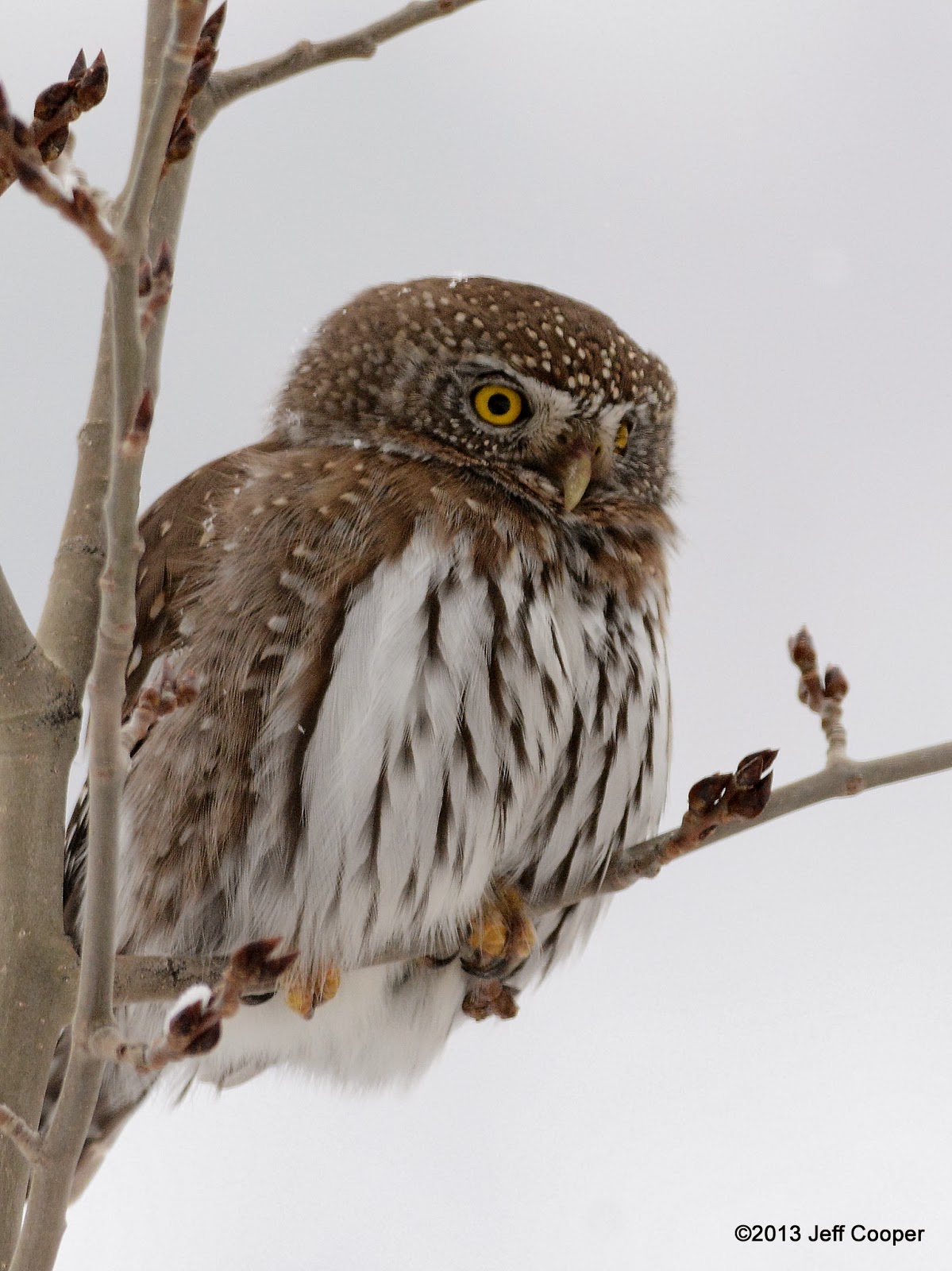
Our first pass through Aspen Grove was bird-less. However, just after we turned to head out Carlos and I simultaneously spotted a Northern Pygmy Owl high above us on a dead tree top. Pygmy Owls are less than seven inches long so we were seeing a small fur ball with a short tail from our vantage point. The owl flew from its original perch while both of us were looking down at our camera gear. Neither of us saw where it went. Talk about searching for a needle in a haystack. Fortunately, we relocated it atop a conifer. Again the owl flew as we were trying to get a closer look. This time it dropped out of sight, but I observed its general direction and followed it around some buildings and up a small hill. I was able to relocate it in a short Aspen Tree, about 12 feet above ground, right next to some cabins where families were playing in the snow. Carlos and I spent about twenty minutes observing, photographing, and sharing the owl with those who passed by us.

Northern Pygmy Owl at Aspen Grove in Utah County, UT
The whitish look at the base of the owl's bill in this image is actually the result of a snowflake that was falling and in between me and the owl when the image was captured.

Northern Pygmy Owl at Aspen Grove in Utah County, UT
 We wanted to see the bird at eye level so we took a few images from one of the cabins next to the owl.

Northern Pygmy Owl at Aspen Grove in Utah County, UT
Back down on the ground I wanted to be some closer images to see what detail could be captured despite the overcast skies. Turning up the exposure compensation helped quite a bit. I shoot .jpg files and use Google's Picasa to manage my images. That's pretty basic compared to many serious nature photographers. Consequently, all I've done with each of these images is crop, slightly sharpen, and darken them so they don't look overexposed. The bright white background is a result of increasing the exposure compensation with the camera in the field. I like the little snow crystals/flakes gathering on the side of the owl's back and head.

Northern Pygmy Owl at Aspen Grove in Utah County, UT
The following images attempt to show basic traits of owls. I took the image below because I wanted to show the toes and talons of these fierce little owls. Owls have four toes. The outside toe for each foot can rotated from front to back as needed. By turning it back the owls can get a good grasp on its prey.

The Talons of a Northern Pygmy Owl at Aspen Grove in Utah County, UT
This shot was an attempt to include a little more of the owl's brown coloring. It was too high to get a full image from the back side.

Northern Pygmy Owl at Aspen Grove in Utah County, UT
With this image you see the eyelids of the owl. Owls and other birds have an extra eyelid called a nictitating membrane. You can see that membrane partially covering the eye in the second image below. The edge of the membrane is the dark line running mostly vertically on the eye. The main eyelid moves up and down, but the nictitating membrane moves more side to side. This membrane helps clean and protect the eyes.

Northern Pygmy Owl at Aspen Grove in Utah County, UT
 Here's a perch more common than seeing a Pygmy on an Aspen Tree. We often find them perched atop conifers or on horizontal branches that reach over top a road or other open space. Pygmy Owls like to watch for mice and other small mammals to come into the open spaces below them. Pygmy Owls will also eat other small birds.

Northern Pygmy Owl at Aspen Grove in Utah County, UT
Just before we left the area I decided to make my second attempt at using the video functionality on my Nikon D7100. Lighting was not great, but the video turned out okay. This clip is less than a minute long, but it shows the tiny owl perched and looking around. You can see its chest moving as it breaths and you can see it retract its body feathers just before it takes flight. I included a slow motion replay of the owl taking flight from it's perch.

I've noticed that the sharpness of the video image is better if you click on the settings icon in the bottom, right-hand corner of the YouTube screen and select an HD setting. Otherwise, the image is a little blurry if you watch it in full screen mode.


Carlos had to end his birding activities after we left Aspen Grove. I returned to our first count area to count more birds in our first area. Once again, the first bird I spotted was a  raptor, a Merlin. Once again, the bird sightings went down hill again. I finished my assignment with the CBC and went home feeling good about completing my assigned counts, but I was really thrilled with the close encounter we had with the Pygmy Owl. 

Saturday, February 9, 2013

Casting a Pellet AND Yard Bird Species #68: What's That All About?

I know.  It's a confusing title for a blog post, but it does allude to two birding highlights I experienced Friday.

I received a phone call from my birding and bird photography friend Eric Peterson Friday morning. He had just found a bird he knew I was trying to add to my species list for the new year--a Northern Pygmy Owl. It was perched on a power line near Aspen Grove, just above Sundance Ski Resort in the mountains above Provo Canyon in Utah County, Utah. I quickly grabbed my bag of gear and made the 30-minute drive into Provo Canyon and up the east end of Alpine Scenic Highway. Eric and the owl were right where they were when I got the call. The owl was content as it perched on the power line above the road. Eric and I took some photos and then followed the owl when it flew further up the canyon and back onto a power line.

Northern Pygmy Owls are about 6.5 inches long, are often active in daylight, and generally eat small birds and small mammals. It's one of the smallest carnivorous birds in North America. While these owls are residents to Utah and other mountainous western states and areas of the US, Canada, and Mexico, most sightings of this bird in Utah take place during the winter when their puffy little bodies are more easily seen as they perch on barren horizontal branches and wires along mountain roads. This vantage point allows them to keep watch over the open roads and spaces below them where unsuspecting birds and rodents pass and become easy prey.

While we were visiting and observing the owl we noticed that it opened its bill wide and started to heave. We knew it was getting ready to cast a pellet. For those who are not aware, birds of prey often eat their prey whole. They digest the meat and fluids of the prey and eventually regurgitate the remaining fur, feathers, bones, etc. in the form of a compact wad of leftover stuff.  We focused our lenses on the owl when it began to heave and started firing away with our digital cameras. Below is a series of images of the owl as it heaved and ejected the unwanted wad of stuff.  I missed the actual ejection with my captured images, but Eric has shared one image where the pellet was captured mid-air, just after being ejected.

Northern Pygmy Owl Near Aspen Grove in Utah County, UT (Photo by Jeff Cooper)
Isn't this how people look just as they realize they are about to lose their lunch, blow chunks, or toss their cookies?

Northern Pygmy Owl Preparing to Cast a Pellet Near Aspen Grove in Utah County, UT (Photo by Jeff Cooper)
Hack! This appears to be quite the process. The eyes are closing, a sign of intense focus, and the posture is beginning to lean forward.

Northern Pygmy Owl Preparing to Cast a Pellet Near Aspen Grove in Utah County, UT (Photo by Jeff Cooper)
And here's the image, courtesy of Eric Peterson, capturing the the projectile and the force behind it--the process consisted of multiple heaves, eyes going closed, fulling gaping mouth.

Northern Pygmy Owl Casting Pellet Near Aspen Grove in Utah County, UT (Photo courtesy of Eric Peterson)
And here is an image of the wet, blackish pellet (~1/2 inch) after Eric trudged through snow up to his thighs to retrieve it and placed it on the road. You should be able to make out some fur and a tiny bone or two. Probably the remains of a small bird and/or mouse or vole.

Freshly Ejected Norther Pygmy Owl Pellet Near Aspen Grove in Utah County, UT (Photo by Jeff Cooper)
As Eric and I parted I thanked him for calling me to see the owl. He asked me to call him if I found anything of interest. He was hoping to photograph a particular species. That brings us to yard bird species #68 and the second part of this post's title. It also shows that favors are returned among good friends.

I had just finished visiting with someone in my home and heard the trill of Cedar Waxwings coming from the backyard. I looked through the back door and began to scan, with the naked eye, a small flock of Waxwings. I was looking specifically for a larger, grayer Waxwing with rufous under the tail and around its dark mask. I was hoping for Bohemian Waxwings to be mixed in with the flock since we've had an irruption of them in the northern parts of Utah this winter. I'm not sure if that's the result of harsh winter conditions in Canada or a good breeding season that has the birds spreading farther to the south than usual.  Just as I was about to give up on my hopes for a Bohemian, a larger Waxwing flew into the Flowering Plum Tree near my back patio. Bingo! A Bohemian Waxwing! The bird Eric said he was hoping to photograph earlier in the day as we were observing the owl. I ran through the house locating my phone for Eric and my camera to document yard bird species #68 (according to my eBird records).  Eric arrived shortly after my call and we photographed the birds as we wandered around my backyard and the yards of two neighbors (permission granted of course--I called them prior to Eric's arrival).

You can see a comparison of the colors and sizes of Cedar and Bohemian Waxwings from one of my previous post by clicking here.  The images below were captured Friday afternoon.

Bohemian Waxwing Visits My Backyard in Pleasant Grove, UT (Photo by Jeff Cooper)

Bohemian Waxwing Visits My Backyard in Pleasant Grove, UT (Photo by Jeff Cooper)

Bohemian Waxwing Visits My Backyard in Pleasant Grove, UT (Photo by Jeff Cooper)

Bohemian Waxwing Visits My Backyard in Pleasant Grove, UT (Photo by Jeff Cooper)
You can see a comparison of Cedar Waxwings and Bohemian Waxwings from a previous post by clicking here.