I returned home from church Sunday and glanced out the kitchen window to see if anything other than House Finches, House Sparrows, and Dark-eyed Juncos was enjoying the food I put in the feeders. I didn't see a single bird below, on, or above the three feeding stations. There was an eery silence around the feeders and throughout the yard. A loaded-yet-abandoned bird feeder on a wintry day in our yard has proven on previous occasions to be an indication that a bird predator is near. And I'm not talking about a neighborhood cat. The birds learn how to work around the cats, but they hide for their lives when one of their own is the predator. I'm talking about a bird-eating hawk.
Cooper's and Sharp-shinned Hawks are notorious for preying on smaller birds around yard feeders during the winter months. A glance around the perimeter of our yard revealed the reason for Sunday's silence. A juvenile Sharp-shinned Hawk, or Sharpie as many call them, was perched on the fence and was keeping a "sharp eye" on the feeders and the densely wooded shrubs where the tweety birds were hiding and pretending not to exist. My wife was not surprised when I lost complete interest in whatever I was supposed to be doing and dashed into my office to retrieve my camera. She's familiar with my bird conniptions. I ran to the garage, propped open the side door and focused as best as I could on the hawk while wind and snow were blowing between us.
This hawk was intent on eating. I could see that its crop was empty and I watched it give piercing glances in all directions as I was composing and capturing images. The images below show how the hawk turned its carnivorous glances from one hiding spot to another. It was determining its best line of approach to lunch.
Juvenile Sharp-shinned Hawk Hunting for Prey Near Yard Feeder, Utah County, UT
Juvenile Sharp-shinned Hawk Hunting for Prey Near Yard Feeder, Utah County, UT
Juvenile Sharp-shinned Hawk Hunting for Prey Near Yard Feeder, Utah County, UT
Juvenile Sharp-shinned Hawk Hunting for Prey Near Yard Feeder, Utah County, UT
The hawk eventually turned and flew to a concealed perch in a neighbor's tree. These hawks will often perch in a concealed location and wait for birds to forget about their presence so they can make a quick and effective ambush.
Separating Juvenile Sharp-shinned and Cooper's Hawks
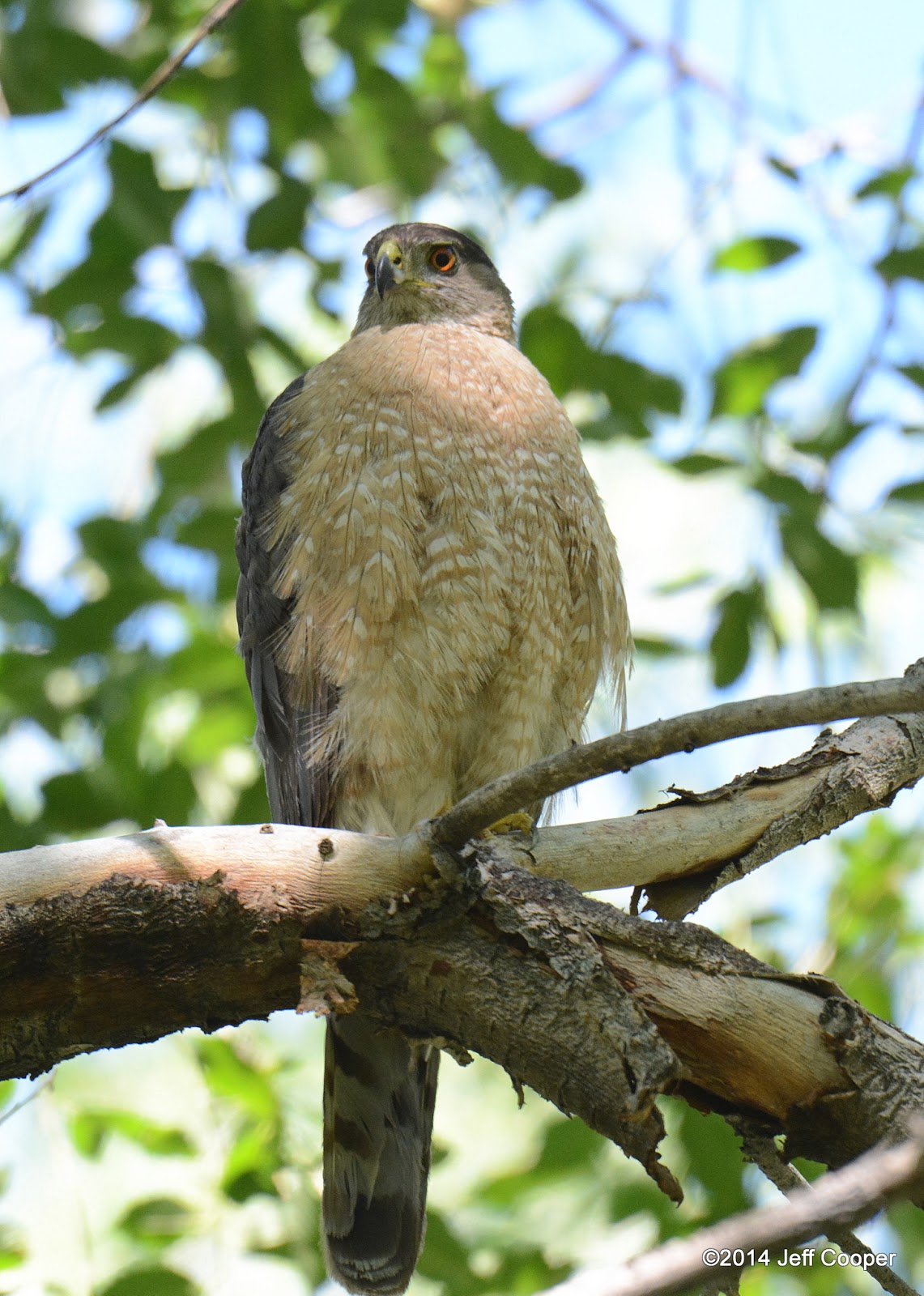
The image above is a good one for identifying the hawk as a juvenile Sharp-shinned. The brown upper side, streaked nape, and yellow eyes are typical for a juvenile. The back will become gray to slate-blue when it becomes and adult. The head is small, relative to the hefty chest, and smoothly rounded from crown to nape. The similar looking Cooper's Hawk presents a larger and blockier looking head relative to its slender or tubular body. The chest for a juvenile Sharp-shinned Hawk has a streaked rather than the barred appearance seen on adults. The streaking for a juvenile Sharp-shinned is more coarse or blotchy compared to the more finely streaked Cooper's Hawk. Cooper's Hawks have a more brown looking streaking on the chest where the Sharp-shinned has more of a rufous or orange color. The markings on the juvenile sharp-shinned are also thicker around the flanks than they are at the top of the chest.
Juvenile Cooper's Hawk in Las Vegas, NV
I'll share an image of a juvenile Cooper's hawk I photographed in Las Vegas this summer to illustrate the traits I've mentioned. There is variability and exceptions occur with these bird species, but the images I'm sharing are typical. This young Cooper's Hawk shows the blocky head, slender body, and fine brown streaking on the chest and belly. The streaking isn't as thick and blotchy in the flanks compared to Sharp-shinned. I think I have a good feel for these hawks and then I run across some that make me scratch my head when trying to separate the two species. Sometimes I find it easier to distinguish them in the field and harder with a photo because photos are one-dimensional. Seeing a bird in the field reveals multiple dimensions including shape, plumage, behavior, etc. It often takes the sum of traits rather than a single trait shown in a photo to accurately identify a bird species.
I shared a post on April 24th that announced a new generation of Cooper's Hawks. Click here to see that post.
I have some good news regarding one of the nest sites that I've followed since that time. I got my first look at chicks when I checked on the nest Thursday after work. I was shocked to suddenly see three fluffy white chicks standing nearly six inches beyond the top of the nest. I later realized there were actually four chicks. I had checked several times recently because I knew the timing for the eggs being laid and when they'd hatch. I knew chicks were growing inside the nest when the mother hawk stopped sitting in the nest and starting standing at the edge of the nest. The image below shows two of the four chicks. You can see that the one on the right probably hatched before the one on the left since it has some juvenile feathers coming in on the chest, shoulders and wings.
The female hawk went from standing at the nest to sitting on the nest on April 23rd. I figured that was probably when she started incubating eggs. I calculated that chicks would start hatching around Memorial Day weekend since the incubation period is 30-36 days for Cooper's Hawk eggs. Chicks are usually in the nest for about 30-35 days after hatching so I estimated that the young birds might start to fledge around the end of June. It seems we are right on schedule.
I didn't visit the nest much during the incubation period, but I did check as I thought hatching may be taking place. I was hoping to see dad bring food to mom and babies, but I never saw that during my brief visits. I guess I didn't show up during feeding times. The next image is typical of what I saw as the chicks were newly hatched inside the nest. Mom would stand at a close guard.
At some point along the way the mother hawk gave up her space in the nest for the growing chicks. I was hopeful I'd see chicks peeking over the edge of the nest during several visits, but the mother continued to be the only visible hawk. I saw dad one day, but he didn't stick around long enough for a photo. Mom, on the other hand provided lots of convenient poses for my lens.
Thursday provided a new and exciting series of events. I stopped by the site after work. I parked my truck and began walking to the stand of trees that housed the nest. I got my first glance of the chicks and could not believe how tall they were standing in the nest. It was as if the nest went from empty to three large chicks overnight. Where were those big chicks hiding all this time?
I looked to my left and mom was in her usual spot, keeping watch over the nest from about 30 yards away. What a beautiful hawk! I couldn't help but wonder,however, "Where on earth was dad? When was he going to appear in his role of provider for these four hungry birds, mom and three hungry chicks?
After admiring mom for a while I turned my attention back to the chicks in the nest. That was until I heard mom start making a few quiet noises. I looked back at her and noticed she was looking to her left. She gave a couple of louder "kak" calls and then flew to where she was looking. That's when I noticed she flew to the male that was waiting in a spruce tree. The two sort of collided with each other a couple feet away from the spruce. Mom flew back toward me and dad moved farther away. I wanted to get an image of dad so I walked his way. I couldn't find him so I turned back toward mom. That's when I realized that dad had actually delivered some prey when the two birds collided near the spruce. Mom was now perched on a branch and plucking downy feathers from what turned out to be a baby bird (Cooper's Hawks primarily eat other birds). She was preparing the prey for delivery to one of her own chicks.
You can see a couple of the plucked downy feathers dropping down to the left of the image below. She would pluck and throw the feathers to one side or other with her beak.
I switched my camera to video mode and captured two short videos while hand-holding the lens fully zoomed to 400mm. It is really hard to hold the lens still and not have the image shake when capturing video. That's what tripods are for, but I didn't have one at the time. The videos actually turned out fairly well.
Here's some short video clips of mom plucking downy feathers from a chick of another bird species before she delivered the flesh to her own chick in the nest.
This short clip is right before mom flies with the prey to the nest.
One chick enjoyed the prey while mom and the other chicks sat contently on my side of the nest. I am fascinated by how mom and dad play their respective roles so well in caring for and raising their young ones. Mom and dad won't eat until after the chicks have eaten and dad will likely deliver a meal to mom before eating his own. Mom is not hunting right now because she is feeding the young and watching over the nest site. Dad will be a busy hawk until the young ones fledge and learn to catch their own prey.
I was driving into the Timpooneke Campground area (Utah County, Utah) with one of my married twin sons this afternoon as part of our plan to scout out some camping areas. I related to my son that I had a close encounter with a Northern Goshawk in the area a couple of years ago, but I missed the photo op because I was taking pictures of a silly little Mountain Chickadee. I had just finished capturing a few images of the chickadee and then lowered the lens to preview the images on the screen. Right then an adult Goshawk passed just ten feet away from me. It disappeared within seconds. I couldn't believe I missed a Goshawk for a chickadee.
Anyway, just after my son and I pulled into the campground today he was marveling over the awesome mountain scenery. We pulled over to take a look and capture some images. I decided to leave my camera with the zoom lens in the truck and take my backup camera with the wide angle lens to capture a landscape scene. I captured one image and reviewed it for exposure. I didn't like it so I tried again with a few setting changes. The north peak of Mount Timpanogos, the icon of Utah County mountains, is almost disappearing in the heavy cloud cover in the background.
Timpooneke Campground with North Peak of Mount Timpanogos in Background--Utah County, UT
I heard a Raven calling from behind us and ignored it. My non-birding son noticed the raven when he saw it fly along the tree line to the left of the meadow shown above. He pointed up and asked, "What is that?" I looked up from the camera and said, "That's a raven." I was just about to look away and resume photographing the landscape when we both noticed something large and rather white looking land on a limb just outside the left edge of the scene you see above. I stopped what I was doing and honed in on what that thing was. I noticed a limb still bouncing a little and wasn't sure if the bird we saw had landed there or launched from there and disappeared into the trees. I noticed a large whitish belly showing between some branches. A second later my brain made the connection and I said, "Oh my gosh(hawk)! That's a goshawk!" I now had a choice to make. Take pictures of a mountain landscape or try to capture an image of a rare hawk. I didn't even have to think before I started running toward my truck to retrieve my better camera with the zoom lens. The truck happened to be in the same general area as the hawk. I hoped the hawk wouldn't fly before I could get my camera with the zoom lens. I also hoped my running in its general direction wouldn't spook it off. With one eye toward the bird and one toward the backseat of the truck (meaning I was really watching the bird and blindly grabbing inside the truck), I managed to get the camera and turn it on. The bird began to look like it was going to fly so I hoped the existing camera settings were ideal for the circumstances, pointed, and released the shutter a few times just before it flew. I lowered the lens and watched in awe as the hawk flew right in front of me and across the meadow. It did a quick turn and then flew down the gravel road and out of sight. My son and I shared a moment that impressed him as much as it did me.
Well, I was unprepared again when a Goshawk in the same general area (maybe even the same hawk) presented itself. I'll just tell people I was photographing a conifer when a rare Northern Goshawk happened to photo bomb that lovely image. That's why the bird was not in focus.
Northern Goshawk at Timpooneke Campground in Utah County, UT
(It took flight before I could get a tight focus on the bird rather than the branch)
I rolled open the blinds on the kitchen window a few morning's ago, looked into the backyard, and said to my wife, "Look! That hawk is eating a bird!" A Sharp-shinned Hawk was having its breakfast in our (the Coopers not the Sharps) backyard. The hawk had taken down an American Robin a moment before I opened the blinds and was plucking feathers. My wife was actually disappointed that one bird would eat another bird and quickly busied herself with other interests inside our home. I, on the other hand, was thinking that history was in the making in terms of yard bird experiences. I've seen Cooper's Hawks and Sharp-shinned Hawks in and around our yard. I've also seen a pile of feathers in the backyard near our feeders a time or two before and thought that one of those hawks must have hunted successfully in the yard. This time, however, I was actually watching the hawk with its prey. It was kind of surreal to watch what was taking place. Nature can be both awesome and terrible at the same time depending on perspective.
Distinguishing between Cooper's Hawks and Sharp-shinned Hawks (aka Sharpies) can be quite challenging with juveniles and adults. I think that the first image (adult) below illustrates this well because key differentiating field marks are obscured:
1. Is the nape pale (Cooper's) or matching the dark gray crown (Sharpie)?
2. What is the relative size of the head to the body? Blocky/large (Cooper's) or small (Sharpie)?
3. How broad is the white tip of the tail feathers? Broad (Cooper's) or thin (Sharpie)?
4. Are the outer tail feathers shorter (Cooper's) or relatively equal in length (Sharpie) to the central tail feathers?
What can you share to help in differentiating between the two species? Feel free to share your thoughts in a comment below.
Adult Sharp-shinned Hawk Preying on an American Robin in Pleasant Grove, UT (Photo by Jeff Cooper)
Adult Sharp-shinned Hawk Preying on an American Robin in Pleasant Grove, UT (Photo by Jeff Cooper)
Adult Sharp-shinned Hawk Preying on an American Robin in Pleasant Grove, UT (Photo by Jeff Cooper)
Adult Sharp-shinned Hawk Preying on an American Robin in Pleasant Grove, UT (Photo by Jeff Cooper)
Adult Sharp-shinned Hawk Preying on an American Robin in Pleasant Grove, UT (Photo by Jeff Cooper)
Adult Sharp-shinned Hawk Preying on an American Robin in Pleasant Grove, UT (Photo by Jeff Cooper)
Adult Sharp-shinned Hawk Preying on an American Robin in Pleasant Grove, UT (Photo by Jeff Cooper)
Adult Sharp-shinned Hawk Preying on an American Robin in Pleasant Grove, UT (Photo by Jeff Cooper)
Adult Sharp-shinned Hawk Preying on an American Robin in Pleasant Grove, UT (Photo by Jeff Cooper)
My Peregrine friend below wonders why you are looking here for today's blog post. He and some of his friends are being presented as one of my monthly contributions to one of the world's leading bird blogs--Birding is Fun. Click here to see my blog post today as it appears on Birding is Fun. It includes closeup images of Peregrine Falcons (like the one below), a Golden Eagle, Red Foxes, and more.
Thanks for visiting my blog. I'll have another post right here at NeoVista Birding in the next few days!
Well, yesterday's birding went well enough that my daughter wanted to go out again this afternoon to try using the Nikon D5100 DSLR camera she got of Christmas. We hopped into the Tacoma for the second day in a row and barely made it out of the driveway when my raptor radar went off. I caught a quick view of the back side of an accipiter perched in my neighbor's backyard tree as we passed his home. Based on the shape I suspected a Sharp-shinned Hawk, North America's smallest hawk. The thought of simply passing on an opportunity to get a close view of a raptor was way too painful so I pulled over and captured a few images. My daughter was getting used to the "spot and stop" mode of driving that takes over when a birder is behind the steering wheel. Getting a close look at a Sharp-shinned Hawk right in 'da hood was a great way to end another year of birding.
I've posted the images below to show various angle's of the bird's head. Rufous barring on the chest and belly, orange/red eyes, and gray crown and back clearly made it an adult bird. I wanted the sun behind me so I captured only front views. You can see typical traits that separate the Sharp-shinned from the Cooper's Hawk. The Sharpie shows a high-centered, barrel chest, small/short head relative to the body size (beware that Cooper's sometimes slump and look short-headed), the dark nape (back of neck) as opposed to a pale nape for a Cooper's Hawk, and the outer tail feathers being about equal in length to the central tail feathers as opposed to shorter outer tail feathers with longer central tail feathers for a Cooper's. The white terminal band on the tail feathers is also very narrow on Sharpies compared to more of a prominent white band for Cooper's. If I had to guess I'd call it a male based on the size being about 10-11 inches, the small end of the scale for an accipiter. Females can be several inches larger than males. It also lacks the rounded outer tail feathers often seen on female Sharp-shinned Hawks.
Adult Sharp-shinned Hawk Pleasant Grove, UT (Photo by Jeff Cooper)
Adult Sharp-shinned Hawk Pleasant Grove, UT (Photo by Jeff Cooper)
Adult Sharp-shinned Hawk Pleasant Grove, UT (Photo by Jeff Cooper)
Adult Sharp-shinned Hawk Pleasant Grove, UT (Photo by Jeff Cooper)
Adult Sharp-shinned Hawk Pleasant Grove, UT (Photo by Jeff Cooper)
About this time last December my wife and I left the cold temperatures and hazy skies of northern Utah and headed south to the warmer temps and clear skies of St George, a lovely little desert community surrounded by beautiful red rock country in the southwest corner of the state. St George is situated near diverse birding locations and is the home of the annual St George Winter Bird Festival held each January. In the right seasons the desert, forest, and riparian habitats offer some great opportunities for northern Utahns and other visitors to see bird species such as Greater Roadrunner, White-winged and Inca Dove, Verdin, Phainopepla, Lesser Nighthawk, Gambel's Quail, Vermilion Flycatcher, Anna's Hummingbird, Black-throated Sparrows, migrating waterfowl, and many more.
One of my favorite spots to visit in St George when I need a quick birding fix is Tonaquint Park and Nature Center. The park is located right in town and provides great bird habitat because of its gardens, trees, and proximity to the Santa Clara River, which runs between the park and a golf course with waterfowl-attracting ponds.
I made a few early morning visits to Tonaquint Park during our stay in St George last December and was delighted to see lots of fun little birds and a few accipiters looking for breakfast each morning I visited. One morning I was trying to position myself between some bushes to get some images of Gambel's Quail. With almost no warning I found myself spinning away from a close encounter with a fast moving bird that seemed to be flying directly toward my head as it rounded a bush ahead of me. I did an instant replay in my mind that went something like, "dark gray on top, orangish belly, white around the vent area. Was that a Robin? Of course not. That bird was way too fast and acrobatic. I bet it was an accipiter. Maybe a Sharpie." I turned and followed the path and discovered an adult Sharp-shinned Hawk, our smallest North American hawk. I watched it attempt to nail several passerines in the area and was amazed at what appeared to be near 90-degree turns mid-air. It perched for a moment and I crept up behind it to capture a few images revealing the front and back of the bird. In the images below you can see its dark nape (as opposed to pale nape of Cooper's hawk), squared rather than rounded tail formed by equally long outer tail feathers, the narrow as opposed to prominent white tip on the tail feathers, its high-centered barrel chest, and relatively small head in comparison to its body.
Adult Sharp-shinned Hawk in Search of Prey at Tonaquint Park in St George, UT (Photo by Jeff Cooper)
Adult Sharp-shinned Hawk in Search of Prey at Tonaquint Park in St George, UT (Photo by Jeff Cooper)
Just a month before my moment with the adult Sharpie in St George I had a special moment with a juvenile as I pulled into the parking lot near my place of work in South Jordan, Utah. It was a cold November morning. I arrived at work a few minutes early so I decided to pull into a parking space that faced a farm field bordered by a stream and Russian Olive Trees to check for bird activity. The rays from the sun were starting to hit the field. The warmth of the rays gradually melted the frost as the shadows retreated from the field. I looked up from inside my truck and saw a Magpie flying a few feet above what turned out to be a juvenile Sharpie. Both were moving in my direction and practically right in front of me. The Magpie dove and made contact several times with the Sharpie's back as it chased it away from the area. Both birds disappeared from my view as they flew behind some trees. The Magpie reappeared at the top of one of the trees and seemed to be in an attitude of scolding. I figured it might be a clue to the Sharpie's new perch so I went into stealth mode with my camera and moved quietly along the tree line. I soon discovered the perch of the Sharpie and witnessed a moment in time I will never forget. The young hawk was perched on a post that was just beginning to receive sunlight so the frost on top of the post was beginning to sparkle. I knew that within moments both the beautiful crystals and the young bird would be gone. The timing for witnessing two beautiful creations of nature in one fleeting moment was fortuitous and impressive. And for that I was grateful!
Juvenile Sharp-shinned Hawk on Frosted Post in South Jordan, UT (Photo by Jeff Cooper)