Common Nighthawks are quite common throughout the United States and Canada during the spring and summer months. I first became familiar with them when I noticed them flying circles around stadium lights during evening sporting events. I learned that they were chasing and feeding on the flying insects that were drawn to the lights. They have very tiny bills as you'll see in some of the images below, but their mouths extend back to beneath the eyes. Their "gaping" mouths are great for snatching flying prey. Nighthawks are mostly active at night, but they are sometimes seen flying in daylight, especially during twilight hours. The distinct wing and throat markings of nighthawks are shown in the image below.
Common Nighthawk in Utah County, UT USA
Common Nighthawks have a rather long migration from South America so they tend to arrive here in Utah a little later than other migrant birds. Once they arrive they seem to get right down to the business of breeding. I'm glad that we consistently have breeding populations along some of our local rivers and in pockets of our local deserts. Males and females can often be seen flying together during the breeding season. During courtship the males will make a steep dive and then curve their wings near the bottom of the dive to create a "whoosh" sound as the air rushes through their flight feathers.
Common Nighthawks in Utah County, UT USA
I was showing an out-of-state visitor to some of Utah County's diverse birding habitats several weeks ago when I happened upon a Common Nighthawk nesting site beneath a Juniper tree. We were walking through a desert area that had a mix of sagebrush and junipers. As I walked toward a particular juniper a female nighthawk flushed from beneath the tree and landed about 15 yards away.
Female Common Nighthawk Distraction Display Near Nest Site in Utah County, UT USA
She began a distraction display which made me realize we were near a nest site. I captured a short video of this particular female to show her protective display. This clip shows the initial display and then ends when she feels she has successfully deterred us from the nest site.
Nighthawks don't actually build nests. They simply lay their eggs on bare ground or gravel rooftops. Consequently, we walked carefully with our eyes to the ground to avoid stepping onto eggs or chicks that might have been blending in with the ground below us. We actually discovered two eggs and then allowed mom to lure us away with her short flights and distraction displays. She was a good mama bird.
Common Nighthawk Eggs in Utah County, UT USA
Common Nighthawk Eggs in Utah County, UT
I am fascinated by the cycle of life so I returned to the nest site a week or so later and concealed my presence with a portable blind. I had hopes of watching the new generation of nighthawks develop from one stage to the next by making periodic visits. Mama nighthawk was still incubating eggs and did not flush since I remained in my blind.
Female Common Nighthawk Incubating Eggs in Utah County, UT USA
I let another week pass and returned to the site again in the blind. I noticed empty egg shells where mom had been incubating them during my previous visit.
It didn't take more than a few minutes to realize that mom and two chicks were just a few feet away from where the chicks had hatched. Mom moved toward the chicks as I started to back away from the site within my blind.
Female Common Nighthawk in Utah County, UT USA
Common Nighthawk Chicks in Utah County, UT USA
Female Common Nighthawk and Two Chicks in Utah County, UT USA
One chick moved under mom's chest while the other remained visible in the image below.
Female Common Nighthawk With One Chick Beneath and One Chick at Chest in Utah County, UT USA
I couldn't help but wonder how these birds raise their young on bare ground. They blend in rather effectively with their surroundings and mom is adept at distracting possible threats from the young ones, but they are still extremely vulnerable to the coyotes, badgers, rattlesnakes, and other predators that roam the desert floors. I hope these two young chicks progress to the point of making their first round trip flights to South America and back so they can continue the cycle of life by creating their next generation. I wonder if they'll return to the same desert for their own breeding seasons.
My most recent trip to the same general habitat resulted in a close encounter with what appears to be a male with all those bright white throat feathers. The female nighthawk did not show nearly as many white throat feathers.
A beautiful day was just beginning when Eric Peterson and I set out for a two-hour drive from Pleasant Grove to Tabiona, Utah yesterday. Our original plans were to observe and photograph a variety of hummingbirds visiting feeders at the cabins of people we know on Tabby Mountain. But as Eric shared in a Facebook post last night, we started with hummers and finished with a chase of Gray Jays and Nutcrackers. We returned home nearly 12 hours and 247 miles later having shared some unique birding experiences.
We arrived at the turn off to the gravel road leading up Tabby Mountain around 7:30. I stopped the truck once as we were making our way up the mountain to the cabins so we could watch some Least Chipmunks and a Golden-mantled Ground Squirrel that were scurrying across and foraging on the road. My interest in finding and photographing mammals has increased recently so I wanted to capture a few images to study and share with others. Yesterday's Golden-mantled Ground Squirrel was the first one I'd ever photographed. One easy way to distinguish generally between ground squirrels and chipmunks is to note whether or not stripes are on the head and face. Ground Squirrels do not have stripes on their heads, but chipmunks do.
Golden-mantled Ground Squirrel on Tabby Mountain in Tabiona, UT
The first cabin we visited had three feeders that were being visited primarily by Black-chinned and Broad-tailed Hummingbirds. The owners let us know about a hummingbird nest above their front porch. They said two babies were in the nest the day before, but one must have flown away. The owners were on their way out to do some fishing so we made sure to give them five pounds of sugar before they left. It was our thank-you for the pleasure of visiting their feeders. We still had three more five-pound bags to share with the other cabins we'd visit during the day.
Baby Black-chinned Hummingbird in Nest
Tabiona, UT
We weren't sure of the species at first, but we soon noticed a female Black-chinned Hummingbird that was protecting the area when other hummingbirds flew too close. The female would occasionally hover around and fly into an Aspen sapling just a few yards away from the nest. Eric investigated the sapling and found the second baby. It had just fledged. We watched as it made very short flights from the tree to a blade of grass, to the porch, and onto the tire of a truck parked in the yard just yards from the nest in which its life was given. What a contrast to see these short, stumbling, and awkward flights and then realize that within a matter of weeks this tiny bird will be buzzing swiftly and accurately from Utah to Mexico. That journey will take several weeks to complete. The image below shows it struggling to secure a perch on the stem of an Aspen leaf--seemingly hanging on for dear life. That act will be second nature in no time.
This Black-chinned Hummingbird just left its nest and is doing all it can to hold onto this Aspen leaf without falling
Tabiona, UT
I don't know if I'll ever see another hummingbird perch on a blade of grass so yesterday was a memorable experience with a hummingbird. It just goes to show how light these tiny birds really are. It's not a natural perch for a hummingbird, but when you are learning to fly you land as safely as possible where ever you can?
Recently Fledged Black-chinned Hummingbird Perched on a Blade of Grass
(Resting on the only place it could find while learning to fly)
Tabiona, UT
Recently Fledged Black-chinned Hummingbird with Eyelid Closed
(Perched on a blade of grass as it rests between very short flights)
Tabiona, UT
Recently Fledged Black-chinned Hummingbird
Resting on the porch between very short flights as it learns to fly
Tabiona, UT
Recently Fledged Black-chinned Hummingbird
Resting on a truck tire between some very short flights as it learns to fly
Tabiona, UT
Eric and I made brief visits to two other cabins to assess the activity of the birds. One of the owners suggested we visit a home a few miles away in Hanna. We followed our friend to that home and did some exploring. There were definitely hummingbirds, but I enjoyed seeing a few more fledgling birds. This time of year is filled with new life for birds and the babies are fun to watch as they learn their way around the new world. I heard the calls of Spotted Sandpipers coming from the stream behind the home so Eric and I made our way to the stream to discover a family with a mom, dad, and at least three siblings. The fledgling below still has some fine, black downy feathers clinging to the tip of its new tail.
Recently-fledged Spotted Sandpiper in Hannah, UT
Eric spent some time photographing hummingbirds while I explored the yard and observed recently fledged Green-tailed Towhees and Black-headed Grosbeaks. We eventually headed back up to Tabby Mountain to focus on some hummingbird photography. I spent a little time trying to capture Rufous Hummingbirds in flight, but I took advantage of one male that posed at the feeder.
Male Rufous Hummingbird Tabiona, UT
Male Rufous Hummingbird Tabiona, UT
Female Rufous Hummingbird Tabiona, UT
Female Rufous Hummingbird Tabiona, UT
My assortment of hummingbird images from our visit two years ago was much more extensive. This year my attention was diverted to some of the other birds visiting feeders around the cabins. Cassin's Finches and White-breasted Nuthatches became the target for some of my attention.
Male Cassin's Finch in Tabiona, UT
Female Cassin's Finch in Tabiona, UT
Nuthatches are known for moving from top to bottom along the trunks and major branches of trees. This is a typical pose for these birds as they forage for bugs hiding beneath bark. They will also eat seeds as they find them.
White-breasted Nuthatch in Tabiona, UT
White-breasted Nuthatch in Tabiona, UT
It's a short clip, but I did capture some video of one Nuthatch. It shows a bit of the characteristic movement of these busy foragers.
Eric and I eventually decided to leave Tabiona and drive up to Mirror Lake Campground because Eric had seen a Gray Jay there during a recent visit. I had never seen one before so it became a quest to help me locate a life bird. We made a brief stop at the convenience store in Hanna to attempt to satisfy some hunger pangs that were beginning to manifest themselves. On the way out of the store I heard the call of a Mountain Bluebird. I looked up and found a female bluebird holding a grasshopper in its beak. That was a sign that a nest with young was nearby. Otherwise the bird would have promptly swallowed the grasshopper to satisfy its own hunger. I didn't see the nest before we left to continue our drive, but I did grab the camera from the truck to capture images to add to the "birds with food in their beaks" collection. People at that store must have thought I was a nut pointing a big lens at a dull looking bird above the entrance to the store.
Female Mountain Bluebird Preparing to Take Food to Nest in Hanna, UT
Female Mountain Bluebird Preparing to Take Food to Nest in Hanna, UT
One of the cabin owners was telling us before we left Tabby Mountain that he had just recently seen and photographed California Quail for the first time in the seventeen years he had lived in that county. Eric and I spotted a male and a female Quail right as we pulled away from the convenience store. We weren't sure if we were lucky or our friend had been really unlucky for the past seventeen years.
The drive was pleasant as we made our way higher into the Uinta Mountains. We took Highway 35 out of Hanna and then onto a dusty gravel road called Soapstone Pass to make our way over Soapstone Mountain and onto Highway 150, which would take us to the campground. We arrived at the campground around 1 PM. Afternoons can be a slow time of day for birding since many birds take cover and rest during the middle of the day. We had hopes that cooler mountain temperatures would encourage some birds to remain active so we could more easily locate them amid the thick conifers and aspens.
Most camp sites in the campground areas were occupied due to Thursday being a state holiday (Pioneer Day) and many people taking advantage of a long weekend. People with food may have actually helped shorten the time it took for us to see not only a Gray Jay but some Clark's Nutcrackers as well. I've heard people who camp high in our mountains refer to these birds as camp robbers since they like to show up and take food and scraps from campsite and picnic areas.
Gray Jay at Mirror Lake Campground in Duchesne County, UT
Gray Jay at Mirror Lake Campground in Duchesne County, UT
Gray Jay at Mirror Lake Campground in Duchesne County, UT
Gray Jay at Mirror Lake Campground in Duchesne County, UT
Gray Jay Picking up Sandwich Scraps at Mirror Lake Campground in Duchesne County, UT
Clark's Nutcracker at Mirror Lake Campground in Duchesne County, UT
Clark's Nutcracker at Mirror Lake Campground in Duchesne County, UT
Clark's Nutcracker at Mirror Lake Campground in Duchesne County, UT
The bird above allowed close approach as it called so I decided to try some video. I had the lens zoomed in on the bird while hand-holding the camera so it is a little shaky. It's definitely better to use a tripod when capturing video through a telephoto lens. The wind kicked up right as I started recording so there is also a bit of noise from the wind blowing into the microphone. A second nutcracker can be heard calling in the background.
We could have stayed longer in the mountains yesterday, but 3 PM rolled around and Eric and I both had plans and commitments for the rest of the day. The mountains were a great escape from the valley heat and provided some memorable experiences for us. It was another great adventure with Eric that helped me appreciate life and the world in which we live.
I shared a post on April 24th that announced a new generation of Cooper's Hawks. Click here to see that post.
I have some good news regarding one of the nest sites that I've followed since that time. I got my first look at chicks when I checked on the nest Thursday after work. I was shocked to suddenly see three fluffy white chicks standing nearly six inches beyond the top of the nest. I later realized there were actually four chicks. I had checked several times recently because I knew the timing for the eggs being laid and when they'd hatch. I knew chicks were growing inside the nest when the mother hawk stopped sitting in the nest and starting standing at the edge of the nest. The image below shows two of the four chicks. You can see that the one on the right probably hatched before the one on the left since it has some juvenile feathers coming in on the chest, shoulders and wings.
The female hawk went from standing at the nest to sitting on the nest on April 23rd. I figured that was probably when she started incubating eggs. I calculated that chicks would start hatching around Memorial Day weekend since the incubation period is 30-36 days for Cooper's Hawk eggs. Chicks are usually in the nest for about 30-35 days after hatching so I estimated that the young birds might start to fledge around the end of June. It seems we are right on schedule.
I didn't visit the nest much during the incubation period, but I did check as I thought hatching may be taking place. I was hoping to see dad bring food to mom and babies, but I never saw that during my brief visits. I guess I didn't show up during feeding times. The next image is typical of what I saw as the chicks were newly hatched inside the nest. Mom would stand at a close guard.
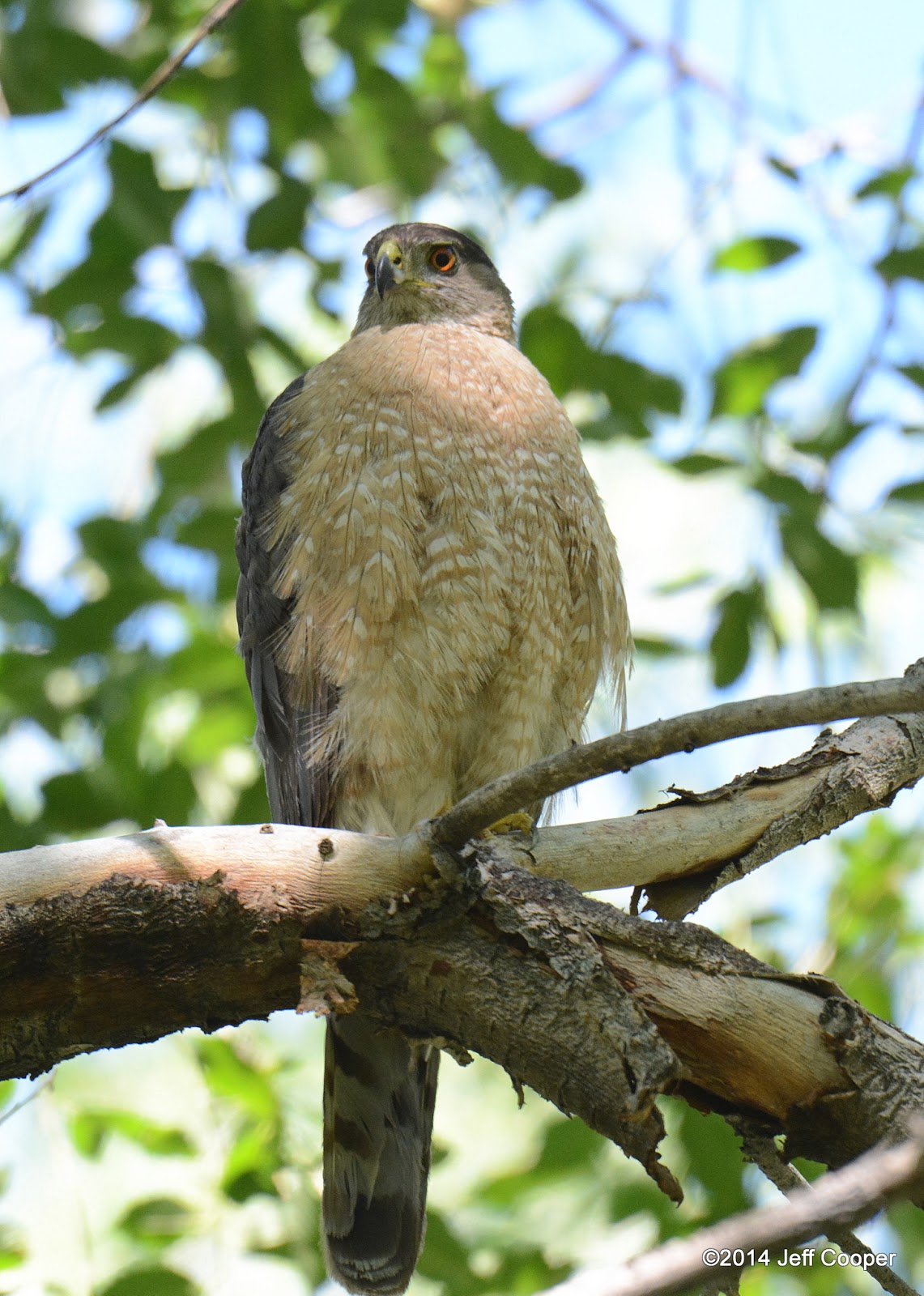
At some point along the way the mother hawk gave up her space in the nest for the growing chicks. I was hopeful I'd see chicks peeking over the edge of the nest during several visits, but the mother continued to be the only visible hawk. I saw dad one day, but he didn't stick around long enough for a photo. Mom, on the other hand provided lots of convenient poses for my lens.
Thursday provided a new and exciting series of events. I stopped by the site after work. I parked my truck and began walking to the stand of trees that housed the nest. I got my first glance of the chicks and could not believe how tall they were standing in the nest. It was as if the nest went from empty to three large chicks overnight. Where were those big chicks hiding all this time?
I looked to my left and mom was in her usual spot, keeping watch over the nest from about 30 yards away. What a beautiful hawk! I couldn't help but wonder,however, "Where on earth was dad? When was he going to appear in his role of provider for these four hungry birds, mom and three hungry chicks?
After admiring mom for a while I turned my attention back to the chicks in the nest. That was until I heard mom start making a few quiet noises. I looked back at her and noticed she was looking to her left. She gave a couple of louder "kak" calls and then flew to where she was looking. That's when I noticed she flew to the male that was waiting in a spruce tree. The two sort of collided with each other a couple feet away from the spruce. Mom flew back toward me and dad moved farther away. I wanted to get an image of dad so I walked his way. I couldn't find him so I turned back toward mom. That's when I realized that dad had actually delivered some prey when the two birds collided near the spruce. Mom was now perched on a branch and plucking downy feathers from what turned out to be a baby bird (Cooper's Hawks primarily eat other birds). She was preparing the prey for delivery to one of her own chicks.
You can see a couple of the plucked downy feathers dropping down to the left of the image below. She would pluck and throw the feathers to one side or other with her beak.
I switched my camera to video mode and captured two short videos while hand-holding the lens fully zoomed to 400mm. It is really hard to hold the lens still and not have the image shake when capturing video. That's what tripods are for, but I didn't have one at the time. The videos actually turned out fairly well.
Here's some short video clips of mom plucking downy feathers from a chick of another bird species before she delivered the flesh to her own chick in the nest.
This short clip is right before mom flies with the prey to the nest.
One chick enjoyed the prey while mom and the other chicks sat contently on my side of the nest. I am fascinated by how mom and dad play their respective roles so well in caring for and raising their young ones. Mom and dad won't eat until after the chicks have eaten and dad will likely deliver a meal to mom before eating his own. Mom is not hunting right now because she is feeding the young and watching over the nest site. Dad will be a busy hawk until the young ones fledge and learn to catch their own prey.