Showing posts with label Nest. Show all posts

Saturday, July 14, 2018

Monitoring a Common Poorwill Nest Site

Male Common Poorwill Wasatch Mountains Utah County, Utah


An endeavor to locate and and photograph Great Basin Collared Lizards on June 8th resulted in a series of visits to a Common Poorwill nest site.

It all started as I was exploring prime habitat for collared lizards--a rocky desert hillside with sparse vegetation. That particular hillside was punctuated with scattered sagebrush and junipers. I was coursing along a south-facing rocky outcrop when a Common Poorwill, an elusive nocturnal bird, flushed from its daytime roost. I wondered if I had stumbled upon a nest site, but when I checked the base of the bush from which the bird flushed I noticed only a single feather. Perhaps it was just the bird's roost for the day, but I captured an image with my phone to preserve a GPS location in case I wanted to return a week or so later to check for evidence of nesting.

My search for collared lizards was quite productive and resulted in some nice photos. My friend Eric enjoyed the photos and asked if I'd take him out to the same location since he'd never photographed collared lizards. We made that trip the next day, June 9th.

I mentioned my encounter with the Poorwills as we hiked up the hillside and suggested we check the previous roosting site. As we approached that site two birds flushed, not from the previous bush, but from a nook of the rocky outcrop. Both birds flew quite a distance, without any attempt to do a distraction display so I could tell that they had no eggs nor chicks to protect. There was no evidence of nesting in nor around that nook so we moved along the hillside. After covering about fifty more yards I was surprised when a third poorwill flushed from the base of a bush to my left. That bird landed a short distance away and did a distraction display, which clued me in to that fact that it had flushed from a nest site. I immediately realized that the poorwill was doing what nature had programmed it to do--protect its offspring. The bird appeared to be a female because it lacked the white corners that males have in their tail feathers. Since both sexes are known to incubate it can't be taken for granted that a bird flushing from a nest site is a female.

Common Poorwill Distraction Display Near Nest Site Great Basin Desert Utah
Rather than follow the bird after it flushed I inspected the base of the bush from which the bird had flown.  I beamed with excitement when I observed two white eggs and promptly alerted Eric so he could observe the eggs as well.

Common Poorwill Nest Site Great Basin Desert Utah

Common Poorwill Nest Site Great Basin Desert Utah

The previous images illustrate typical nesting behavior for Common Poorwills--laying their eggs in gravelly areas next to bushes that provides a fair amount of shade. These two eggs were on the south side of a bush on a south-facing hillside. They were situated in a way that allowed morning sun followed by shade from mid-morning through evening. Because I am fascinated by nature and the cycle of life, and because it is quite rare to find a poorwill nest site, I shared with Eric my desire to carefully and briefly revisit the site every few days to document the progress.

Several days later on June 13th we returned to the site and observed that an adult was still incubating the eggs.

Common Poorwill Incubating Eggs Great Basin Desert Utah

Common Poorwill Incubating Eggs Great Basin Desert Utah

I returned to the site by myself on June 17th to discover that one chick had just hatched and the second was in the process of hatching.

Common Poorwill Hatchling and Egg Great Basin Desert Utah

The upper right edge of the remaining egg shows evidence of a breach, evidence that the second chick was in the process of hatching. The tiny beak, nostrils, and eyelids were the only distinguishing features among the messy fluff of down feathers.

Common Poorwill Hatchling and Egg Great Basin Desert Utah

Common Poorwill Egg Shell Being Breached By Chick Great Basin Desert Utah

I made another quick visit to the site on June 19th, ten days after initially discovering the two eggs, with hopes of confirming that the second chick had successfully hatched. Sure enough the adult had two chicks tucked under its chest. The down feathers of one chick can be seen slightly protruding from beneath the bird's left side, the right side from our perspective.

Common Poorwill on Chicks at Nest Site Great Basin Desert Utah

Common Poorwill on Chicks at Nest Site Great Basin Desert Utah

The adult moved away and began its distraction display as I slowly approached. I quickly captured images of the chicks for documentation purposes and left the site.

Common Poorwill Hatchlings at Nest Site Great Basin Desert Utah

Common Poorwill Hatchlings at Nest Site Great Basin Desert Utah

When I returned on the 23rd, just under a week after the chicks had hatched, down feathers were being replaced by pin feathers on both chicks.

Common Poorwill Hatchlings at Nest Site Great Basin Desert Utah

On the 27th, about ten days after hatching, both chicks were still at their hatch site and were beginning to show signs of typical cryptic plumage.

Common Poorwill Chicks at Nest Site Great Basin Desert Utah

Common Poorwill Chicks at Nest Site Great Basin Desert Utah

Common Poorwill Chicks at Nest Site Great Basin Desert Utah

As I was leaving the area after this afternoon visit I noticed that my truck was registering a temperature of 101 degrees Fahrenheit. It was a reminder of some of the harsh conditions that are endured by creatures that live in our local desert.


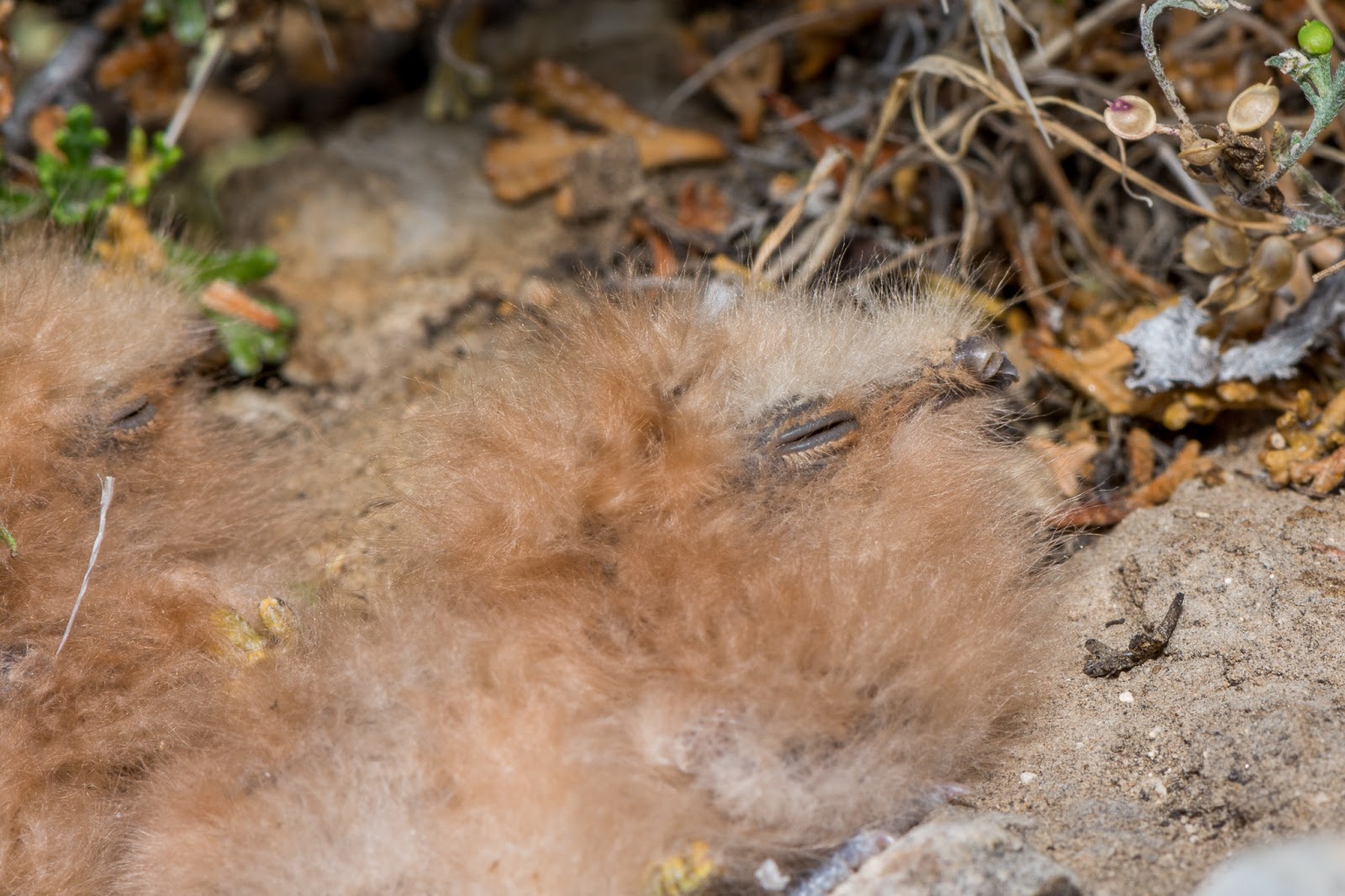
My last observation of the two chicks took place on the 30th, nearly two weeks after the chicks had hatched. Eric joined me on this trip. We discovered that the birds had fledged and moved to a new roosting site about 20 yards up the hill from their hatch site. Knowing that it might be my last observation since the birds had ventured from their hatch site I took the opportunity to capture detailed images of their plumage and features.

Common Poorwill Fledglings Near Original Hatch Site Great Basin Desert Utah

Common Poorwill Fledgling Beak and Nostril Detail

Common Poorwill Fledgling Crown Feather Development

Common Poorwill Fledgling Feather Development

Common Poorwill Fledgling Feather Development

Common Poorwill Fledgling Feather Development

This image was captured to remind me of where the eggs were laid and where I last saw the chicks because I was unable to locate them several days later when I made my last attempt to observe their development. I feel grateful for the opportunity to watch those chicks develop. I'm also grateful to have a desert playground to explore so close to home.


Monday, July 27, 2015

A New Generation of Common Nighthawks

Common Nighthawks are quite common throughout the United States and Canada during the spring and summer months. I first became familiar with them when I noticed them flying circles around stadium lights during evening sporting events.  I learned that they were chasing and feeding on the flying insects that were drawn to the lights. They have very tiny bills as you'll see in some of the images below, but their mouths extend back to beneath the eyes. Their "gaping" mouths are great for snatching flying prey. Nighthawks are mostly active at night, but they are sometimes seen flying in daylight, especially during twilight hours. The distinct wing and throat markings of nighthawks are shown in the image below.

Common Nighthawk in Utah County, UT USA

Common Nighthawks have a rather long migration from South America so they tend to arrive here in Utah a little later than other migrant birds. Once they arrive they seem to get right down to the business of breeding. I'm glad that we consistently have breeding populations along some of our local rivers and in pockets of our local deserts. Males and females can often be seen flying together during the breeding season. During courtship the males will make a steep dive and then curve their wings near the bottom of the dive to create a "whoosh" sound as the air rushes through their flight feathers.

Common Nighthawks in Utah County, UT USA

I was showing an out-of-state visitor to some of Utah County's diverse birding habitats several weeks ago when I happened upon a Common Nighthawk nesting site beneath a Juniper tree. We were walking through a desert area that had a mix of sagebrush and junipers.  As I walked toward a particular juniper a female nighthawk flushed from beneath the tree and landed about 15 yards away.

Female Common Nighthawk Distraction Display Near Nest Site in Utah County, UT USA

She began a distraction display which made me realize we were near a nest site. I captured a short video of this particular female to show her protective display. This clip shows the initial display and then ends when she feels she has successfully deterred us from the nest site.


Nighthawks don't actually build nests. They simply lay their eggs on bare ground or gravel rooftops. Consequently, we walked carefully with our eyes to the ground to avoid stepping onto eggs or chicks that might have been blending in with the ground below us. We actually discovered two eggs and then allowed mom to lure us away with her short flights and distraction displays. She was a good mama bird.

Common Nighthawk Eggs in Utah County, UT USA

Common Nighthawk Eggs in Utah County, UT

I am fascinated by the cycle of life so I returned to the nest site a week or so later and concealed my presence with a portable blind. I had hopes of watching the new generation of nighthawks develop from one stage to the next by making periodic visits.  Mama nighthawk was still incubating eggs and did not flush since I remained in my blind.

Female Common Nighthawk Incubating Eggs in Utah County, UT USA

I let another week pass and returned to the site again in the blind. I noticed empty egg shells where mom had been incubating them during my previous visit.


It didn't take more than a few minutes to realize that mom and two chicks were just a few feet away from where the chicks had hatched. Mom moved toward the chicks as I started to back away from the site within my blind.

Female Common Nighthawk in Utah County, UT USA

Common Nighthawk Chicks in Utah County, UT USA

Female Common Nighthawk and Two Chicks in Utah County, UT USA

One chick moved under mom's chest while the other remained visible in the image below.

Female Common Nighthawk With One Chick Beneath and One Chick at Chest in Utah County, UT USA

I couldn't help but wonder how these birds raise their young on bare ground. They blend in rather effectively with their surroundings and mom is adept at distracting possible threats from the young ones, but they are still extremely vulnerable to the coyotes, badgers, rattlesnakes, and other predators that roam the desert floors. I hope these two young chicks progress to the point of making their first round trip flights to South America and back so they can continue the cycle of life by creating their next generation. I wonder if they'll return to the same desert for their own breeding seasons.

My most recent trip to the same general habitat resulted in a close encounter with what appears to be a male with all those bright white throat feathers. The female nighthawk did not show nearly as many white throat feathers.

Common Nighthawk in Utah County, UT USA

Common Nighthawk in Utah County, UT USA


Monday, August 25, 2014

Black-Hawk Breeding Success in Utah

I'm posting today as a follow-up to a post I shared three months ago (May) when I discovered an active Common Black-Hawk nest in southwestern Utah. You can view that original post by clicking here.

My wife and I were at the tail end of a road trip to three national parks this past weekend and stayed in a hotel in St George, Utah.  I decided to get up early Saturday morning to drive out and check on the nest site. It was my first time back to the area since discovering the nest and I had to make at least one attempt to satisfy my curiosity about whether or not the hawks were successful in breeding. I had shared the location with wildlife officials so they could monitor the nest site. I sent emails on occasion to get updates, but I never got a confirmation that the hawks were successful breeders.

I had often thought about the pair of hawks over the past few months and Saturday presented a short window of opportunity for me. I knew their habits for feeding from my previous observations so I checked those locations at a specific time of day. It took less than 20 minutes to get my first look at an adult bird. I heard what I thought was a Spotted Sandpiper calling from a secluded location north of the adult hawk and ignored it. However, two minutes after walking away from the scene I slowly recalled the sound to my mind and it dawned on me that I was hearing a second Black-Hawk, not a Spotted Sandpiper. I backtracked to the location and kept my cover while creeping through young aspen and willow trees toward the calling bird.


Moments later I was enjoying my first observation of a juvenile Common Black-Hawk. It was proof of successful Black-Hawk breeding in Washington County, Utah. I can't express how delighted I was to see that bird. It looked just like I expected, just like the images I had studied and dreamed of seeing someday. The location of the bird's perch was fully shaded since the early morning sun was still behind a large hill when I captured the image below. Lighting wasn't ideal for capturing details, but I'm pleased to have this image to remember that unique experience and moment in time.

Juvenile Common Black-Hawk #1 in Washington County, UT
Before I knew it I heard and then saw two juveniles at the same time. I'm fairly certain I heard a third one calling farther north of the two, but I can't rule out that it might have been an adult. The second bird was farther from me, but I did get a super-cropped image for documentation purposes.

Juvenile Common Black-Hawk #2 in Washington County, UT
I hope these young birds continue to thrive and return as adults to increase the population of nesting Common Black-Hawks in southwestern Utah. They may become and produce beautiful hawks like their parent below. That would be awesome to witness.

Adult Common Black-Hawk in Washington County, UT
Raised at Least Two Juveniles the Summer of 2014


Tuesday, August 12, 2014

The Desert Delivers: Claws, Fangs, Flora, and Talons

A birding trip to the West Desert of Utah County this past Saturday was already a success before we found the bird we were seeking. My friend Eric P and I were attempting to locate some Short-eared Owls when we came upon an American Badger that was returning to its den after a night of wandering the desert. Birds and photography prompt our adventures, but we always have our eyes and ears alert for the discovery of the secretive and fascinating mammals and reptiles that also live in the habitats we explore. Saturday's adventure included the badger, a Great Basin Rattlesnake, a beautiful Blazing Star flower, some owls, and a variety of hawks that were learning to fly, hunting, and launching from the tops of power poles.

The sun was still below the horizon when we caught our first glimpse of the badger. It stopped in its path momentarily and stared at us before continuing its stroll toward one of the entrances to a den. We started our observation from within my Tacoma, but we eventually ended up sitting on the high ground above and across from the badger. We watched as it went in and out of the den several times. It went in with a clean muzzle and came out with a dirty one.
American Badger in the West Desert of Utah County, UT
The Short-eared Owls eluded us for quite some time during the early morning hours, but we persisted in our efforts to locate them. Eric and I decided to spend some time on foot so we could venture from the dirt road and course the desert grass which was dotted with sagebrush and other low-profile vegetation. I mentioned to Eric that it was a bit surprising that we'd never accidentally stepped on a rattlesnake during the many forays we'd made into perfect rattlesnake territory . Eric agreed and we continued our search for the owls. I noticed and became briefly distracted from the owl hunt by the beautiful yellow blossoms of Smoothstem Blazing Stars. The yellow blossoms were a bright touch of color to the otherwise dull landscape. The Blazing Star is appropriately named with its five yellow petals and burst of numerous stamens. These blossoms open at dusk and remain open until the morning hours when they close for the day.  They are capable of self pollinating when pollinators are unavailable, but the plant I observed was being pollinated by a honey bee.

Smoothstem Blazing Star in the West Desert of Utah County, UT
The bee landed on and clung to several of the stamens as they slowly gave in to the weight of its body. The pollen grains building up on the sides of the bee's hind legs are visible in the image below. These clumps of pollen are sometimes referred to as pollen baskets. Some of the pollen grains will fall from the basket and be transferred to the stigma of flowers to enable the pollination process. I rejoined Eric in the owl search after wrapping up my brief fascination with the Blazing Star and the Honey Bee.

Honey Bee on Smoothstem Blazing Star in the West Desert of Utah County, UT
A decision to check one unlikely location ended up flushing our first Short-eared Owl. Soon we discovered a second owl. We knew that approaching them in the truck (essentially a mobile blind) was better than on foot, but the owls ended up moving farther from the road. We began another search on foot and put some space between us to better cover the ground. We hadn't gone far when Eric happened upon a Great Basin Rattlesnake that was sunning itself. The snake began to take cover in a sagebrush as I made my way toward Eric's location, but I was able to see the tail end of the snake as it slithered beneath a sagebrush. We didn't have a snake hook with us so we improvised by extending one leg of a tripod I retrieved from the truck. We pulled the snake from beneath the sagebrush to allow brief (and safe) examination and photography. The snake turned out to be about three feet long with a diameter of about two inches.

Great Basin Rattlesnake in the West Desert of Utah County, UT
We made another brief effort to track down some Short-eared Owls after spending time with the rattlesnake before deciding to turn our focus toward the hawks in the desert. We had seen a family of Swainson's Hawks where the dirt road connected to the highway so we made our way in that direction. The family of hawks was still there when we arrived at the location so we captured a few images of the parents and juveniles. One of the parents was a light-morph showing the typical dark bib on the chest and the white under wing coverts contrasting with darker flight feathers. 

Adult Light-morph Swainson's Hawk Above the West Desert of Utah County, UT
The juvenile captured in flight below appears to be an intermediate or dark-morph. The markings on the chest would be fewer for a light morph and possibly heavier for a dark morph.

Juvenile Intermediate-morph Swainson's Hawk Above the West Desert of Utah County, UT
After getting back on the highway and beginning our ride home we came across a Red-tailed Hawk perched on a power line. It reminded me of finding a Swainson's Hawk perched on a wire several months earlier. I'm not sure why, but I had never really noticed large hawks perching on wires before. Saturday we saw both a Red-tailed and a Swainson's Hawk perched on wires before getting home Saturday. The Red-tailed Hawk below chose the wire over the top of the pole.

Red-tailed Hawk Near Fairfield, UT
A second Red-tailed Hawk was perched in a more common position on the top of a pole. We pulled over to photograph the hawk and captured several images just as it launched from its perch.

Red-tailed Hawk Near Fairfield, UT
Yet another Red-tailed Hawk launched from it's perch as we pulled over to observe it momentarily.

Red-tailed Hawk Near Fairfield, UT
Just as we arrived at the edge of town we discovered yet another family of Swainson's Hawks. Both parents and at least two juveniles were present. One of the juveniles flew from and returned to a perch on a power line.

Juvenile Intermediate-morph Swainson's Hawk in Lehi, UT
We had just one more stop to make on our way home. I had tentatively planned to drop by and check on a Swainson's Hawk nest site I had been watching for the past couple of months. I knew that the single chick from the nest had recently fledged so I was curious to see how it was doing. The image below is from a previous visit to the nest site. It was windy that day so mom and dad were leaning into the wind to maintain their perches. Dad is an intermediate morph (on the left) and mom is a less common dark morph. Dad is showing the gray cheeks often displayed by adult males.

Adult Intermediate-morph Male (left) and Dark-morph Female Swainson's Hawks in Lehi, UT
The image below was captured when the single chick was covered primarily in white downy feathers. It was a very curious bird when I observed it for the first time.

Swainson's Hawk Chick in Nest in Lehi, UT
The nest appeared to have been used beyond its capacity when we arrived Saturday. I think the chick had tromped around it so much that it had no choice but to branch out and then fledge.

Remains of a Swainson's Hawk Nest in Lehi, UT
The young bird was perched on a power line about thirty feet from the vacated nest. Mom was still present, but dad was absent during our brief visit. I was impressed by the transition that had taken place between the time I saw the fluffy white chick and the juvenile hawk we observed Saturday morning. 

Recently Fledged Swainson's Hawk in Lehi, UT
Mom did a few flyovers and gave some calls to alert her youngster to our presence. She was such a beautiful dark-morph. Very few that I've seen are as dark, nearly black, as this mother hawk.  

Dark-morph Swainson's Hawk in Lehi, UT
It was approaching 11 AM and Eric and I both had other commitments to keep. We acknowledged we'd had a great morning and made our way home. I can't wait to see what we discover during our next tag team adventure in Utah's amazing outdoors.