Showing posts with label Golden Eagle. Show all posts

Sunday, February 22, 2015

Birding Arizona Top to Bottom (Day 1 of 4)

Whiskered Screech-Owl in Madera Canyon, Arizona
My friend, Eric Peterson, and I left northern Utah about 3:30 in the morning on Friday the thirteenth. We were embarking on a trip that would take us within miles of the Mexican border in southeastern Arizona. By the time we returned to our homes in Utah County, Utah the following Monday evening we'd covered nearly 2000 miles, observed and identified nearly 130 species of birds, and added thirteen species to my personal bird species life list. We missed only four of the seventeen species I had on my target list for life birds.

Our first official stop for a bird was shortly after sunrise in the northern Arizona town of Fredonia. We had spotted a Prairie Merlin perched in a tree on the southern edge of town. I'm a sucker for raptors so I did a u-turn and captured a few images, despite the falcon being so high in the tree.

Prairie Merlin in Fredonia, Arizona
A Golden Eagle perched on a juniper caused us to make our second impromptu stop. I parked our rented SUV on the side of the road so we could approach the eagle while using a juniper tree as a blind. Well, the eagle must have seen our long shadows and took flight before we were ready to shoot.

Golden Eagle in Flight in Northern Arizona
Our first planned stop was along Highway 89A at Navajo Bridge above Marble Canyon. California Condors are known to perch on the support structures of the bridge and on the 400' cliffs that rise above the Colorado River below the bridge. When our first bird was a small falcon and our second was a large eagle we had hopes that the California Condor would be next. I'd never seen a California Condor before so I was hopeful to pick up my first life bird of the trip. The view from the foot bridge was spectacular. The image is a little deceiving because those cliffs really are hundreds of feet tall.

The Colorado River and Marble Canyon Seen From Navajo Bridge in Marble Canyon, Arizona
The view below the bridge was also spectacular because it contained my first sighting of a California Condor. The Condor, known as K6, was preening on a rock right below us. I did a search of the Peregrine Fund website and discovered that K6 (aka 586) hatched May 24, 2010 and was released into the Arizona wild March 21, 2012. He's considered a teenager of sorts for Condors. The skin on his face will turn pink when he reaches adulthood.

California Condor in Marble Canyon, Arizona

California Condor in Marble Canyon, Arizona
With a little patience we were  able to see the bird do some pre-flight stretching and then glide from its perch to pass below the foot bridge and land on the auto bridge support structure. The wing span of a Condor is about 109 inches or about 9 feet.

California Condor in Marble Canyon, Arizona
The pose on the auto bridge reminded me of a scene from the movie Castaway. When Tom Hanks stretched out his arms and declared to no one (since he was on a deserted island), "I have created fire!"

California Condor in Marble Canyon, Arizona
We saw about five Condors at the bridge, including this juvenile which was perched on the foot bridge below us. The juveniles have black skin on their heads. This one was tagged with "O9". I unable to find an exact match for this on on the Peregrine Fund website.

California Condor in Marble Canyon, Arizona
After enjoying the scenery and condors from Navajo Bridge we continued our journey. Our next stop was Montezuma Well Picnic Area just off of I-17 in Yavapai County, Arizona. This is where Eric helped me locate another life bird, Bridled Titmouse. I didn't get photos of the Titmice that I liked, but I did get one or two at other stops later in our trip. I did capture a unique pose of a pair of Mourning Doves at the picnic area. I noticed both were showing their gold iridescent feathers on the sides of their necks so I attempted to capture an image with both showing those golden feathers at the same time.

Mourning Doves at Montezuma Castle National Monument, Arizona
We observed over 20 species, including a flycatcher we were unable to positively identify, during our short stop at the picnic area. We saw an adult Bald Eagle flying high above us and flushed a Sharp-shinned Hawk on our way out of the picnic area to continue our fortune with raptors for the trip.

Our next planned stop would be the Riparian Preserve at the Gilbert Water Ranch before spending the night at my daughter's home in Gilbert. We spent about 90 minutes just before sunset birding the Preserve. It's a must-visit for birders who visit central Arizona and I visit it nearly every time I go visit my daughter's family. A Green Heron seen as the sun was setting was a highlight of the visit to the Preserve for me. I like the soft golden-orange light on the bird. I first noticed it facing one way and then watched as it slowly turned and moved into a more heavily wooded perch about 15 feet away.

Green Heron in Gilbert, Arizona
We saw about 40 bird species before we left the Preserve to enjoy dinner with my daughter's family. Among the 40 was a Roadrunner. It was the first time I'd seen a Roadrunner at the Preserve despite having made numerous visits over the past few years. It was the Gilas at the Saguaros that gave us our final photo ops for Day 1 of our trip. A female was captured atop a cactus and a male, showing his red crown, was seen watching the world from its hole.

Female Gila Woodpecker in Gilbert, Arizona
Male Gila Woodpecker in Gilbert, Arizona
Our trip was starting off swell. After a few hours of sleep we were hitting the road before 5 Saturday morning so we could make our way down beyond Tucson for my inaugural southeast Arizona birding experience. Eric had been there before so I was grateful to have him navigating as he usually does on our outdoor adventures. We were on our way to bird Florida and Madera Canyons for Day 2 of our 4-day trip.


Sunday, August 24, 2014

Going to Extremes: Golden Eagle to Calliope Hummingbird

My wife and I used a long weekend and over 1200 miles from the life of our Honda to visit three amazing national parks this past weekend. We visited Bryce Canyon, Zion, and Grand Canyon National Parks. We started at Bryce Canyon Thursday night, but we literally visited Bryce Canyon, Zion, and the Grand Canyon between Friday morning and Saturday afternoon. That is extreme, but we had a great time. America is beautiful and we love the red-rock country of Utah and Arizona. I'll share some of the trip highlights in coming days, but what happened this evening when we returned home capped off an extreme weekend in a bird sort of way. I'll explain and share a couple of images.

I'll start on the large end of extreme, a close encounter with one of North America's largest birds, the Golden Eagle.

Rain was falling as we were approaching the small town of Panguitch, Utah last Thursday. We were about 30 minutes from Bryce Canyon NP. I was driving and keeping track of the various raptor species I was seeing on the power poles along the highway when a raptor on a distant pole set off my eagle alarm. The shape, posture on the pole, and relative size were perfect for a Golden Eagle. It shouldn't surprise my wife at this point, but she wondered what the heck I was doing when I told her I was going to do a u-turn on the small two-lane highway. After completing the maneuver (which included a second u-turn), using the car as a mobile blind to get close to the eagle, and waiting for traffic to pass, I exited the car and did my special approach to the bird. It's a way of getting close without sending threatening body language to the bird. Once I was in the right place I was able to turn toward the eagle and capture a few images. White coloring at the base of the tail feathers let me know I was observing an immature bird.

The overcast sky didn't allow me to use a high shutter speed so the flight shots didn't turn out the way I would have liked. That's a bummer because few things compare to an eagle in flight. The image below was the best of the bunch, but it didn't start out that way. I recently started shooting raw images and playing around with Adobe Lightroom. I still don't know what I'm doing with the software, but I was able to change the lighting and bring out some hidden details from the raw image. For me, a raptor nut, the trip was starting out just right.

Immature Golden Eagle Near Panguitch, UT

Now for the other extreme at the tail end of our trip, a very close-to-home encounter with North America's smallest bird, the Calliope Hummingbird.

Prior to leaving for our trip last Thursday I loaded the front and back yard hummingbird feeders with sugar water. I did that because I was hoping that migrating Calliope Hummingbirds would visit my feeders again this year. It was about this time last year when I began to see several Calliopes at my feeders. I was hopeful that they'd follow the same migration route this year and drop by my house for another visit. I figured that I'd increase my odds for drawing them in again this year if I kept the feeders busy with the typical Black-chinned and Rufous Hummingbirds while I was gone.

I read an email from another Utah birder while I was on my trip. He emailed the local community to find out if anyone was seeing Calliopes in Utah County. His question was raised because he researched eBird, an online tool I and countless other birders use to report bird species we observe. He saw that I had reported Calliopes at my yard feeders this time last year and was wondering why no one was reporting them this year. My fingers were crossed that my loaded feeders were doing their job in my absence.

Well, we returned from our trip this afternoon and the second bird I saw at my front porch feeder was a young male Calliope. Success! He doesn't have his long sword-like gorget feathers, but he'll have them soon.

Immature Male Calliope Hummingbird in Pleasant Grove, UT
Adult males generally migrate ahead of the females and juveniles, but I'm still hopeful that an adult male will pay a visit again this month. I'd like to get some video of an adult male at the feeder. For now I'll share a clip of tonight's young male as it fed from the feeder. The image quality will be better if viewed at 1080p HD.


Tuesday, June 4, 2013

Not Bad For Office Birding!

I originally posted this last fall on birdingisfun.com. I wanted to share a copy of the same post here on my own blog.
*********************************************************************************
Several years ago I worked in a facility on the edge of Spanish Fork, Utah. It was surrounded by agricultural fields and just 10 minutes from numerous birding hot spots. I could leave for lunch and bird open fields, mountains, woods, the shore of a major lake, and multiple riparian areas in less than an hour. And then my company decided we needed to move from the more rural area to class A office space in the big city of South Jordan, just minutes from downtown Salt Lake City. I, for one, was not excited about the move because I feared losing easy access to nature on my lunch breaks. However, because of my position, I was allowed to choose my office in the new location so I made a trip to the new building and was pleasantly surprised when I discovered that we had a small cow pasture, a creek, and a small hillside dotted with Russian Olive trees behind our building. I was glad a family or two was still holding out on selling their property to further commercial developments. I returned to my coworkers and stated, "I want the corner office that looks out over the cow pasture." No one argued with me because they wanted to be on the front side of the building looking at the beautiful man-made water fountain in the middle of a large roundabout.

You can see a Google Map I created to highlight the area and some of the notable sightings during my time in that office by clicking here.

We officially moved in to the building in the spring and it wasn't long before a pair of Swainson's Hawks flew in from Argentina and established a nest. They soared and hunted outside my office daily. Soon their young were fledged, and then they left for the season to be replaced by wintering Red-tailed Hawks. I noticed Sharp-shinned and Cooper's Hawks rising from the Russian Olives almost daily, had a few Prairie and Peregrine Falcon fly-bys, Bald Eagles, and then an adult Golden Eagle that flew literally ten feet from my window. "That's it! I have to start bringing my camera to work!" My secret bird photography hobby soon became well known by my coworkers and landlords when I informed them that we had a pair of Peregrine Falcons perching on and hunting from the ledges of our buildings. I soon became friends with the maintenance guys who gave me access to places in and around the buildings to get the following images of the Peregrines.

This bird was just on the other side of a tinted office window when I arrived for work one morning.


This one was having lunch on the ledge right outside my top-floor corner office. There were some safety wires on the balcony between the bird and me that caused the two blurry lines running across the image. This goes to show that I do very little editing (crop, sharpen, darken, etc.) to my images. I don't shoot in raw format and I don't own Photo Shop. I do all my photo management with Google's Picasa--a low budget approach.


A building maintenance worker allowed me access to this bird from the roof of our building after it had finished eating its meal.


This is one of the juvenile Peregrines that hunted around our building in the spring of 2011. I have documented at least three separate Peregrines near my office.


This adult female would often perch on a ledge right below my office. I was able to identify the male and female based on a size comparison when the two birds were perched close. The female had more of a pink/rufous wash on the chest and belly than the male.


This image allows a comparison of the two adult Peregrines. The female is the larger one on the right. The female had more of the pink/rufous wash on the chest and belly.


Below are a few images of other fun birds seen from my office.

One day I noticed a Golden Eagle perched in a tree below my office. The bird remained in the area for about four days straight. I thought this was odd since Golden Eagles usually hang out and hunt more in the foothills and mountains rather than the middle of the valley surrounded by buildings and homes. I soon learned that a deer had died among the trees and was providing a consistent food source for the eagle.


The image below isn't all that great, but it was taken as the eagle's nictitating membrane was mid-blink. You get a decent look at the golden nape feathers as well.


I was greeted by this juvenile Sharp-shinned Hawk when I pulled into my parking space early one frosty winter morning. I love how the frost crystals are sparkling as the sun hit them. Both the hawk and the crystals would soon be gone so it was a special moment in time.


These Magpies often fed on scraps left by humans in and around the office parking lots.


I watched a family of Red Foxes grow up in the trees below my office. Two kits came out from the trees in the image below.


This fox is hunkered down in a ditch from which it ambushed grazing Canada Geese more than once. I will spare you the images of what was found in the ditch.


The fox below was hunting for voles since there were no geese around.


A severely cropped image, but the fox below had just taken a Canada Goose by the neck and is dragging it back to the irrigation ditch for a private meal. I witnessed this scene with some coworkers during a break from work. The magpies are waiting for their turn at the prey. The food chain manifested itself below my office on a daily basis as one creature preyed on another.


As the sun would set each winter night I'd witness thousands and thousands of European Starlings flocking to an unknown roost north of my office. I wish I would have taken pictures of that spectacle when I had a chance before changing jobs. Some images are stored only in our minds as we witness the scenes of nature.

Wednesday, January 16, 2013

Not Bad For Office Birding!

My Peregrine friend below wonders why you are looking here for today's blog post. He and some of his friends are being presented as one of my monthly contributions to one of the world's leading bird blogs--Birding is Fun. Click here to see my blog post today as it appears on Birding is Fun.  It includes closeup images of Peregrine Falcons (like the one below), a Golden Eagle, Red Foxes, and more.

Thanks for visiting my blog. I'll have another post right here at NeoVista Birding in the next few days!


Sunday, December 30, 2012

Dad is Like a Kid in a Candy Store!

"Dad is like a kid in a candy store with all those birds!" That's how my 27-year-old daughter described me Saturday when she and I returned home to family after spending about 30 minutes photographing birds at Kiwanis Park near the mouth of Battle Creek Canyon in Pleasant Grove, Utah. She had just witnessed her dad's boundless enthusiasm for tracking down and photographing birds. Within minutes of exiting the truck with my daughter I was experiencing sensory overload--seeing and hearing birds calling from all directions. Which way should I go?  As I focused my attention on a tiny Brown Creeper working its way up to the top of a tree I noticed a juvenile Golden Eagle soaring in the sky above us. It was soaring between the two mountains forming the mouth of the canyon.  At the same time I was trying to decide if I should go after the Black-capped Chickadee, Spotted Towhee, Dark-eyed Junco, Western Scrub-Jay, Northern Flicker, or Townsend's Solitaire--all of which were calling from different locations. While watching the eagle and listening to all the bird calls I heard something very clearly from behind me. "Dad! A woodpecker 'thingie' just flew onto that tree!" I looked up and saw a handsome male Downy Woodpecker with his bright red crown.

Male Downy Woodpecker at Battle Creek Canyon in Pleasant Grove, UT (Photo by Jeff Cooper)
Male Downy Woodpecker Showing his Crown at Battle Creek Canyon in Pleasant Grove, UT (Photo by Jeff Cooper)
I had removed my Nikon 1.4x teleconverter from my lens before my daughter and I exited the truck because I suspected we'd be primarily photographing passerines (small perching birds) at close distances among the trees. Consequently, it was a stretch for my 300mm f4 lens to capture a nice shot of the soaring Golden Eagle, but I did my best to bridge more than 200 yards between us and the majestic hunter of the mountains. The cropped image below captured enough detail to reveal the iridescent gold feathers on the nape as well as the whitish tail with a dark terminal band and the two-toned under wings indicative of an young eagle. It's not a great image, but its a typical view and I love to see the eagles soar!

Juvenile Golden Eagle Soaring Above Battle Creek Canyon in Pleasant Grove, UT (Photo by Jeff Cooper)
I couldn't help but realize that my daughter was having an experience I had a couple of years ago when I stood in about the same spot one winter day and observed both a tiny Brown Creeper and a soaring Golden Eagle. One of our smaller and larger birds of North America in one experience.

While watching the eagle I heard a "chut, chut" sound coming from a nearby tree. It was a sound familiar and unfamiliar at the same time. I couldn't connect it to a species so I had to locate the bird. The tree was rather leafless but overgrown with wild branches, making it difficult to see what species of bird was responsible for the call. I saw a movement which clued me in to the general location of the bird and I was able to briefly see the bird's chest and head as it peered between some branches. It was a Hermit Thrush. Range maps for the Hermit Thrush indicate they should not be in Utah during winter months, but we do have them here year round. My Sibley app for my Android phone indicates that Hermit is typically the only "Thrush" (speaking specifically of birds with "Thrush" in their common name) that winters in North America.

Winter Holdover and Hiding Hermit Thrush at Battle Creek Canyon in Pleasant Grove, UT (Photo by Jeff Cooper)
I noticed several times that the Hermit would half lift and stiffen its wings as it made the "chut, chut" sounds. I captured this behavior in the image below. I'm very interested in understanding this behavior further. I wonder if it may be a reaction to a predator or other threat.

Winter Holdover and "Chutt"ing Hermit Thrush at Battle Creek Canyon in Pleasant Grove, UT (Photo by Jeff Cooper)
Winter Holdover and Hiding Hermit Thrush at Battle Creek Canyon in Pleasant Grove, UT (Photo by Jeff Cooper)
I turned my daughter's attention to the call of a Townsend's Solitaire after capturing images of the Hermit Thrush. She then watched more of my birding-without-abandon style as I quickly moved down a snowy slope, across a thin layer of ice just inches above a still-flowing stream and then up another snowy slope to get to a better vantage point. I grabbed and pulled on a tiny little branch to stabilize myself as I went up the steep, snowy slope--all the while holding my camera and lens in such a way that my body would take the blow instead of the gear if I did slip and fall. My daughter told me afterward that the branch would not have supported me if that became necessary. The effort was worthwhile as I was able to position myself in the midst of several Solitaires as they foraged, danced in flight, and called back and forth to one another.

Townsend's Solitaire at Battle Creek Canyon in Pleasant Grove, UT (Photo by Jeff Cooper)

Townsend's Solitaire at Battle Creek Canyon in Pleasant Grove, UT (Photo by Jeff Cooper)

Townsend's Solitaire at Battle Creek Canyon in Pleasant Grove, UT (Photo by Jeff Cooper)
Our time was short and my daughter, who has grown accustomed to her warm winters in Phoenix, was getting cold so we hopped back into the truck and made our way home. I'll have to head back to the canyon soon and spend some more time with those birds because things were just warming up for the kid in the candy store when we had to leave.

Sunday, November 25, 2012

Through the Eyes of a Novice: Birding With My Non-birding Brother

The Utah County Birders Club issues a  challenge every other year to its members. Various requirements are set forth to qualify for a beginner, intermediate, or advanced birder. We are in the midst of one of those challenges this year. One of the requirements I chose to meet in my effort to qualify for an advanced birder was to introduce someone to birding. One of my older brothers from Kentucky, where I grew up with seven brothers and four sisters, was visiting Utah in early spring this year. He was a great sport and accepted the invitation to spend a  morning birding with me. There is nothing like watching a non-birder get excited time and time again as he is introduced to birds and bird behavior in a new way, in a NeoVista or "new view" sort of way.

Wilson's Snipe in Vineyard, UT
(Photo by Jeff Cooper)
When my brothers and I were growing up and participating in boy scout camps we had a tradition of taking first-time campers out late at night for a "snipe" hunt. We'd tell the new camper to follow us far from camp and then give him a bag to hold while the rest of us would leave the him alone so we could go roust up some snipes and chase them in his direction. His job was simple. Just stay put and wait for the snipes to come his way so he could snatch them up in his bag. In reality we'd leave the new camper out in the dark while the rest of us went back to camp because we, the supposedly smart ones, all knew there was really no such thing as a snipe.  Well, I was able to show my older brother all these years later that there really is such a thing as a snipe, a Wilson's Snipe to be exact. We found several in a wet field in Vineyard, UT. I was able to show him an Osprey on a nest stand in that same general area before we moved on to our next location.

Western Meadowlark in Palmyra, UT (Photo by Jeff Cooper)
One of the things that really impressed my brother over and over as he lifted his borrowed binoculars to his eyes was the diversity of color displayed by many common birds that had never really caught his attention before our morning together. At one point he exclaimed, "Look at how yellow that bird's throat, belly, and eyebrows are!" when he observed a Western Meadowlark on a post. Can you imagine his amazement when he saw his first of many male American Kestrels, North America's most colorful raptor. And the male Ring-necked Pheasant really surprised him.
American Kestrel on Provo Airport Dike in Provo, UT (Photo by Jeff Cooper)
Male Ring-necked Pheasant in Palmyra, UT (Photo by Jeff Cooper)
Bar-headed Goose (likely an escapee) at East Bay Golf Course
Provo, UT (Photo by Jeff Cooper)
A bird that was clearly not where it belonged was an Asian Bar-headed Goose (likely an escapee) that has shown up for two springs in a row now at the East Bay Golf Course in Provo, UT. We had gone to that area to see some Black-crowned Night Herons that are regulars.

We got a fair share of raptors for my brother as we drove through some agricultural areas in Utah County. We encountered lots of Red-tailed Hawks, including a very uncommon Harlan's Hawk (soon to be heading back to Alaska), a fly-by Peregrine Falcon, a Prairie Falcon, and some Northern Harriers.

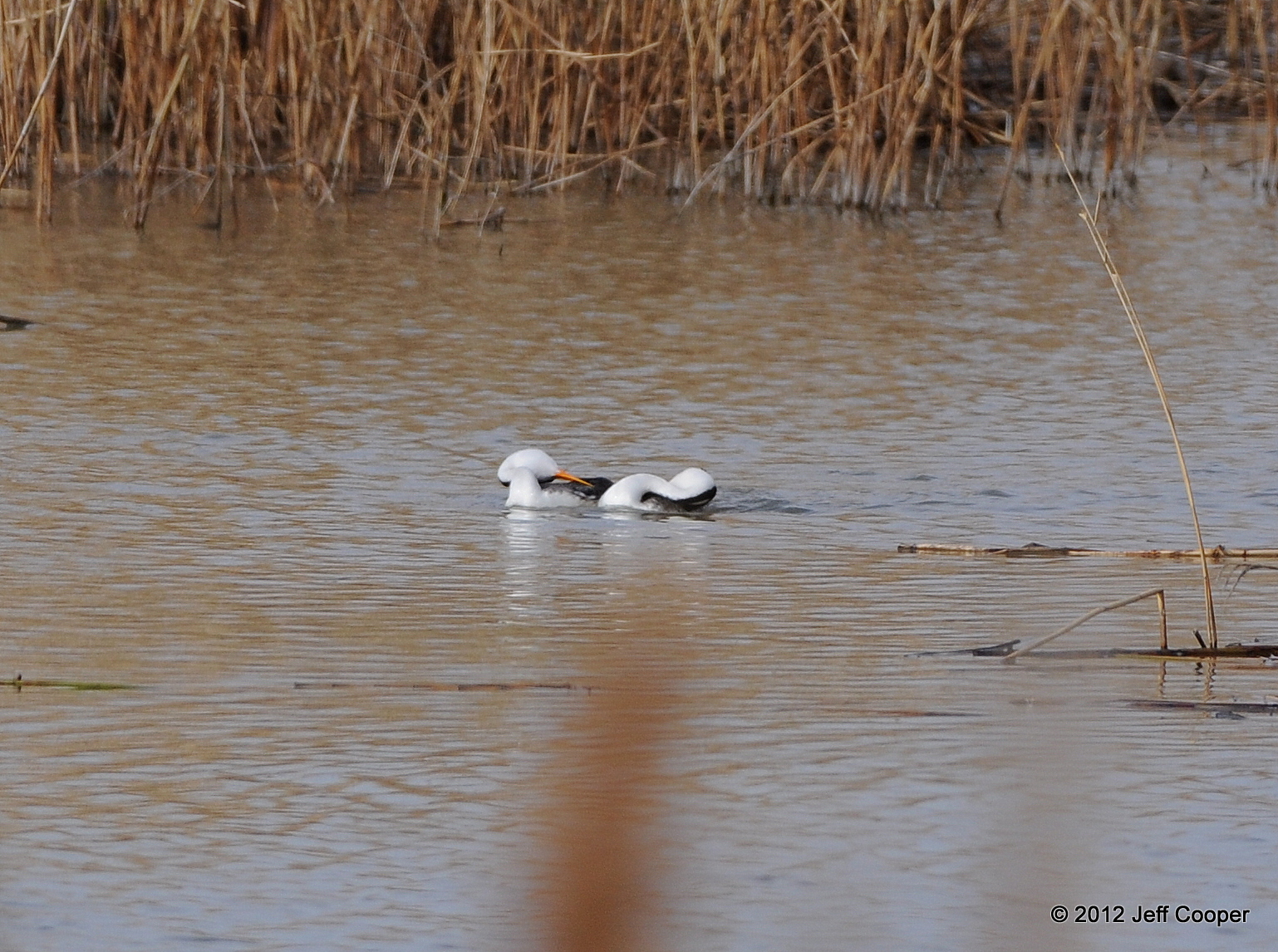
Some bird behaviors that my brother found fascinating included a Marsh Wren doing a spread eagle--or should we say a spread wren--while it called and perched on two separate phragmite stalks, a pair of Clark's Grebes doing courtship dances, and a Golden Eagle perched on a power pole in the middle of a large field because it was keeping watch over the carcass of a cow that was providing a great food source.
Marsh Wren Perched in a Spread Eagle, Sorry-Spread Wren, on the Provo Airport Dike in Provo, UT
(Photo by Jeff Cooper)


Bowing to your partner.


Admiring your  Partner


Blushing at your partner's glow
Golden Eagle Standing Guard Over Cow Carcass in Springville, UT (Photo by Jeff Cooper)
Another unexpected bird for the time and location was a beautiful Lincoln's Sparrow that appeared just before we saw the Clark's Grebes dancing along the Provo Airport Dike.
Lincoln Sparrow on Provo Airport Dike in Provo, UT (Photo by Jeff Cooper)

Dark-eyed Junco Along SR 77 in Springville, UT
(Photo by Jeff Cooper)


The closest encounter of the day came as my brother and I were standing on the side of the road looking across a fence that separated us from the Golden Eagle. I noticed some movement in the grass below us, looked down, and then pointed my brother's attention to a Dark-eyed Junco.

The greatest encounter of the day came right at the end of our morning as we were driving on a dirt road known as River Lane, near the small towns of Palmyra and Lakeshore. We had driven to the end of the road where it leads to a small sandy beach on the south end of Utah Lake. We had looked for ducks and gulls out on the lake and were driving away, surrounded by lots of trees. It was early spring so many of the trees were still leafless. In jest I said, "Now we just need to get you a nice owl to round out your day." No more than a moment later, as I scanned the thickly wooded area to my left I caught a glimpse of something that made me let out a "hee, hee!" like a kid in a candy store. We backed up a little and I looked over to my brother with a smile and he said, "What?!"  I pointed to what looked like a clump of branches and asked, "Do you see it?" "See what?", He asked. I pointed to and described the location of my discovery for several minutes without him being able to get a visual. Finally we got out of the truck and walked closer. When he finally saw it he asked in complete amazement, "How the heck did you see that?" I had seen the silhouetted tips of the ear tufts of a Great Horned Owl, barely visible above a thick bunch of limbs. We walked to the other side of the tree and saw the owl pictured below. The opposite side of the clump provided a much better view into the eye of a mystical creature.
Great Horned Owl on River Lane Near Palmyra and Lakeshore, UT (Photo by Jeff Cooper)
That was a day I will never forget. I was with my brother and re-lived the excitement of seeing both new and common birds in a whole new way--through the eyes of a novice birder. See what you can do to introduce someone new to the joy of finding and observing some of nature's most interesting creatures.