The Utah County Birders Club issues a challenge every other year to its members. Various requirements are set forth to qualify for a beginner, intermediate, or advanced birder. We are in the midst of one of those challenges this year. One of the requirements I chose to meet in my effort to qualify for an advanced birder was to introduce someone to birding. One of my older brothers from Kentucky, where I grew up with seven brothers and four sisters, was visiting Utah in early spring this year. He was a great sport and accepted the invitation to spend a morning birding with me. There is nothing like watching a non-birder get excited time and time again as he is introduced to birds and bird behavior in a new way, in a NeoVista or "new view" sort of way.
 |
Wilson's Snipe in Vineyard, UT
(Photo by Jeff Cooper) |
When my brothers and I were growing up and participating in boy scout camps we had a tradition of taking first-time campers out late at night for a "snipe" hunt. We'd tell the new camper to follow us far from camp and then give him a bag to hold while the rest of us would leave the him alone so we could go roust up some snipes and chase them in his direction. His job was simple. Just stay put and wait for the snipes to come his way so he could snatch them up in his bag. In reality we'd leave the new camper out in the dark while the rest of us went back to camp because we, the supposedly smart ones, all knew there was really no such thing as a snipe. Well, I was able to show my older brother all these years later that there really is such a thing as a snipe, a Wilson's Snipe to be exact. We found several in a wet field in Vineyard, UT. I was able to show him an Osprey on a nest stand in that same general area before we moved on to our next location.
 |
| Western Meadowlark in Palmyra, UT (Photo by Jeff Cooper) |
One of the things that really impressed my brother over and over as he lifted his borrowed binoculars to his eyes was the diversity of color displayed by many common birds that had never really caught his attention before our morning together. At one point he exclaimed, "Look at how yellow that bird's throat, belly, and eyebrows are!" when he observed a Western Meadowlark on a post. Can you imagine his amazement when he saw his first of many male American Kestrels, North America's most colorful raptor. And the male Ring-necked Pheasant really surprised him.
 |
| American Kestrel on Provo Airport Dike in Provo, UT (Photo by Jeff Cooper) |
 |
| Male Ring-necked Pheasant in Palmyra, UT (Photo by Jeff Cooper) |
 |
Bar-headed Goose (likely an escapee) at East Bay Golf Course
Provo, UT (Photo by Jeff Cooper) |
A bird that was clearly not where it belonged was an Asian Bar-headed Goose (likely an escapee) that has shown up for two springs in a row now at the East Bay Golf Course in Provo, UT. We had gone to that area to see some Black-crowned Night Herons that are regulars.
We got a fair share of raptors for my brother as we drove through some agricultural areas in Utah County. We encountered lots of Red-tailed Hawks, including a very uncommon Harlan's Hawk (soon to be heading back to Alaska), a fly-by Peregrine Falcon, a Prairie Falcon, and some Northern Harriers.
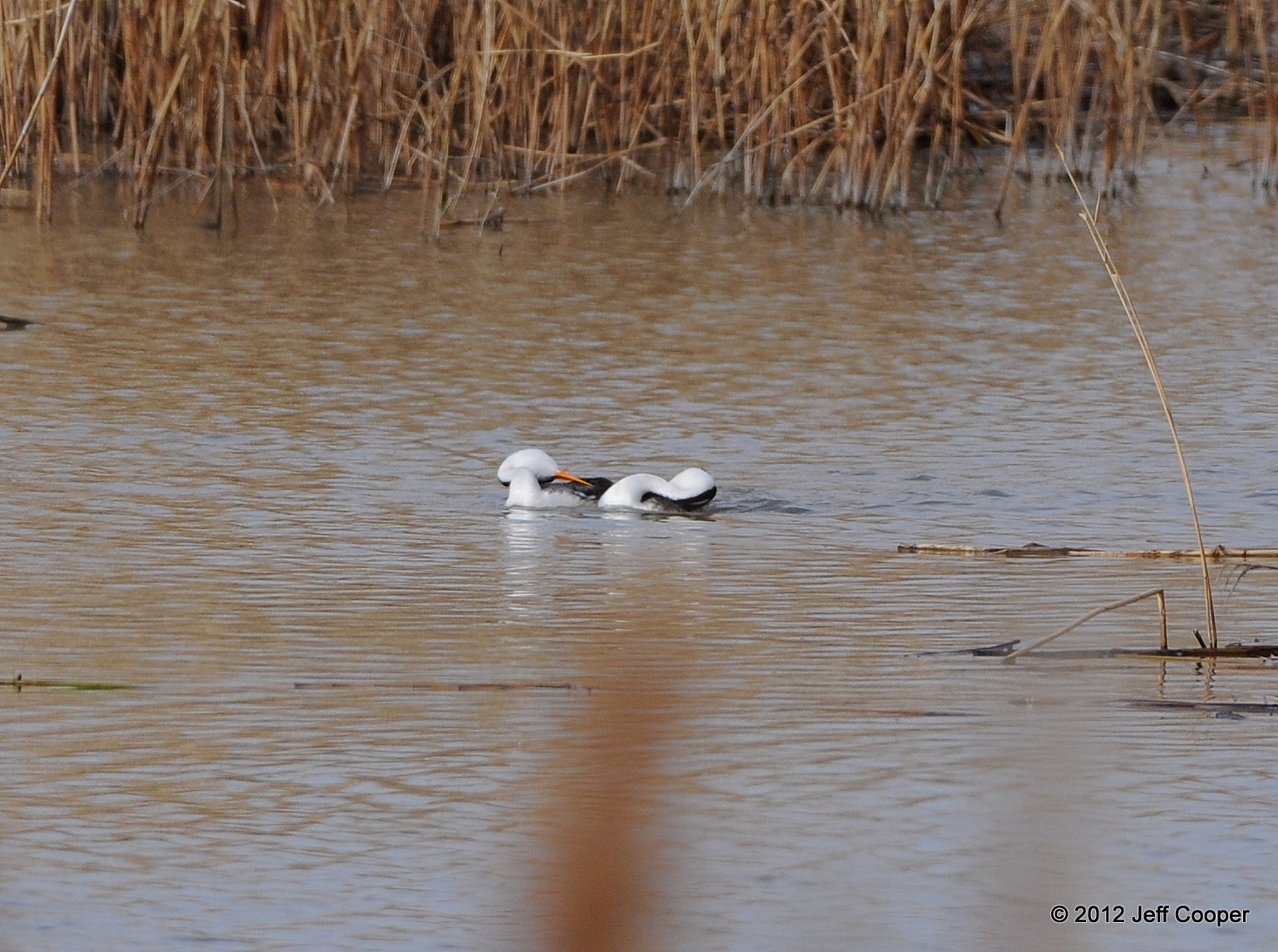
Some bird behaviors that my brother found fascinating included a Marsh Wren doing a spread eagle--or should we say a spread wren--while it called and perched on two separate phragmite stalks, a pair of Clark's Grebes doing courtship dances, and a Golden Eagle perched on a power pole in the middle of a large field because it was keeping watch over the carcass of a cow that was providing a great food source.
 |
Marsh Wren Perched in a Spread Eagle, Sorry-Spread Wren, on the Provo Airport Dike in Provo, UT
(Photo by Jeff Cooper)
Bowing to your partner.
Admiring your Partner
Blushing at your partner's glow
|
 |
| Golden Eagle Standing Guard Over Cow Carcass in Springville, UT (Photo by Jeff Cooper) |
Another unexpected bird for the time and location was a beautiful Lincoln's Sparrow that appeared just before we saw the Clark's Grebes dancing along the Provo Airport Dike.
 |
| Lincoln Sparrow on Provo Airport Dike in Provo, UT (Photo by Jeff Cooper) |
 |
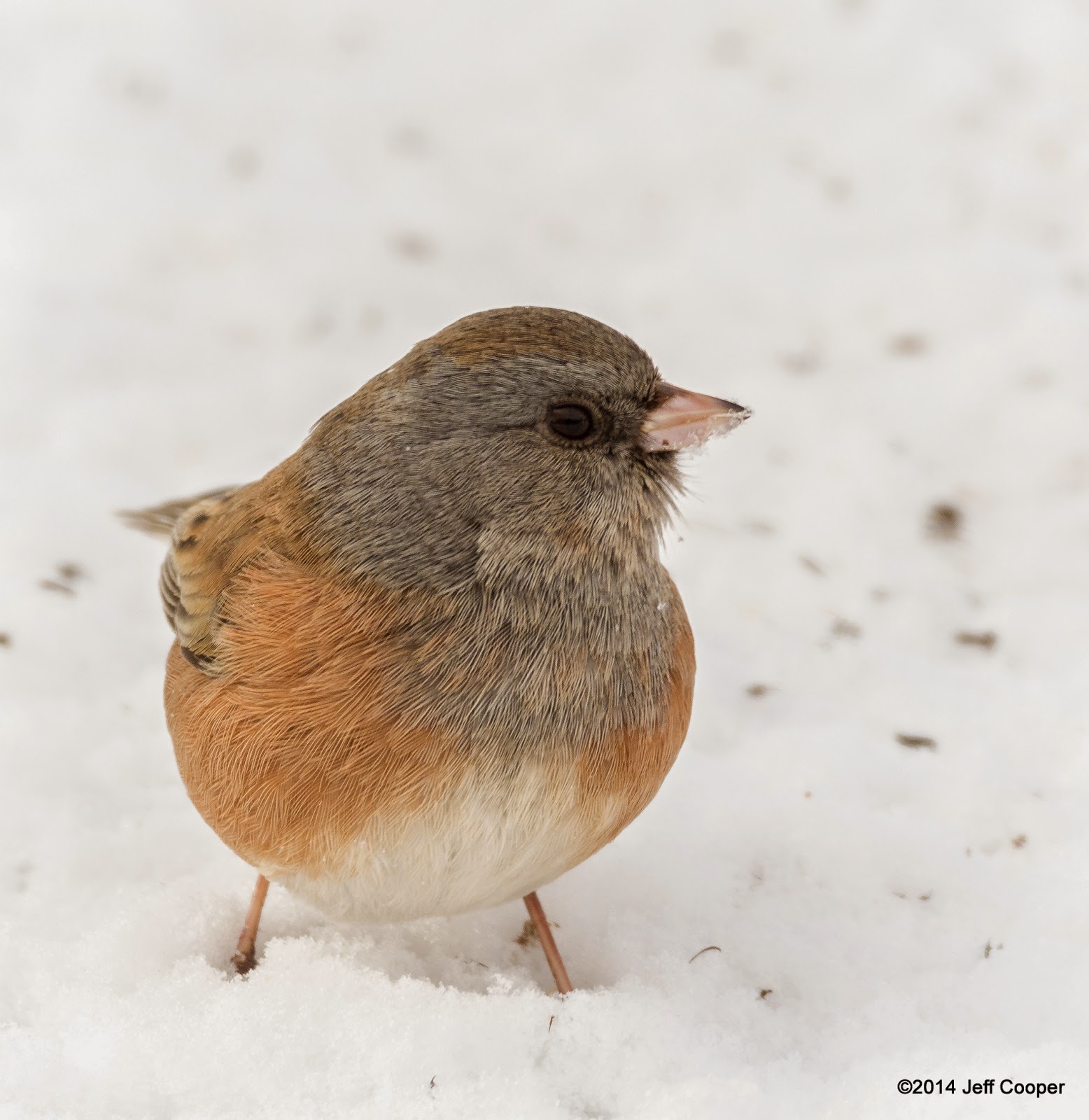
Dark-eyed Junco Along SR 77 in Springville, UT
(Photo by Jeff Cooper) |
The closest encounter of the day came as my brother and I were standing on the side of the road looking across a fence that separated us from the Golden Eagle. I noticed some movement in the grass below us, looked down, and then pointed my brother's attention to a Dark-eyed Junco.
The greatest encounter of the day came right at the end of our morning as we were driving on a dirt road known as River Lane, near the small towns of Palmyra and Lakeshore. We had driven to the end of the road where it leads to a small sandy beach on the south end of Utah Lake. We had looked for ducks and gulls out on the lake and were driving away, surrounded by lots of trees. It was early spring so many of the trees were still leafless. In jest I said, "Now we just need to get you a nice owl to round out your day." No more than a moment later, as I scanned the thickly wooded area to my left I caught a glimpse of something that made me let out a "hee, hee!" like a kid in a candy store. We backed up a little and I looked over to my brother with a smile and he said, "What?!" I pointed to what looked like a clump of branches and asked, "Do you see it?" "See what?", He asked. I pointed to and described the location of my discovery for several minutes without him being able to get a visual. Finally we got out of the truck and walked closer. When he finally saw it he asked in complete amazement, "How the heck did you see that?" I had seen the silhouetted tips of the ear tufts of a Great Horned Owl, barely visible above a thick bunch of limbs. We walked to the other side of the tree and saw the owl pictured below. The opposite side of the clump provided a much better view into the eye of a mystical creature.
 |
| Great Horned Owl on River Lane Near Palmyra and Lakeshore, UT (Photo by Jeff Cooper) |
That was a day I will never forget. I was with my brother and re-lived the excitement of seeing both new and common birds in a whole new way--through the eyes of a novice birder. See what you can do to introduce someone new to the joy of finding and observing some of nature's most interesting creatures.