Showing posts with label Raptors. Show all posts

Monday, December 15, 2014

Hooked on Hawks: Blame it on Jerry


Rough-legged Hawk in Davis County, UT USA


Back in 2009 I was on a date with my wife. No it hasn't been that long since we dated. We were on the waiting list at a restaurant and decided to kill some time by checking out the Barnes & Noble Bookstore across the parking lot from the restaurant.  For some reason, a childhood interest in birds bubbled up and led me over to field guides for birds. I decided to purchase one of the guides that night because I found the diversity of the birds fascinating and I wanted to study them further. When my married daughter saw the field guide on my desk at home she asked about it and made a mental note that led her to purchase some inexpensive binoculars for my birthday. One thing led to another and I found myself becoming a "birder".

After about one year of delving into "birding" I wanted to learn more about hawks. I had become familiar with a local club called Utah County Birders and asked one of their members who might help me learn more about hawks. I was told to consider some guy named Jerry who was supposed to be a raptor expert. Jerry was posting occasional emails to a Utah birding listserv and I noticed he did seem to know a bit about raptors when I read his emails. Like countless other newbie birders I sent Jerry a photo of one of the most common hawks in North America and asked for his help. I look at that situation now and realize how little I knew at the time. Jerry responded with the ID for the hawk and shared the important field marks for identifying it as a juvenile light-morph Red-tailed Hawk.

The simple Red-tailed Hawk question I had led to other questions. When I found myself perplexed by trying to decide whether I'd seen and photographed a Cooper's Hawk or a Sharp-shinned Hawk I sent off an email to Jerry. I got a response with some tips on distinguishing between the two look-alike species.  At one time I learned that Jerry had actually written books on identifying raptors so I did a Google search and realized that I was exchanging emails with North America's premier raptor expert. It wasn't too long before I found myself standing on the side of a mountain in Salt Lake City being dumbfounded by how quickly Jerry was able to identify hawks in flight and at great distances. He described how the harrier has a buoyant flight style, compared how eagles soar in large, lazy circles compared to the tighter circular soaring of a hawk, and distinguished between Cooper's Hawks and Sharp-shinned Hawks based on the slight nuances in shape and flight style. I learned later that I spurred one of Jerry's blog posts when I was asking him about subtle nuances that help him distinguish between similar looking species in flight. It made sense when I connected his comments with being able to easily distinguish between my identical twin sons at a distance based on the subtle nuances of posture and movement. Jerry helped me identify my first Harlan's Hawk. Imagine my surprise when I bought a book to which Jerry contributed and I saw an image of a Harlan's Hawk he and I both observed and photographed in Utah. Jerry fueled my fire for gaining more and more knowledge of North America's raptors. In short, I blame Jerry Liguori for getting me hooked on hawks.

Check out Jerry's website: Click Here
Buy his books: http://www.jerryliguori.com/store
Follow his blog posts on the Hawkwatch International website by clicking here.

Here are some images of hawk species I saw and/or photographed for my first time during 2014. I owe a lot to Jerry when it comes to my continued interest and increasing knowledge of North America's fascinating birds of prey.

Harris's Hawk Near Apache Junction, AZ USA
Common Black-Hawk in Washington County, UT USA
Red-shouldered Hawk in Long Beach, CA USA
This one is not a new species, but it was the first time I identified and photo a sub-adult Swainson's Hawk. I credit this ID to having studied Jerry Liguori's books and learning that the Swainson's Hawk is the only buteo that has subadult plumage. Other buteos go from juvenile to adult plumage as they go through their first molt.

Swainson's Hawk Sub-adult in Salt Lake City, UT USA
I'll sign off with a line Jerry wrote in my copy of one of his books, "...and I hope you see lots of hawks!"


Wednesday, July 31, 2013

Raptor Quiz For Birding Is Fun!

I originally shared this post on BirdingIsFun! on July 16, 2003. I'm releasing it here on my blog as well.

Most of the images in this post come from the "not my favorite" folder. I wasn't pleased with lighting, quality, angle, or some other aspect of the image. For those same reasons, however, they lend themselves well to quiz material. All are raptors and I've numbered them 1 to 11. If you are interested, write down the number and the ID as you scroll through and identify them. I will provide my IDs and reasoning at the end of the quiz images. Even if you only attempt to ID a few it might be a fun exercise for you. My IDs are based primarily on experience in the field and the following references I use frequently:
  • Hawks From Every Angle by Jerry Liguori
  • Hawks At a Distance by Jerry Liguori
  • Sibley Field Guide to Birds of Western North America (both the book and the Android app)
  • Hawks of North America 2nd Edition by William S. Clark/Brian K. Wheeler
I'm not an expert, but I do consult my references and people who know raptors inside and out. I learned quite a few things by putting together this quiz. Feel free to share your thoughts in a comment if you have questions or a different opinion. 

With the exception of one raptor photographed in Kentucky (#8), all of these raptor images were captured in the state of Utah. Can you identify each one? How about the age and sex for the ones that seem easy to you? How about a subspecies?  A species and even the same bird might show up more than once in the images below.

Have fun and thanks for playing along!

#1

#2

#3

#4
#5

#6

#7

#8 (the one seen in Kentucky)

#9

#10

#11


THE ANSWERS ARE JUST BELOW SO DON'T CONTINUE SCROLLING UNLESS YOU ARE READY TO CHECK YOUR IDs.


  1. Adult Light Harlan's Hawk: Mostly whitish tail with rufous tips and edges, white scapulars, white belly with crisp belly marks
  2. Dark Ferruginous Hawk: Large/long yellow gape, whitish tail, pale wing panels (showing on upper wing), white flight feathers (showing on underwing)
  3. Juvenile Harlan's Hawk: Juvenile Harlan's Hawks have heavily barred flight feathers and primaries are barred to the tip. the bird is black and white overall with heavy mottling
  4. Adult Sharp-shinned Hawk: High-centered chest, smallish head, red eyes, heavy rufous barring. The outer tail feathers are shorter so it appears to be the tail of a Cooper's Hawk. However, female Sharpies can have rounded tails.
  5. Juvenile Sharp-shinned Hawk: Accipiter shape, high-centered chest, smallish head. Some adult-like rufous barring on under side, but eyes are still yellow (juvenile trait) and there is still brown streaking on the head and nape (juvenile trait).
  6. Dark Western Red-tailed Hawk:   This is a tough one from what is shown in the image above. You may see a hint of the rufous showing through to the underside of the tail that barely extends below the cross rail on which the bird is perched. From the one image provided above it would be hard to rule out the possibility of a Harlan's Hawk. See additional images of this bird below for a better look at the tail and the bird in flight.
  7. Adult Cooper's Hawk: Accipiter-length tail with visible white tip, rufous-barred, tubular body, small-eyed appearance, and the crown color is light for what would be expected for an adult Sharp-shinned Hawk. The top side is gray with brownish "hands" or primaries. It is pale-eyed for an adult Cooper's.
  8. Broad-winged Hawk: Buteo shape, rufous barring across chest and most of belly, 
  9. Light Swainson's Hawk: White under-wing coverts contrast withe dark remiges, brown bib on light underside.
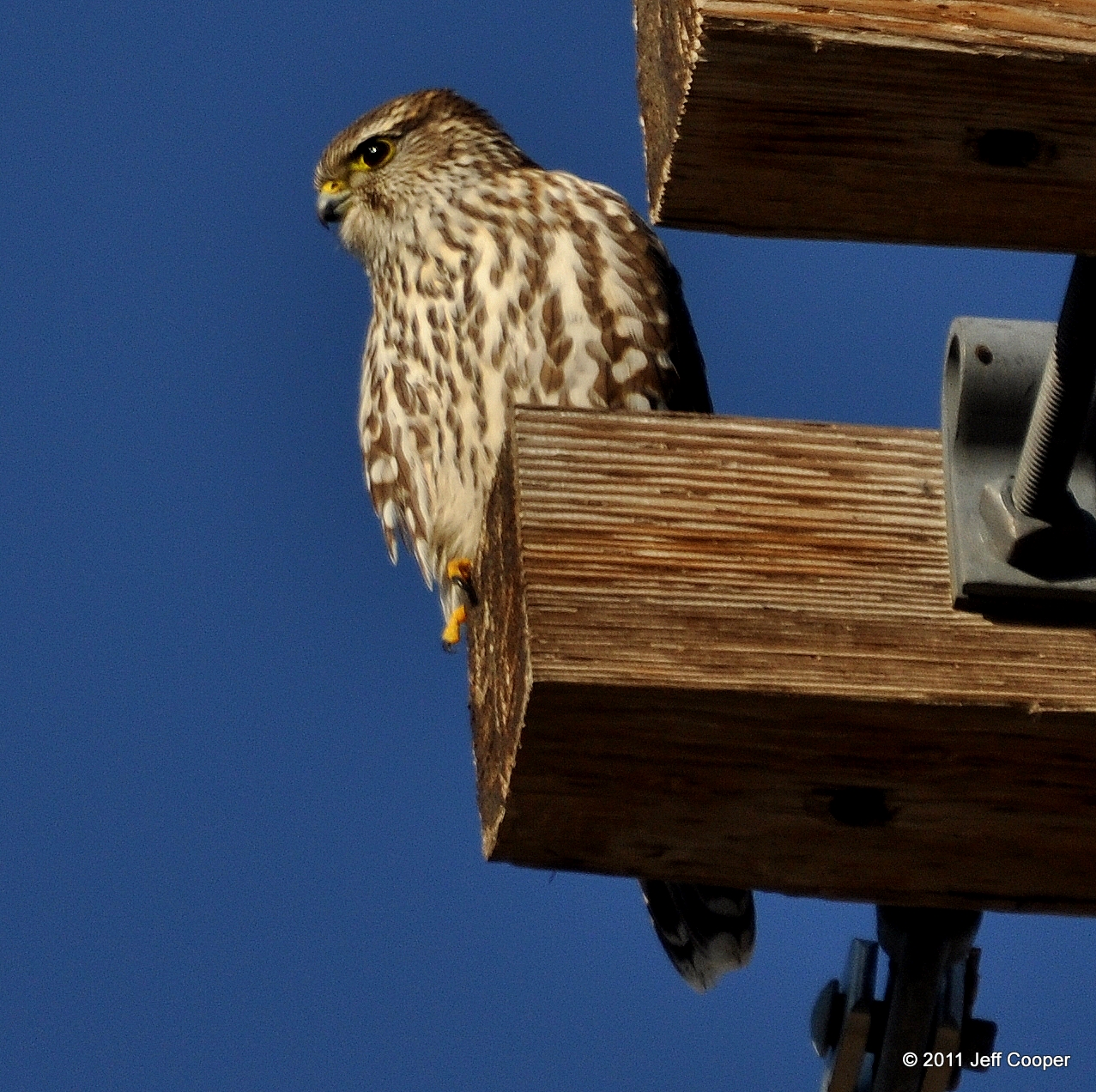
  10. Merlin (Taiga): Brown upper side, white supercilium, pale throat, and heavy rufous marking on chest and belly.
  11. Adult Light Harlan's Hawk (same bird shown in image #1): Streaked head, bright white underside with sparse and distinct belly marks, and whitish tail. See additional images of this bird below.
Additional images of the light adult Harlan's Hawk shown in #1 and #11

These images show the lack of banding in the flight feathers which is sometimes the case with adult Harlan's Hawks. The dark terminal band in the remiges is an adult trait as well. The bright white underside with distinct spots, and white around the eye are marks of a light Harlan's Hawk as well.

Adult Light Harlan's Hawk American Fork, UT

Adult Light Harlan's Hawk American Fork, UT

Additional Images of the Dark Western Red-tailed Hawk shown in #6

The head and underside of this hawk appeared almost completely dark. The image below shows it has a red tail, some juvenile feathers remain near left edge, and there is a dark band across the bottom edge.

Adult Dark Western Red-tailed Hawk in Heber City, UT

Saturday, May 25, 2013

Raptor Quiz Part One

The images in this post come from the "not very good" folder. Consequently, they lend themselves to quiz material. Poor lighting, deep cropping, and other factors make identification of some of these birds challenging. I've numbered them 1 to 12. If you are interested, write down the number and the ID and then share your ID in the comments below. Even if you only attempt to ID a few it can be a fun exercise. I'll share my IDs in a few days.

All of these raptor images were captured in the state of Utah. If you can identify them trying adding the age or specific subspecies name. Hint: Some species and even the same bird may show up multiple times in the images below.

#1
Merlin? Yes. But Taiga, Prairie, or intergrade?


#2

#3

#4

#5

#6

#7

#8

#9

#10
#11

#12


Sunday, November 25, 2012

Utah's Winter Raptors Revisited

The following is a re-post of my first-ever blog post. It was born out of an invitation from Robert Mortensen to be a contributor to his birding blog, BirdingIsFun.com. It was first published October 16, 2012 on BirdingIsFun.com. I'm re-posting here so it is included among my other NeoVista Birding posts. I hope you enjoy it! Jeff

I was out of state or otherwise preoccupied this year during the peak of fall passerine migration in Utah, but I'm not letting that dampen my birding enthusiasm because another of my favorite birding seasons is quickly approaching. I know that when the Wasatch Range of the Rocky Mountains takes on its fall colors and our Swainson's Hawks and Ospreys leave the state around the end of September/early October it is time to get excited for winter raptors.

Someday (on my buck list) I'm going to make it to one of the popular hawk migration sites, but until then I'll continue to enjoy local hawk migration sites such as Squaw Peak Lookout above Provo, Utah.  I joined a small group of Utah County birders September 29th for a hawk watch and thrilled at the sights of all three accipiter species (Northern Goshawk, Cooper's Hawk, and Sharp-shinned Hawk), Red-tailed Hawks, and Golden Eagles making their way southward along the ridges. We enjoyed watching one Cooper's Hawk rise from the trees in the hillside below us, catch a thermal, and soar right before our eyes. The hawk rose slowly and circled in front of and above us as if it wanted to make a lasting impression, which it did. I could see that its crop was full and it was fueled for the next segment of its migration. It rose higher and higher and then ended the gentle looping with a direct flight southward along the ridge.
Migrating Cooper's Hawk Provo, Utah
(Photo by Jeff Cooper)

Last November I happened to photograph my first Harlan's Hawk (subspecies of Red-tailed Hawk), without even knowing it at the time, in a location we refer to locally as Point of the Mountain. It was Jerry Liguori, raptor expert and author, who confirmed the Harlan's ID when I shared some images with him. Once Jerry confirmed the ID and I shared the sighting with the local birding community raptor watchers descended upon the location and multiple Harlan's Hawks were observed throughout the winter.  Point of the Mountain is a plateau at about 5100' and sits between the borders of Salt Lake and Utah Counties. It is also the location for the Utah State Flight Recreation Area which is used by hang gliders, paragliders, and hunting raptors because of the thermals rising from the hillsides and open fields below.
Juvenile Harlan's Hawk at Point of the Mountain Lehi, Utah (Photo by Jeff Cooper)
Once I became a little more discerning with my observations of the ubiquitous Red-tailed Hawks I was able to locate my first light adult Harlan's Hawk which had claimed a small field in American Fork for its hunting grounds. Jerry Liguori shared with me that recent data indicates that light Harlan's Hawks make up about  12% of the total Harlan's Hawk population. The images below show the bright white underside lacking buff and rufous tones, blobby belly marks, streaked head, white around the eyes, dark terminal bands in the wings, and the absence of other banding in the wing and tail feathers--all typical traits for light adults. The upper side image shows the whitish scapulars and pale tail feathers which are also common with these hawks.
Light Adult Harlan's' Hawk American Fork, Utah (Photo by Jeff Cooper)
Light Adult Harlan's Hawk American Fork, Utah (Photo by Jeff Cooper)
One day while visiting the fields south of the Point of the Mountain and behind our local Cabela's store (a place we call Traverse Ridge) I came across two hunting Prairie Falcons. One would perch on a power pole, leave the pole with a dive and then make a swift, low flight across a field only to do a u-turn and return to its previous perch. After seeing this occur several times I decided to use my truck as a blind and park below the pole to capture some action images. I saw this same behavior with another Prairie Falcon the other day at Point of the Mountain and employed my previous truck-as-a-blind strategy to capture action shots of that bird as well.
Prairie Falcon Below Traverse Ridge in Lehi, Utah (Photo by Jeff Cooper)

Adult Prairie Falcon at Utah State Flight Recreation Area Above Point of the Mountain Utah County, Utah
(Photo by Jeff Cooper)
During the winter months I often hope and check for Bald Eagles in a small stand of cottonwood trees near one of our local boat harbors in Lindon, Utah.
Bald Eagle (under overcast sky) at Lindon Marina in Lindon, Utah (Photo by Jeff Cooper)
It was a pleasant surprise to see groups of Bald Eagles perched on snags along rivers and highways during  a drive through southern Utah on my way to Phoenix last December. I especially enjoyed the one below after driving to the outskirts of the tiny town of Panguitch, Utah.
Bald Eagle near Panguitch, Utah (Photo by Jeff Cooper)
The Rough-legged Hawk below was flying next to our van as one of my great birding friends and I drove along the Antelope Island State Park causeway last winter.
Rough-legged Hawk on Antelope Island State Park Causeway Davis County, Utah (Photo by Jeff Cooper)
I'm excited about the prospects of seeing Merlins and Ferruginous Hawks this winter as I cruise the valleys and open fields.
This Merlin made Pleasant Grove, Utah its winter home in 2011 (Photo by Jeff Cooper)
Ferruginous Hawk near Beryl Junction, Utah (Photo by Jeff Cooper)
And there is always the surprise visit of a Cooper's or Sharp-shinned Hawk at our winter yard feeders. I received a call from a friend last winter to let me know a Sharp-shinned Hawk had just taken some prey in his backyard. I quickly drove over and witnessed the scene below.
Adult Sharp-shinned Hawk Having it Meal Pleasant Grove, Utah (Photo by Jeff Cooper)
Are you ready for winter raptors? I can hardly wait for the next one that comes into view!

Friday, November 23, 2012

Black Friday Specials: Raptor Style


Like many Black Friday shoppers, I left the house this morning before the sun was up. However, I was not heading to the local Walmart. I was looking for my own version of Black Friday specials in places far from any department store. I was hunting for raptors in the agricultural areas surrounding the small farming towns in the south end of Utah County, about one hour south of Salt Lake City.

While there weren't nearly as many specials as you'd find in a Walmart, I did find a few. I found my first-of-season BALD EAGLE--a beautiful adult--between the small towns of Goshen and Lakeshore. A gorgeous dark ROUGH-LEGGED HAWK was found along Goshen Bay Road in a tree near an abandoned Golden Eagle nest.  Warm Springs WMA, between Santaquin and Goshen, presented a sleek male HARRIER catching then eating prey on a fence post along Hwy 6. RED-TAILED HAWKs were spread throughout Santaquin, Goshen, Elberta, and the south end of Utah Lake near the towns of Palmyra and Lakeshore. It was unusual for the area, but I did not see one accipiter this morning. Maybe I needed another set of eyes in the truck.

My favorite spot of the day was about two blocks south of the town or Elberta. I spotted one then two PRAIRIE MERLINs. One of the Merlins allowed me to capture a few decent images as it perched in a tree along the road. I watched it turn its head from left to right and then some more, nearly 360 degrees.

Prairie Merlin Near Elberta, UT (Photo by Jeff Cooper)

Prairie Merlin Near Elberta, UT (Photo by Jeff Cooper)