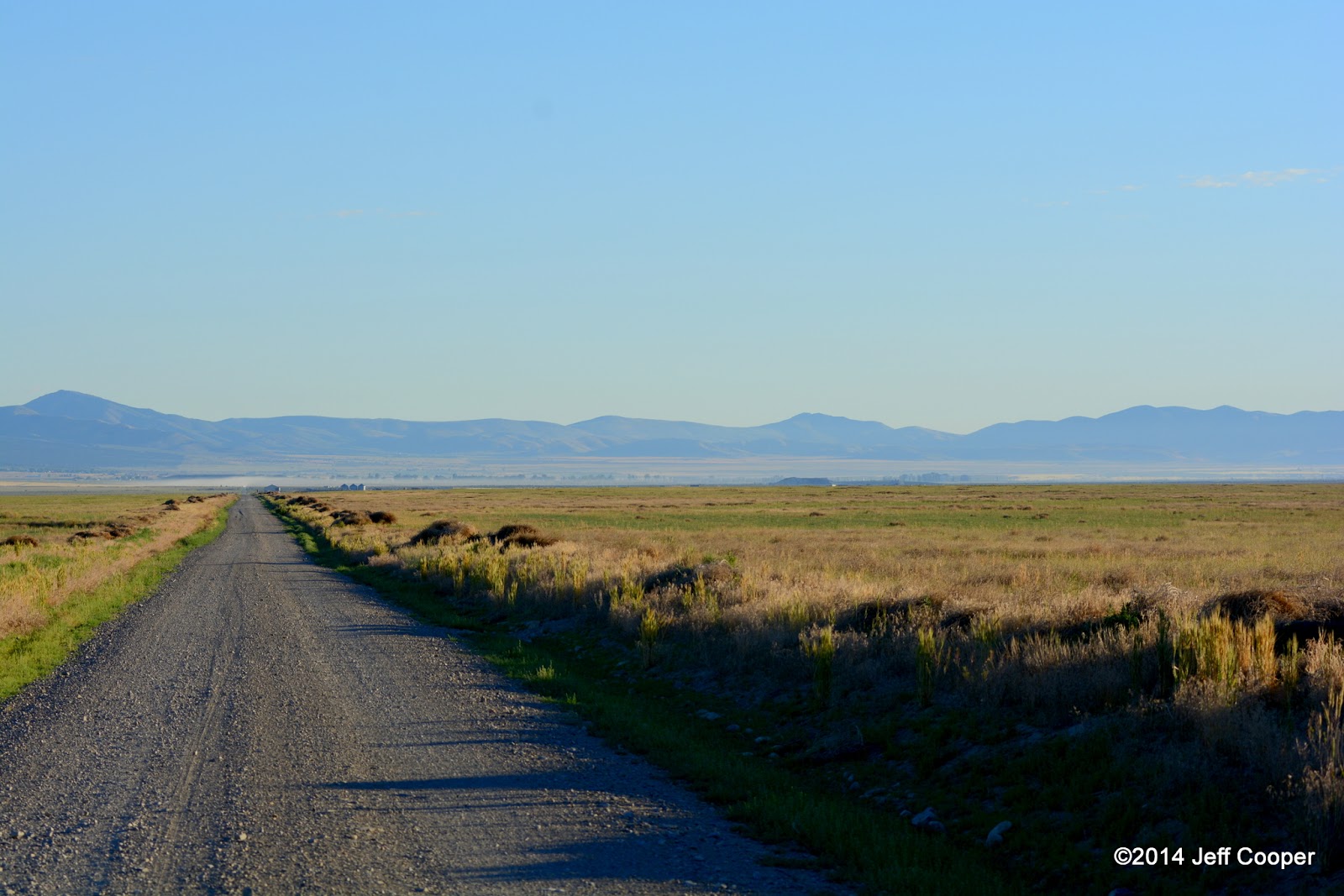
I thoroughly enjoyed spending a Friday afternoon and all day Saturday exploring parts of Zion National Park and the extreme southwestern desert of Utah a week ago so I decided I wasn't quite done with desert wanderings this past Friday night. I made the decision to get up early Saturday morning and head over to Soldiers Pass Road on the west side of Utah Lake in Utah County. My excellent birding friend and birding mentor Eric Huish had shared his experience of birding Soldiers Pass Road about two weeks before and it sounded like a fun place to explore, especially since he had reported Gray Vireos in the area, a bird I had never seen in northern Utah. The habitat is arid and hilly and begins with sagebrush at the low elevation and turns into pinyon-juniper at higher elevations. The possibility of seeing rarities and area specialty birds only 30 minutes from home was very appealing.
I arrived at the Soldiers Pass turnoff, a few miles south of Saratoga Springs on SR 68, around 6:30 am. The sun was just coming over the mountains to the east and I was in hilly territory so the sun was reaching some east-facing spots of the hills and valleys of Soldiers Pass while still being hidden from most of the pass. Bird activity was still a little slow at that time due to the mostly shady conditions. However, I did get to park and observe a somewhat nervous yet curious Jack Rabbit as I waited for more sunlight to grace the pass.
 |
| Jack Rabbit Along Soldiers Pass Road in Utah County, UT (Photo by Jeff Cooper) |
The first singing bird I heard then saw as I drove slowly up the pass was a Spotted Towhee. I could soon hear the chipping of Lark Sparrows coming from about ground level and from inside the junipers. A Northern Mockingbird was soon heard then seen on a hillside. The west side of Utah Lake is a nice place to see the otherwise rare bird for northern Utah. Mockingbirds are much more common in southern Utah. Just as I reached a hairpin turn on the gravel road which rose into the sunlight I heard and spotted a couple of singing male Black-throated Sparrows. This area of Utah County is also one of the few places in Northern Utah for reliably seeing these handsome sparrows. The soft morning light shone on the these birds as they sang from their respective sagebrush and juniper perches.
 |
| Black-throated Sparrow at Sunrise Along Soldiers Pass Road in Utah County, UT (Photo by Jeff Cooper) |
 |
| Black-throated Sparrow at Sunrise Along Soldiers Pass Road in Utah County, UT (Photo by Jeff Cooper) |
The hills were coming alive with singing birds with the sun shining on most areas of the pass--Northern Mockingbirds, Spotted Towhees, Lark Sparrows, House Finches, Brown-headed Cowbirds, and more. I stopped my truck at one point to try to identify a song that was both familiar and unfamiliar at the same time. My brain was processing at a very slow speed, but it eventually came to me. It was the song of a Gray Vireo--the song I had listened to a few times on my phone's bird recordings earlier in the morning. I retrieved my phone, searched for Gray Vireo and then played their song. It was a perfect match. I pulled up the binoculars and located the bird singing from a hillside. I exited the truck, followed the song as I hiked up the hillside, and found a small open space between juniper branches to frame my first Gray Vireo image of the day.
 |
| Gray Vireo Through Juniper Bush Along Soldiers Pass Road in Utah County, UT (Photo by Jeff Cooper) |
After sneaking a few images of the bird from my juniper hiding place I decided to move closer to obtain the image below. The Gray Vireo is a rather plain looking bird, but it was fun to hear them sing and watch them move about their habitat.
 |
| Gray Vireo on Soldiers Pass Road in Utah County, UT (Photo by Jeff Cooper) |
Below are images of the very first Gray Vireo I ever saw. It came to investigate me as I was attempting to photograph birds from behind some brush in southern Utah a couple of year ago. At the time I thought it was a Blue-gray Gnatcatcher. My friend Eric Huish pointed out that it was a Gray Vireo when he saw the images after returning from my trip.
 |
| My First Gray Vireo South of Enterprise, UT (Photo by Jeff Cooper) |
The image below shows that the tip of the upper mandible actually crosses over and down slightly to the side of the lower mandible. I don't know if that is typical or not.
 |
| My First Gray Vireo South of Enterprise, UT (Photo by Jeff Cooper) |
When my friend Eric first reported hearing a Gray Vireo on Soldiers Pass a couple of weeks ago he said it was hard to hear the birds singing because a Cicada emergence was taking place and there were ten or so Cicadas calling from every sagebrush and juniper (thousands) in the area. The emergence had passed before I arrived this past Saturday, but I did here Cicadas clicking their wings from nearly every juniper bush. When I stood still and listened to these Cicadas clicking their wings it sounded like someone had just poured milk over a very large bowl of Rice Crispy cereal. The whole area around me was making that familiar soft popping sound. While I've had my share of Rice Crispy treats over the years, I haven't eaten a bowl of Rice Crispy cereal for a very long time so the sound took me back a few years, almost to childhood.
 |
| Cicada on Juniper on Soldiers Pass Road in Utah County, UT (Photo by Jeff Cooper) |
This Lark Sparrow was perched near the Cicada I photographed above. The sparrow took flight just as I was getting focused on it in its perch. I wasn't quite ready for an action shot.
 |
| Lark Sparrow Taking Flight From Juniper on Soldiers Pass Road in Utah County, UT (Photo by Jeff Cooper) |
Shortly after leaving the Cicada and Lark Sparrow I saw a couple of Loggerhead Shrikes. I didn't get any photos of those birds, but here a couple of images of one seen previously on Antelope Island in Davis County, Utah. These predatory songbirds will prey upon insects and small rodents, as seen in the first image below. I watched the bird below drop from the thistle perch and take the small vole from the grass below. Shrikes will often impale their prey on sharp thorns, barbed wire, or some other sharp object for later consumption.
 |
| Loggerhead Shrike With Vole on Antelope Island in Davis County, UT (Photo by Jeff Cooper) |
Doesn't the look below seem to say, "Don't mess with me!"?
 |
| Loggerhead Shrike on Antelope Island in Davis County, UT (Photo by Jeff Cooper) |
Back to Saturday's images from Soldiers Pass. Another birding friend of mine, Martha, coincidentally birded the same location Saturday, but she arrived about an hour behind me. I met her coming up the pass as I was heading down. Together we chased the call of a Common Nighthawk. We hiked up a hillside from which we also heard two Gray Vireos singing. One Common Nighthawk flew over our heads as we stood near the top of one of the hills. We enjoyed watching the bird do its flight display. It would circle higher and higher while giving its insect-like "beeerrz" call and then take a steep dive and give its soft "boom", more like a humming "oooovvv" sound at the bottom of its dive. The bird came close at one point, but flew between me and the sun as it did so. Looking into the sun kind of blinds a photographer so I missed that shot. I did manage the image below as the bird flew high overhead. I increased exposure compensation in the field knowing the bird was back lit. That helped, but I also had to crop the image quite a bit to show the detail that is seen below.
 |
| Common Nighthawk Flying High Above Soldiers Pass Road in Utah County, UT (Photo by Jeff Cooper) |
These birds are generally crepuscular, active mostly during dusk and dawn hours, as they hunt flying insects. They nest on the ground in gravel or on gravel rooftops. The flight display of this bird may have been to attract a mate or claim territory near an existing nest.
I want to share a better view of these summer visitors to Utah so here is a photo of the first Common Nighthawk I ever saw and then some taken while watching nighthawks feed on flying insects over an agricultural area near Lakeshore, Utah.
 |
| Common Nighthawk Roosting on River Lane in Palmyra, UT (Photo by Jeff Cooper) |
 |
| Common Nighthawk Hunting Flying Insects Over Agricultural Fields Near Lakeshore, UT (Photo by Jeff Cooper) |
 |
| Common Nighthawk Hunting Flying Insects Over Agricultural Fields Near Lakeshore, UT (Photo by Jeff Cooper) |
A pleasant surprise for both Martha and me was discovering two Juniper Titmice that were first heard then seen as they flew into some junipers and foraged for insects. They were probably a breeding pair considering time of year and location.
 |
| Juniper Titmouse on Juniper Along Soldiers Pass Road in Utah County, UT (Photo by Jeff Cooper) |
I saw my very first Juniper Titmouse a couple of years ago as I was beginning to hike into Yellow Fork Canyon in Salt Lake County. The image below is of that first titmouse. It was carrying food in its bill. That is a sign that it was taking food to a nest or recently fledged birds. Otherwise it would have wasted no time swallowing the bug.
 |
| Juniper Titmouse Carrying Food to Nest Site in Yellow Fork Canyon Salt Lake County, UT (Photo by Jeff Cooper) |
Martha told me earlier that she was going to drive over the summit of Soldiers Pass Road and down into Cedar Valley to meet her husband George, who is a pilot, at the small airport in Cedar Valley. While we were visiting after observing another Gray Vireo together Martha's attention was drawn to the sound of an airplane coming toward our location. It was her husband George!
Somehow, despite the sound of roaring propellers during George's flyover, I heard the chatter of a pair of Bushtits coming from behind us. Martha and I both got a quick glimpse of the Bushtits before they disappeared into some cover. I managed one quick shot from a distance of one Bushtit as it very briefly popped up and perched on a juniper.
 |
| Bushtit on Soldiers Pass Road in Utah County, UT (Photo by Jeff Cooper) |
Here's a closer image of a Bushtit I captured in my in-laws' backyard in Cypress, California last summer. They are very busy and nomadic, rarely being seen in the same area except during nesting season when the eggs and babies require constant attention.
 |
| Bushtit in Cypress, CA (Photo by Jeff Cooper) |
Martha and I eventually said goodbye and headed our separate ways. Just as I reached the bottom of Soldier Pass and headed back to SR 68 I saw some Lark Sparrows. I noticed one sparrow was holding food in its bill and suspected it was taking the food to a nest. The bird flew down low into a sagebrush. As I approached the sagebrush I noticed there was a nest with three little babies. I hope you can see the dried-grass nest and get a sense of how well it was hidden inside a sagebrush.
 |
| Dried-grass Nest of Lark Sparrows in Sagebrush on Soldiers Pass Road Utah County, UT (Photo by Jeff Cooper) |
I'll finish with an image of a Lark Sparrow I captured a few weeks ago on my way home from work. It represents the most frequently seen bird during my drive up and down Soldiers Pass this past weekend.
 |
| Lark Sparrow Lehi, UT (Photo by Jeff Cooper) |