Thursday, December 4, 2014

Not Just a "Brown" Pelican

The name "Brown" Pelican seems fair when it comes to a descriptor for juveniles and the Atlantic variety, but it doesn't aptly describe the appearance of Pacific adults when they are sporting their breeding plumage. A striking combination of red, yellow, olive, and orange in the pouch and facial areas brighten the otherwise white, silver, and brown colors of these birds. I saw these striking colors this past weekend as I watched groups of Brown Pelicans plunge dive for fish at the Bolsa Chica Ecological Reserve in Orange County, California.


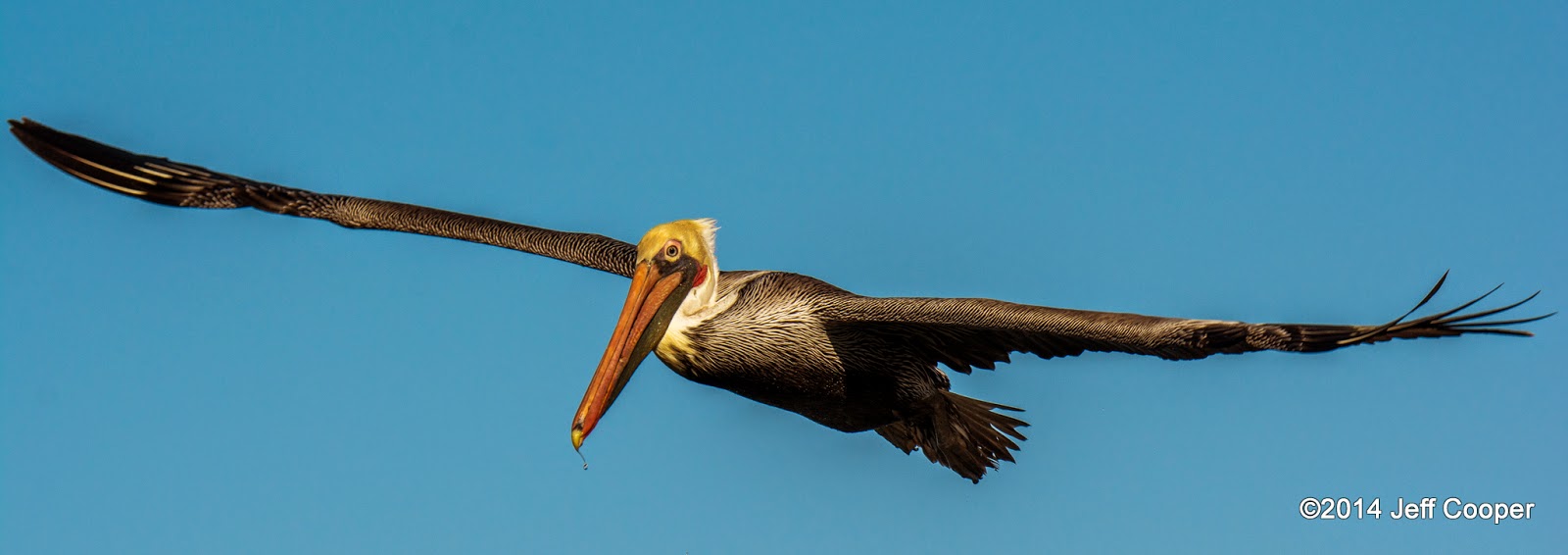
Pelicans are large, with wings spans reaching 6.5 feet, and fly rather gracefully. They can often be seen gently cruising just inches above the surface of the water. I enjoyed watching their smooth flight as they came and went before me. The following series shows one approaching my position. You can see water dripping from the tip of its bill. Eventually there is a single drop just below the bird's bill. The last image of the series also shows the webbing between the toes. This webbing makes them strong swimmers. My understanding is that Pelicans are the only birds to have webbing between all four toes.


I tried to capture some video as the pelicans did their plunge diving, but it was hard to track their flight and keep them in the frame while the lens was zoomed. I'll know better how to capture video if I get the chance again, but I did capture a few images of birds in various stages of the plunge dive. The first image shows the bird beginning to break it's glide with a sudden bank to its left.


One came up empty just as another submerged its head. The pouch is probably fully expanded while the upper and lower mandibles begin to close the net, so to speak.


Pelicans essentially dive to just below the surface of the water. Their body's are not fully immersed. Their pouch expands to take in water and hopefully fish. After emerging the pelican hangs the bill down to allow water to drain and then tilts the head back to swallow the food. Not all of the catch from a dive is retained as the pelican allows water to drain from its pouch. An empty shell and small fish fell from this bird's pouch as it was in the process of tilting the head back for a swallow.


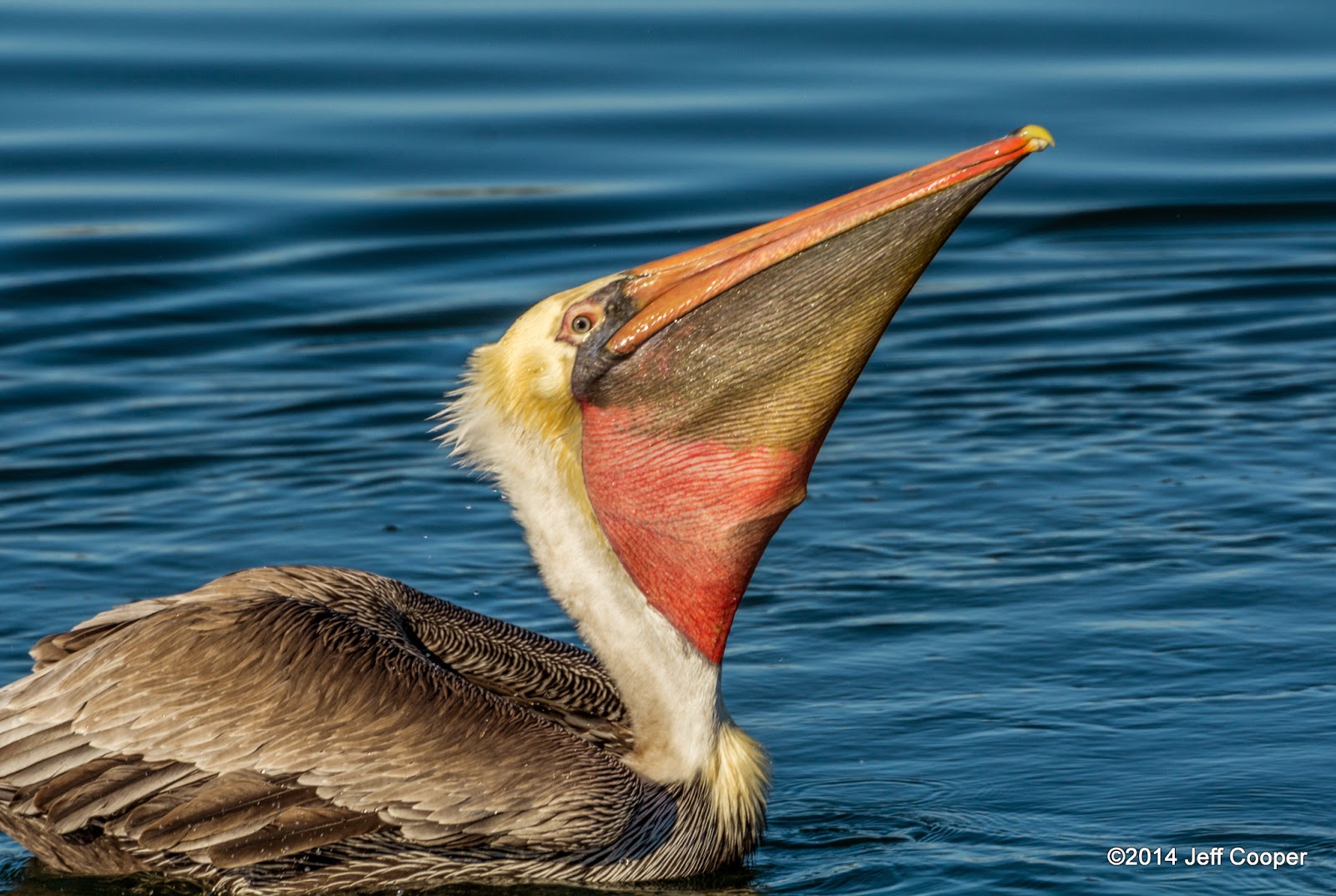
The small bulges in the pouch below are formed by the fish and debris that are gathered during a dive.  Part of one small fish can be seen near the tip of the bill.


And it is too late at this point for anything in that pouch to return to the water before it is fully digested. I like this view of the pouch and its structure. You can see the folds that allow the pouch to expand and fold down as needed.  That hook on the tip of the bill helps the bird to hang onto slippery fish.

I watched one bird as it preened between dives. I was surprised by how it could twist and turn itself into a "pelican pretzel". Can you imagine getting your mouth to your back?


I captured a number of images I'd like to share, but I'll finish with a portrait, a landing, and a wing stretch.


Wednesday, December 3, 2014

White-tailed Kite Preening and Kiting

I spent Thanksgiving weekend in Orange County, California with some of my wife's family. My wife and her sister wanted to do some Christmas and clothes shopping on Black Friday and Saturday, but my sister in law felt bad about leaving me at the house while they went shopping. My wife told her sister there was no need to worry about Jeff. "He has his camera and will spend as much time as we give him exploring the sites and birds of Orange County."  It was a win-win situation from my perspective. And my wife agreed. She would enjoy shopping with someone who can genuinely ooh and ah over clothing and I'd be free to discover and capture images of the birds of Orange County.

I had amazing experiences over the weekend and wasn't sure which one to share first on the blog. I had extremely close observations of Pelicans repeatedly plunge diving into shallow water to scoop up fish in their large pouches, discovered two life birds (Nuttal's Woodpecker and Ridgway's Rail), watched a gull prepare and swallow an octopus whole, photographed Red-shouldered Hawks, and spent about an hour watching a White-tailed Kite preen, call, and kite over a small wetland area. I'll start by sharing the White-tailed Kite encounter.

Prior to Saturday I'd seen two White-tailed Kites. One was a vagrant juvenile that showed up temporarily near St George, Utah. The other was a brief encounter with an adult bird near Santa Cruz, California. These birds range along the California coast where coastal prairies exist, parts of Mexico, and the southern parts of Texas and Florida. They prefer open grassy areas with scattered bushes and shrubs. When they are not conspicuously perched on a snag or bush, they kite (hover) over the open spaces and then drop from the sky to catch prey, which generally includes small rodents. These kites are striking and appropriately named raptors as you'll see in the images and video clips I'll share. Adults are mostly white on the underside, white-tailed, and pale gray on the upper side with black shoulder patches. Their eyes are blood red. The skin on the legs and cere are yellow.

Seeing a White-tailed Kite was on my wish list for the Orange County weekend so I got a little excited when I drove past what looked to me like great kite habitat. I decided to check out the area briefly, but I came up empty handed. I returned to the area later in the day and was delighted to find an adult perched on a snag just above a small wetland area.

Adult White-tailed Kite Near Huntington Beach, CA
The kite was perched on private property so I remained on the right side of the fence to capture some images as the bird preened and occasionally took flight to do some kiting. It stretched its wings several times before taking flight.

Adult White-tailed Kite Near Huntington Beach, CA
I captured short video clips as the bird demonstrated exactly why it is called a White-tailed Kite. The video clip below shows some kiting behavior and short flights where the black shoulder patches are seen briefly. I wasn't expecting to do video so I did not have a tripod. I had to handhold the camera with the lens fully zoomed to 400mm so there is some camera shake, but it was fun and the video turned out okay. I like how the bird dangles its legs at times while it kites and how it lifts its head to check its surroundings when it isn't searching the wetland below for prey. A bird in flight always impresses me.

The video should be viewed in 1080p HD for the best resolution. Otherwise the resolution may be low.


I've put a few segments together in the next video to include the bird calling, show various stages of preening (stretching, plucking, scratching, and fluffing), and allow some calls and whinnying of Soras to be heard in the reeds below the kite. Those sounds help illustrate the habitat for these kites. A Great Egret was foraging in a small marsh below the kite and can be heard croaking at one point. What other birds do you recognize calling in the video?


People often ask me what is my favorite bird. My typical response is, "The one I just observed or photographed." A White-tailed Kite is definitely at the top of my list for awesome birds.

Monday, November 24, 2014

A "Sharp-eye" on the Bird Feeders

I returned home from church Sunday and glanced out the kitchen window to see if anything other than House Finches, House Sparrows, and Dark-eyed Juncos was enjoying the food I put in the feeders. I didn't see a single bird below, on, or above the three feeding stations. There was an eery silence around the feeders and throughout the yard.  A loaded-yet-abandoned bird feeder on a wintry day in our yard has proven on previous occasions to be an indication that a bird predator is near. And I'm not talking about a neighborhood cat. The birds learn how to work around the cats, but they hide for their lives when one of their own is the predator. I'm talking about a bird-eating hawk.

Cooper's and Sharp-shinned Hawks are notorious for preying on smaller birds around yard feeders during the winter months. A glance around the perimeter of our yard revealed the reason for Sunday's silence. A juvenile Sharp-shinned Hawk, or Sharpie as many call them, was perched on the fence and was keeping a "sharp eye" on the feeders and the densely wooded shrubs where the tweety birds were hiding and pretending not to exist. My wife was not surprised when I lost complete interest in whatever I was supposed to be doing and dashed into my office to retrieve my camera. She's familiar with my bird conniptions. I ran to the garage, propped open the side door and focused as best as I could on the hawk while wind and snow were blowing between us.

This hawk was intent on eating. I could see that its crop was empty and I watched it give piercing glances in all directions as I was composing and capturing images. The images below show how the hawk turned its carnivorous glances from one hiding spot to another. It was determining its best line of approach to lunch.

Juvenile Sharp-shinned Hawk Hunting for Prey Near Yard Feeder, Utah County, UT

Juvenile Sharp-shinned Hawk Hunting for Prey Near Yard Feeder, Utah County, UT

Juvenile Sharp-shinned Hawk Hunting for Prey Near Yard Feeder, Utah County, UT

Juvenile Sharp-shinned Hawk Hunting for Prey Near Yard Feeder, Utah County, UT
The hawk eventually turned and flew to a concealed perch in a neighbor's tree. These hawks will often perch in a concealed location and wait for birds to forget about their presence so they can make a quick and effective ambush.

Separating Juvenile Sharp-shinned and Cooper's Hawks

The image above is a good one for identifying the hawk as a juvenile Sharp-shinned. The brown upper side, streaked nape, and yellow eyes are typical for a juvenile. The back will become gray to slate-blue when it becomes and adult. The head is small, relative to the hefty chest, and smoothly rounded from crown to nape. The similar looking Cooper's Hawk presents a larger and blockier looking head relative to its slender or tubular body. The chest for a juvenile Sharp-shinned Hawk has a streaked rather than the barred appearance seen on adults. The streaking for a juvenile Sharp-shinned is more coarse or blotchy compared to the more finely streaked Cooper's Hawk. Cooper's Hawks have a more brown looking streaking on the chest where the Sharp-shinned has more of a rufous or orange color. The markings on the juvenile sharp-shinned are also thicker around the flanks than they are at the top of the chest.

Juvenile Cooper's Hawk in Las Vegas, NV
I'll share an image of a juvenile Cooper's hawk I photographed in Las Vegas this summer to illustrate the traits I've mentioned. There is variability and exceptions occur with these bird species, but the images I'm sharing are typical. This young Cooper's Hawk shows the blocky head, slender body, and fine brown streaking on the chest and belly. The streaking isn't as thick and blotchy in the flanks compared to Sharp-shinned. I think I have a good feel for these hawks and then I run across some that make me scratch my head when trying to separate the two species. Sometimes I find it easier to distinguish them in the field and harder with a photo because photos are one-dimensional. Seeing a bird in the field reveals multiple dimensions including shape, plumage, behavior, etc. It often takes the sum of traits rather than a single trait shown in a photo to accurately identify a bird species.

Wednesday, November 19, 2014

Making Local History with a Hoodie in 'da Hood

We have a small "neighborhood" pond near my home. It's called Manila Creek Pond and it is used as one of many urban fisheries managed by the Division of Wildlife Resources. Fish-eating birds such as diving ducks, loons, herons, cormorants, and osprey are drawn to the pond because it is stocked with trout...and gold fish that residents decide they don't want to keep around the house. Right now the ducks are moving into and through Utah so I've stopped by the little pond every couple of days to see if it has attracted a migrating duck or other water bird.

I was happy to see a Hooded Merganser on the neighborhood pond on November 13th. Birders affectionately refer to these ducks as "hoodies".  They are a "diving" duck. They go down and swim under water to catch their prey, usually small fish. "Dabbling" ducks, like the mallards you see on nearly every pond, simply stick their head under water, or dabble, to gather plants and seeds from shallow water. I reported my hoodie sighting online with Cornell University's eBird program. I checked the eBird history of species reported on this pond and discovered that this was the first one to be reported. I guess we made a little birding history since it was the first record of a "Hoodie in 'da hood". Hoodies generally prefer sheltered ponds and bays, water that is surrounded by wooded hiding places. Our local pond is void of such hiding places. However, birds show up in unexpected places during migration when they are simply looking for a temporary place to rest and some food for refueling.

The adult male hoodies are very easily identified when seen in their breeding plumage and you'll see why with some images at the end of this post. Telling the difference between adult and juvenile females, however, is a bit of a challenge. Below is an image of the duck when I first located it last week. I've seen it several days since, including this evening on my way home from work. Based on some expert opinion I believe it is a juvenile female, but I'm not completely confident since I rarely see juveniles for this species.

Hooded Merganser on Manila Creek Pond in Pleasant Grove, UT
Adult Male and Female Hooded Merganser
South Jordan, UT
The image to the right shows the unique breeding plumage for an adult male or drake Hooded Merganser. Even when the male returns to a mostly brown, non-breeding plumage during summer months it still shows a nice yellow iris. Young males also show the yellow iris. An adult female is in the background of the image to the right. By comparing this known female with the image above I think you can see the adult female has a longer hood, try to imagine the length if its hood was up, and some white lines in the tucked flight feathers near the rear. The bird pictured above has a smaller hood and is lacking the wing markings of the adult female. The eye color doesn't really provide much of a clue between adult and juvenile females. Both have an iris color that appears dark brown/red.

The unique hood on the male, by the way, can be raised and flared just as you see in the image to the left. Males display their full hood during courtship and sometimes when alarmed.

Keep your eyes open as you pass by your local watering holes. Water foul are on the move and could be coming to a neighborhood near you.