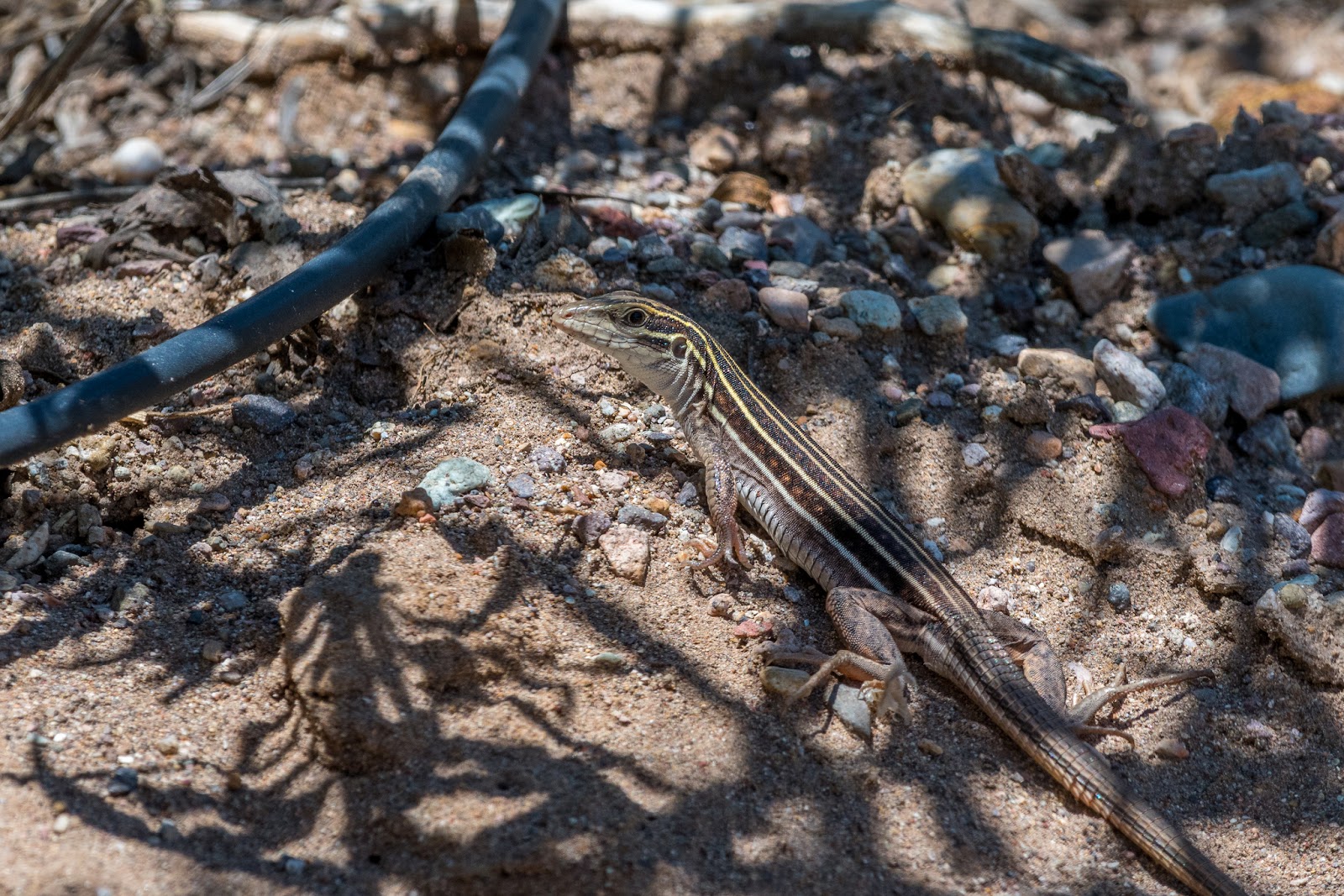
Male Greater Earless Lizard in Oro Valley, Arizona
My occasional encounters with snakes and lizards while chasing down birds ignited my interest in reptiles, or "scales and tails" as some might call them. Spending time in nature cultivating one interest naturally leads to interest in other forms of life inhabiting and adding variety to our earth. A recent trip to southeast Arizona with my adventurous friend Eric Peterson allowed both of us to enjoy a splendid mix of birds, reptiles, mammals, amphibians, landscapes, and healthy doses of Mexican food to keep our engines fueled.
The short flight from Salt Lake City to Tucson passed quickly. We picked up our rental car and drove to a Walmart to pick up a temporary cooler, ice, drinks, fruit, and some snack foods. From there we headed south toward our first destination, the Kubo Bed & Breakfast (B&B) in Madera Canyon. Whitehouse Canyon Road just below Madera Canyon is where we were able to locate one of my favorite bird species of the trip, a Varied Bunting. It was nice to get a colorful male for my first-ever sighting of this species.
Male Varied Bunting Santa Cruz County, Arizona
I captured several images of the male Varied Bunting perching on the hillside below us. The image below shows a little more of the coloring on the chest and offers a little more perspective on the relative size of the bird (about 5.5") since it wasn't cropped as much as the image above.
Male Varied Bunting Santa Cruz County, Arizona
Blue Grosbeaks are much more common in southeast Arizona than they are in Utah. We encountered several brightly colored males along Whitehouse Canyon Road.
Male Blue Grosbeak Santa Cruz County, Arizona
Eric spotted a neonate Western Diamondback Rattlesnake basking in the middle of the road as we drove along Whitehouse Canyon Road. Being new to the world it had just a single button for its rattle. It's difficult to see in this image, but it is just beyond the black and white banding of the tail.
Neonate Western Diamondback Rattlesnake Santa Cruz County, Arizona
I captured video of the small snake as it moved away from us and into the grass on the side of the road, all the while keeping a close eye on us. Some ants and insects crawling near the snake give a relative indication of the young snake's size. The quality of the video will be best when viewed at 720p or 1080p HD
Seeing Jack Rabbits in the deserts of the western states is still fun for this Kentucky boy even after living in Utah now for several decades. I captured this image to share the harsh reality of living in the wild. I've hosted a tick or two, for a day or two, as a result of playing in the woods, but this rabbit is hosting a colony of ticks and some of the blood-thirsty beasts look like they should have popped by now.
Tick-infested Black-tailed Jack Rabbit Santa Cruz County, Arizona
We saw over 30 species of birds without much effort as we spent some time around the Kubo B&B and drove up and down the canyon our first afternoon and evening. Magnificent and Broad-billed Hummingbirds, Bronzed Cowbirds, Sulpher-bellied Flycatchers, Hepatic Tanagers, Mexican Jays, Bridled Titmice, Painted Redstarts, and Yellow-eyed Junco were a few we do not see in northern Utah.
Here are two sides of a male Broad-billed Hummingbird frequenting the nectar feeders at the Santa Rita Lodge in Madera Canyon.
Male Broad-billed Hummingbird Madera Canyon, Arizona
Male Broad-billed Hummingbird Madera Canyon, Arizona
This Yellow-eyed Junco was going up and down the roadsides near our B&B collecting insects. I figured it was collecting those insects to take them back to a nest to feed young birds. Otherwise it would have consumed the bugs posthaste.
Yellow-eyed Junco Madera Canyon, Arizona
Nocturnal birding did not disappoint us after enjoying a nice dinner in Green Valley. We were able to hear Mexican Whip-poor-will calling at the top of Madera Canyon. We heard, saw, and photographed Whiskered Screech-Owls and then finished our nocturnal birding efforts with the world's smallest owl, the Elf Owl. This tiny owl is between 5 and 6 inches tall. They breed during the spring and summer months in Arizona and then head back to Mexico for the fall and winter.
Elf Owl Madera Canyon, Arizona
After we finished owling we visited with some gentlemen across the road from our B&B who were collecting insects that were drawn from the darkness of the night to bright lights suspended next to draped white sheets. Here's an image from my phone in case my explanation of their setup failed to create an appropriate image in your mind's eye.
As we were talking we caught a glimpse of a Ringtail (aka Ring-tailed Cat) that was climbing over a wood pile next to one of the lodges. It was my first time ever seeing one of those racoon-related mammals because they are elusive nocturnal critters. I was not prepared for the brief encounter so I have only the image in my head to remember that sighting.
After visiting with our temporary neighbors and before going to bed we had one last activity planned for our first day in southeast Arizona. We did some cruising along remote roads to look for snakes that were absorbing heat from the asphalt as the desert air was cooling. We found another Western Diamondback and captured some photos and video of the snake before safely removing it from the road.
Western Diamondback Rattlesnake Santa Cruz County, Arizona
The snake didn't want to be removed from the road so it warned us with its rattle. Here's a short video of the snake just before we moved it into a nearby field.
Little did we realize that on our way back to our B&B we'd have one more surprise. It was July. It was the rainy season. And it was high time for America's largest toad to be out looking for love. It's always fun to run across Sonoran Desert Toads during the rainy season since they spend much of the rest of the year hidden below the surface of the desert to avoid the arid heat. We spotted our toad in our headlights as it was hopping down the road. These toads can get up to 8" long and can weigh close to two pounds when full grown. They can secrete toxins from their skin to deter predators.
Sonoran Desert Toad Santa Cruz County, Arizona
Day one was a complete success in terms of the variety and number of encounters we had with critters of the southeast Arizona desert.
Day 2
After a good night's sleep I awoke early and went over to where the gentlemen were attracting bugs the night before to see if birds were taking advantage of the man-made insect buffet. The curiosity paid off. Sulpher-bellied Flycatchers were on the scene making their squeaky baby toy noise between eating bugs and perching in surrounding trees. Acorn Woodpeckers, Black-headed Grosbeaks, nuthatches, juncos, and an assortment of other bird species were feeding and calling from nearby perches. I particularly enjoyed seeing a Hepatic Tanager with its multicolored plumage. I captured an image of the tanager eating one of the bugs.
Hepatic Tanager Madera Canyon, Arizona
Just down the road from our B&B was the Santa Rita Lodge where Magnificent, Broad-billed, and other hummingbird species were taking advantage of nectar feeders. Mexican Jays, Acorn Woodpeckers, and doves were just a few of the species gorging themselves at the seed feeders. I don't have many images of Bronzed Cowbirds so I captured a couple for future reference and to share here. One image shows the ruff (thick neck feathers) just as the bird was relaxing the ruff from a full display of those feathers.
Bronzed Cowbird Madera Canyon, Arizona
Bronzed Cowbird Madera Canyon, Arizona
One of the Brown-headed Cowbirds caught my attention as I watched is at a feeder. The upper bill was overgrown and twisted, but that did not prevent the bird getting sufficient food. It turned out that this was just the first of two Brown-headed Cowbirds with elongated bills that we'd encounter during out trip.
Brown-headed Cowbird Madera Canyon, Arizona
Madera Canyon, Arizona
I stopped to capture the image to the left with my phone as I was driving down Madera Canyon because my boss in Utah thought I was crazy to spend a vacation in the 100+ degree heat in an Arizona desert. I told him we'd be spending a fair amount of time in the mountains where it was cooler, but we wasn't buying it. This probably isn't an image he had in mind when he thought of my Arizona trip.
Our destination for the end of day two was Beatty's Guest Ranch in Miller Canyon in the Huachuca Mountains. We planned to stop at The Paton Center for Birds in Patagonia on our way over to Miller Canyon, just outside of Sierra Vista.
As we were driving to Patagonia I was watching for raptors, hoping to pick up a Gray or Zone-tailed Hawk. What a pleasant surprise we had when we spotted an adult Gray Hawk perched on a power line along South River Road, just before we connected with and made our turn onto Highway 82 (Patagonia Highway). We had to drive past the hawk and do a u-turn to get back to it. This put the bird on the driver's side of the vehicle so Eric was able to get a few nice shots. The bird flew before I was able to capture an image, but I did manage a long-distance shot after the bird perched on the stump of a dead tree. The image has been deeply cropped to show a little more detail of the bird's field marks.
Adult Gray Hawk Santa Cruz County, Arizona
Gopher Snake Santa Cruz County, Arizona
We also came across a Gopher Snake that was crossing the road on our way to Patagonia. It put itself in a precarious position after we pulled over to take a look at it. We carefully pulled away without harming the snake and then watched it crawl to a safer place.
Some Black Vultures flew overhead just as we were about to continue our drive to Patagonia. I captured a couple of images for documentation purposes. Someday I'll get a closer shot of one of these vultures.
Black Vulture Santa Cruz County, Arizona
We found our target Violet-crowned Hummingbird rather quickly after arriving at the Paton Center for Birds in Patagonia. The lighting wasn't great, but this image will suffice until a future encounter.
Adult Violet-crowned Hummingbird Santa Cruz County, Arizona
I spent a little time looking for reptiles around the Paton Center. I initially thought the lizard below was a Desert Grassland Whiptail, but upon closer look I'm calling it a Sonoran Spotted Whiptail. I can see light spotting between the stripes on the back of the lizard. Grassland Whiptails shouldn't show those spots between the dorsal stripes. The ranges for both species overlap so attention to detail becomes necessary, especially for a novice "herper" like me. What's unique about Sonoran Spotted Whiptails is that every individual is a female (parthenogenetic). The offspring, from unfertilized eggs, are clones of the mother. Let's hope this doesn't develop among humans or men will become redundant. I prefer to remain a necessary component of the human equation.
Sonoran Spotted Whiptail Santa Cruz County, Arizona
We didn't stay at the Paton Center for long after getting our target hummingbird because we wanted to get over to Miller Canyon, where we would spend the night a Beatty's Guest Ranch. As we made our way to Miller Canyon we spotted a Zone-tailed Hawk. I had been scrutinizing every vulture-like bird I saw flying as Eric was driving us to our destination. I caught a quick glimpse of black and white tail bands on a particular large, dark raptor that was flying over an agricultural field and called out, "Zone-tailed Hawk" so Eric would slow down for a look. We did a u-turn and relocated the hawk and watched it course over fields in search of prey for a few minutes before it disappeared behind a hill.
We arrived at Beatty's Guest Ranch in the early afternoon. We met the owners, paid our fee for the night, and packed our gear up to our quarters. We stayed on the upper floor of the building to the far left of the phone image below.
Beatty's Guest Ranch Miller Canyon, Arizona
Here is a phone image I captured looking down the canyon from inside our lodge.
After dropping off our bags we took a short walk up to a shady hillside where we sat on benches while watching lots of hummingbirds visit a number of well-supplied nectar feeders. This area has controlled access so it can only be enjoyed by those who pay a small fee or stay at the lodge. We saw at least six species of hummingbirds there, but my favorite were Broad-billed and Magnificent.
Male Magnificent Hummingbird Cochise County, Arizona
Yarrow's Spiny Lizards were the lizard species of the hour during our lazy birding session at the nectar feeders.
Female Yarrow's Spiny Lizard Cochise County, Arizona
Male Yarrow's Spiny Lizard Cochise County, Arizona
We enjoyed our only Italian dinner of the trip in Sierra Vista with Eric's friend Jan. They became acquainted years ago as members of the Doberman Pinshcer Club of America.
Always the birders, we did what we could to locate owls, poorwills, and whip-poor-wills as we made a slow drive up the dark canyon to our lodge. It's not much to look at, but below is an image I captured with my phone when a bio luminescent Glowing Click Beetle landed on Eric's shirt. The beetle has two spots from which it controls the intensity of its luminescence. Google that beetle name and you'll be able to see and learn more about the unique beetle. We saw a number of them flying along the road that night.
We heard an Elf Owl and got visuals of several Whiskered Screech-owls along the upper end of the canyon. We'll close out this post as we did that evening with a couple of images of a Whiskered Screech-Owl.
Whiskered Screech-Owl Cochise County, Arizona
Whiskered Screech-Owl Cochise County, Arizona
We finished Day 2 feeling like we'd had another successful day. As is often the case in the canyons of southeast Arizona during the monsoon season a clamorous and productive rain storm blew through during the evening. I rather enjoyed the storm knowing I was safe and dry for the night. I could only imagine what we'd experience during the remaining four days of our trip as I recalled the events of the first two days before drifting off to sleep. More to come in my next few posts.
I found my very first Elf Owl, the smallest owl in the world, during one of the trips my wife and I took to Mesa, Arizona. I had looked forward to finding one for some time before we made our first trip to Mesa during the breeding season. We were visiting with my daughter and her family. I checked my Birdseye app for where Elf Owls were being seen in Maricopa County and a place called Coon Bluff Recreation Area was showing recent sightings. My daughter shares my spirit of adventure so the two of us left her husband, my wife, and their baby boy at home and explored along Coon Bluff Road one evening after dark. We heard Elf Owls, but we didn't see them before we needed to return home. I returned the next night in a solo effort and was able to photograph the first one I ever saw. You can read the stories and see the images of that sighting and other really cool dessert birds from that spring trip by clicking here.
I'll keep the narrative short on this post and focus on the images from a recent evening on Coon Bluff Road as well as some fun images of Burrowing Owls I check on during each visit to Gilbert, Arizona.
Elf Owls are about 5 1/2 inches tall with a wingspan of about 13 inches. They nest and roost in tree cavities and forage primarily for insects at night. They have no problem preying on scorpions. They love the cavities in Saguaros. They breed during the spring and summer months in southern parts of Arizona and New Mexico, west Texas, and northern parts of Mexico. They migrate farther south during winter months.
Elf Owl on Coon Bluff Road Near Mesa, AZ
Elf Owl on Coon Bluff Road Near Mesa, AZ
Elf Owl on Coon Bluff Road Near Mesa, AZ
Elf Owl on Coon Bluff Road Near Mesa, AZ
Elf Owl on Coon Bluff Road Near Mesa, AZ
I heard a couple of Western Screech Owls calling when I first parked my care on Coon Bluff Road, but my target bird was the Elf Owl. After some one on one time with the Elf Owl I followed the sound of a singing Western Screech Owl. I located that owl and captured the image below.
Western Screech Owl on Coon Bluff Road Near Mesa, AZ
As I was leaving the area to return home I noticed what reminded me of the Bull Frogs I used to see often while growing up in Kentucky. I pulled over and was surprised to see what looked like a wet frog in the middle of a dry desert. Toads, not frogs, live in deserts so it had to be some sort of toad. I captured the images below and then went home to search the Internet for its identity. I discovered that it is a Sonoran Desert Toad. They are active at night and breed during June and July. They are one of the largest toads in North America (about 7 inches long), have white rather than dark throats like most toads, and have large paratoid glands behind their eyes which secret poison as a defense mechanism. Their poison could cause death to a dog if the dog picked it up by it mouth. Click here for a link to more information on these toads from the Arizona-Sonora Desert Museum web site.
Sonoran Desert Toad on Coon Bluff Road Near Mesa, AZ
Sonoran Desert Toad on Coon Bluff Road Near Mesa, AZ
Sonoran Desert Toad on Coon Bluff Road Near Mesa, AZ
Finally, I found seven Burrowing Owls at my regular spot in Gilbert. I check on this burrow site every time I visit Gilbert. I would love to hear some of the captions you would create for these personality-filled birds. Please free to share your suggested captions for what some of these owls could be thinking or doing as they stretch, scratch, sniff, and roll their heads.