Showing posts with label Desert Horned Lizard. Show all posts

Tuesday, July 10, 2018

Up Close With Horns and Collars

The morning sun was warming up the eastern edge of the Great Basin Desert as I turned off the pavement and onto a dusty gravel road that would lead me several miles to the base of a rocky hillside with sparse vegetation.  I had studied Google Maps to pinpoint an area that looked promising for Great Basin Collared Lizards and was on my way to check it out. I was anxious to begin my search so I was moving along at a steady clip.  A a cloud of dust was trailing behind me until I caught a glimpse of a tiny anomaly on the surface of the path ahead. I recognized the shape as a Desert Horned Lizard just in time to ensure that my tires straddled it as I passed over and attempted an abrupt, but safe, stop. After the cloud of dust dissipated a glance at the rear view mirror confirmed that the lizard was still safe and sound in its original position. A spontaneous expression of "Happy day!" escaped my lips as I approached the tiny, modern-day dinosaur. It's always a good day when you encounter a horned lizard.

I moved the lizard to a safer place and captured some images with both the Nikkor 200-500mm and the Micro Nikkor 105mm (macro) lenses. The armor of these guys is fascinating if you really take the time to examine it.


The macro lens allowed me to capture some of the finer details of its natural body armor. The images that result from the macro lens give the five-inch lizard the appearance of a larger and fierce creature. In reality, they are small and quite docile, even sluggish. When threatened they may attempt to lay low and blend in with their surroundings, sometimes half burying themselves in sand, or make a quick but short dash to nearby vegetation where they remain motionless, again hoping to blend in with their surroundings.


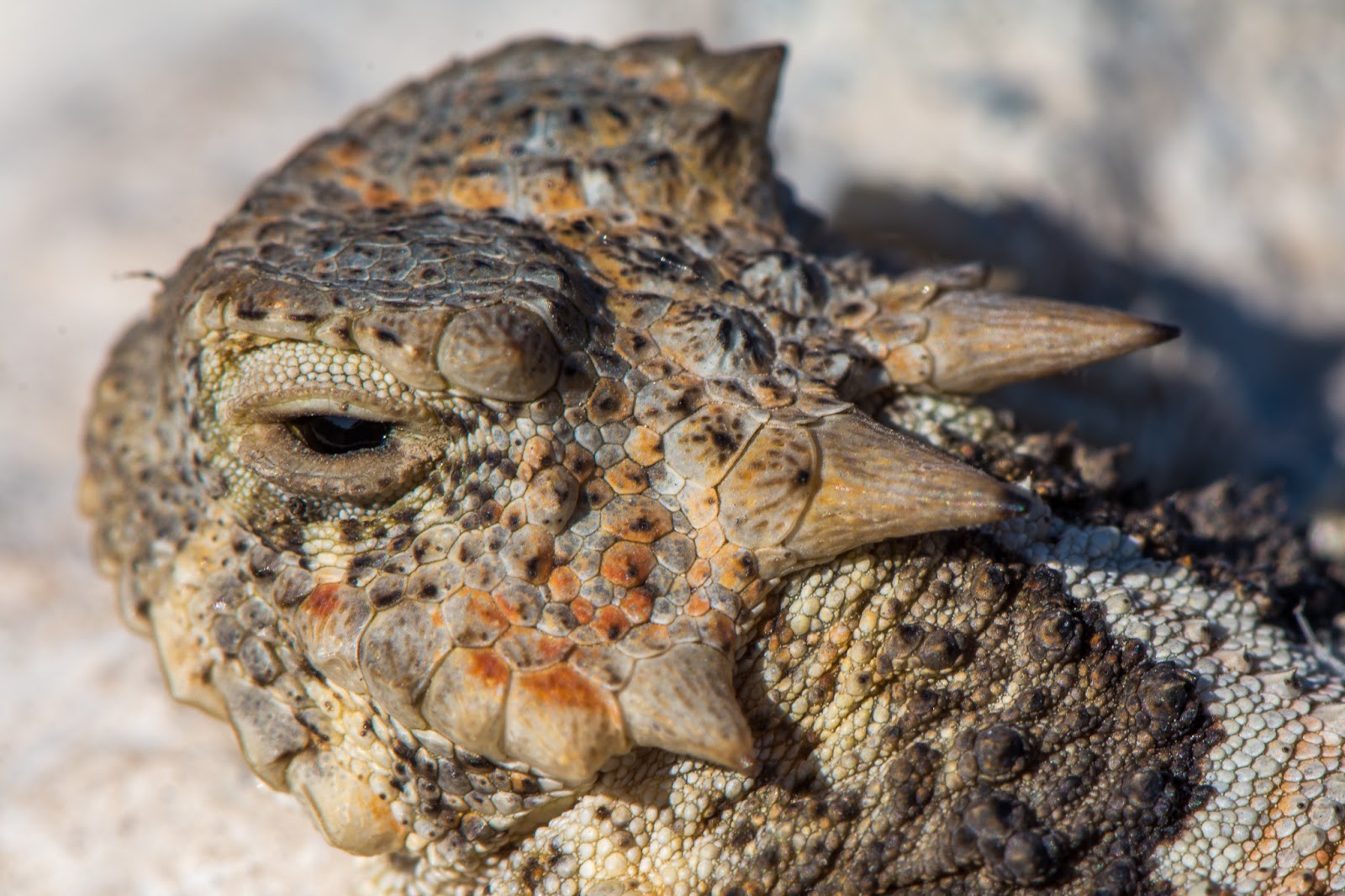

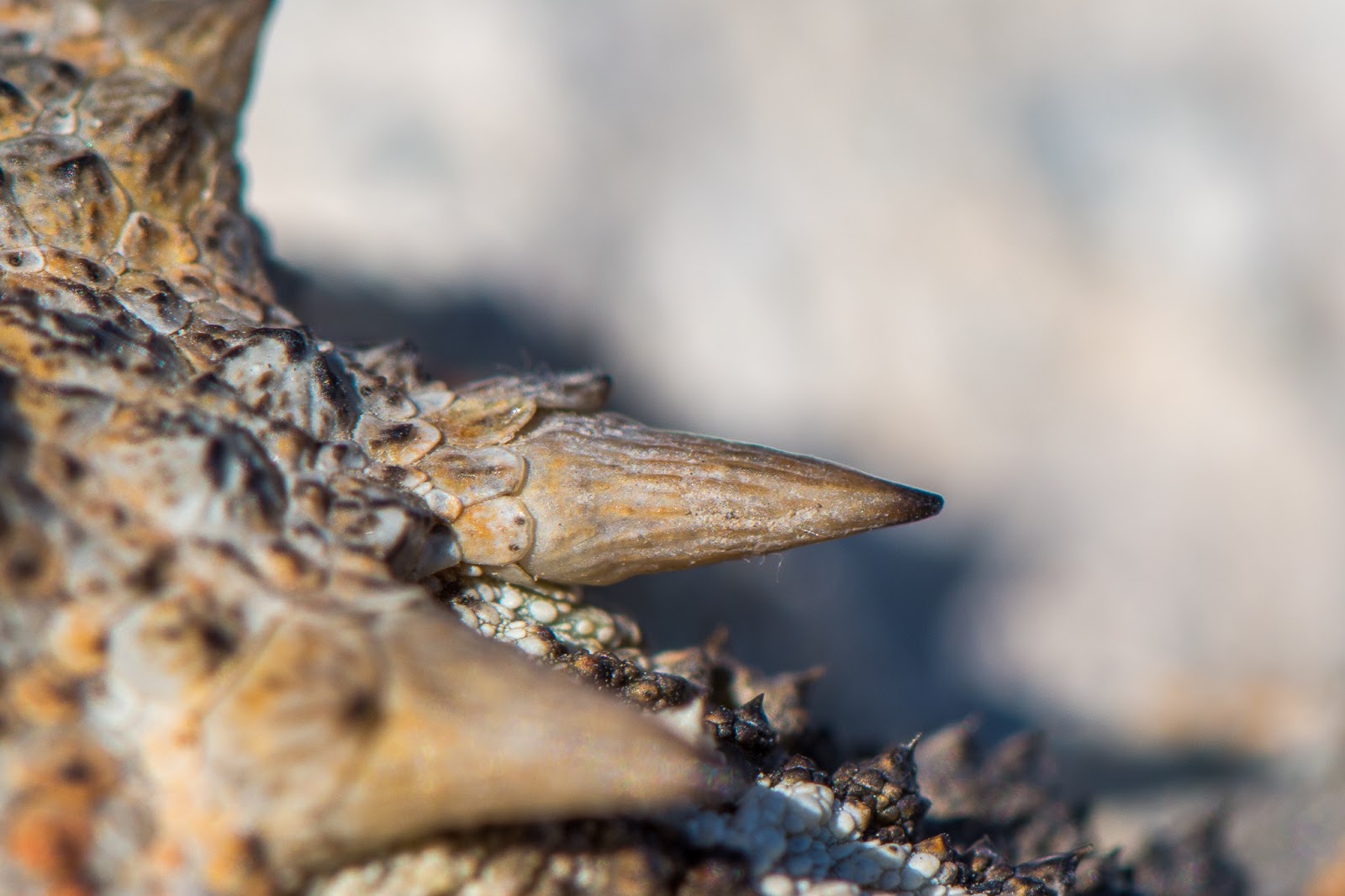
Here is detail of one of the two longest occipital  horns.

And another head shot, this time from beneath the blunt snout. If you were an ant, the primary component of the horned lizard diet, you'd be concerned if you looked up and had this in your view.


The shapes of thorns, warts, and granular scales mix with varied colors in this image of the left side of the lizard's back. The colors often vary from one individual to another as they tend to match the common colors of their local environment.


The image below shows the keeled scales protecting the forearm and the lateral row of shark-tooth-like scales that are found on both sides of the lizard.


Shortly after leaving the Desert Horned Lizard I arrived at the base of the rocky hillside I pinpointed on Google Earth. I've been told by a paleontologist friend that these rocks are from the Middle Cambrian period so they are believed to be over 500 million years old.


Here is another image I captured later that morning at another location I explored. Both of these images show typical habitat for the Great Basin Collared Lizard in northern Utah.


The first collared lizard of the day was small and blended in quite well with its limestone surroundings. A small cluster of tiny red mites can be seen between the base of the tail and the left hind leg. I later came to understand that it is common for mites to ride along on these lizards.


This female, the most striking lizard of the morning, displayed some nice orange striping as it basked on the top of a small mound of lichen-covered rocks. Typically, the females are less colorful than their male counterparts, but they develop the bright orange stripes during breeding season.


She was quite cooperative even after eventually moving to the top of another rock.


This male's collars were accentuated with white/creamy contrasting lines and a bluish tint on the neck, shoulders, and back.


The males varied in appearance. This one lacked the bluish coloring and had a couple of dark lines on the upper back and more fine white spotting than the one above, which appeared to have more of darker spots on a light base. Many males show the faint vertical line that can barely be seen running down the top of part of the tail.


This image provides a nice look at the large head and strong jaw structure of the collared lizard.


Several clumps of mites were seen on the should of this guy, along with a small group in the ear.


I really enjoyed see the results of these head shots. So much detail in the eye and and face were captured, including my faint reflection in the pupil.


I captured the following images when I realized that this individual was shedding old skin for a newer, brighter look.


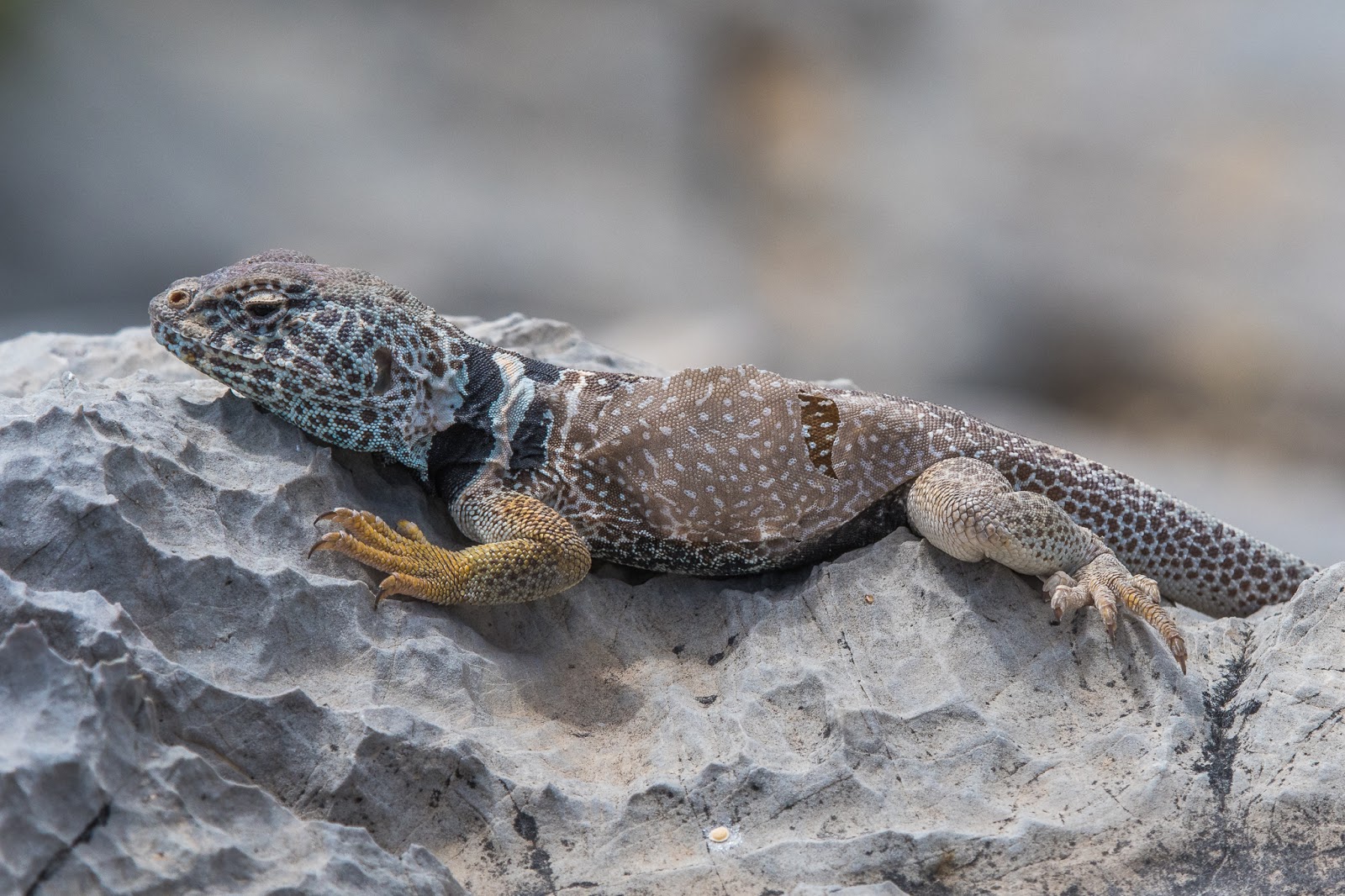
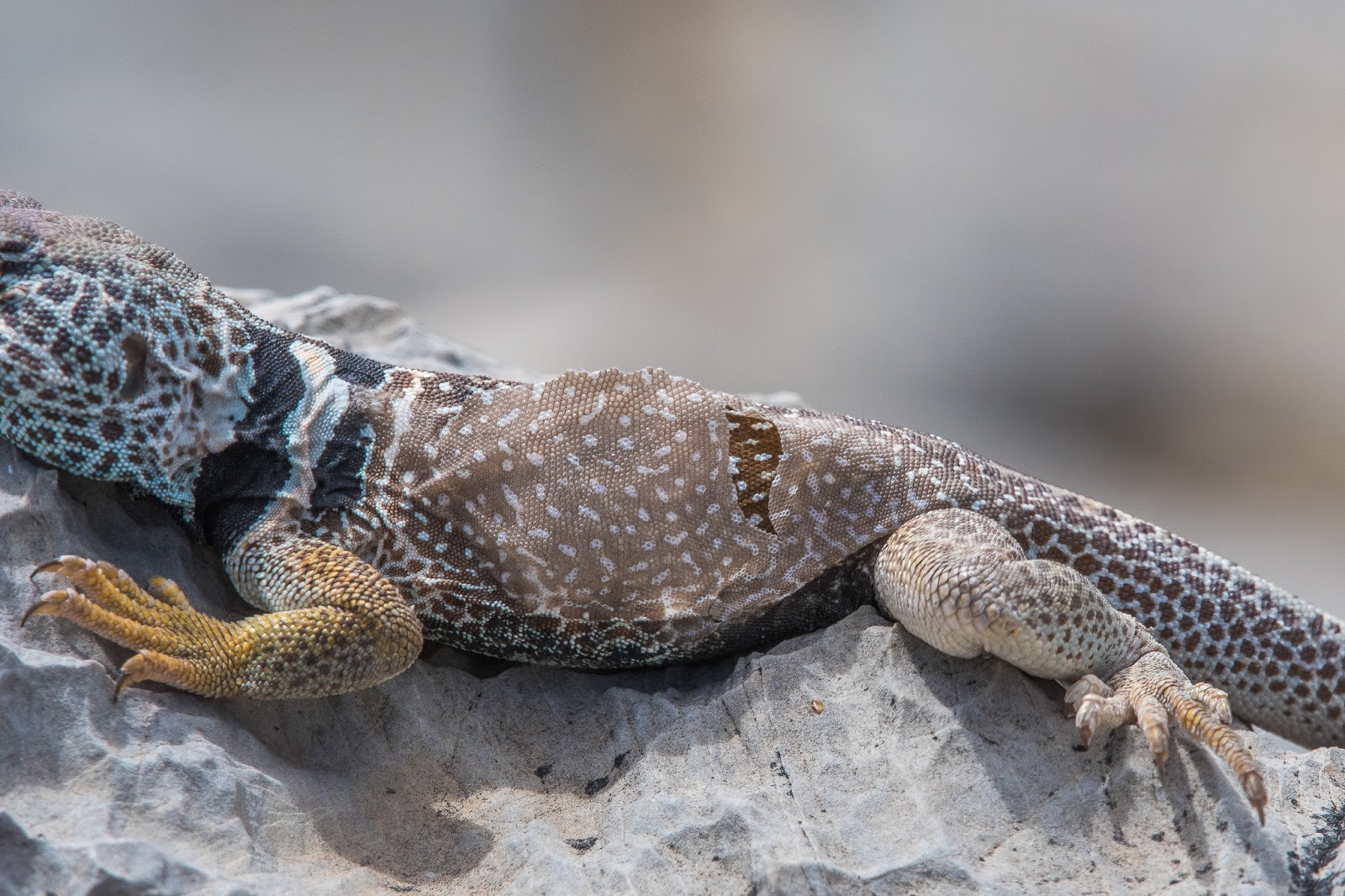

These collared lizards are about 4 1/2 inches from snout to vent and their tails can add another 7 or more inches to their total length. They tolerate higher temperatures than most lizards in their territories. They use their speed to secure prey that primarily consists of arthropods but also includes some vegetation and even smaller lizards.

I eventually made several trips to various locations to document Great Basin Collared Lizards. During that process I enjoyed the accidental discovery of some unique bird nests. One of those nests was occupied by an elusive nocturnal bird, a Common Poorwill. I'll be putting together a post to share progressive images of the Poorwill nest site in the next few days. It was a rare opportunity to follow and document that progression with images from eggs to hatchlings to fledglings.

Saturday, December 30, 2017

Labor Day Lizards, Bugs, and Public Lands

This post should have been published back in September. Somehow I started but never finished it. I hope it is better late than never.

Labor Day weekend reminded me of why I love living in northern Utah. I had Saturday and Monday mornings to spend off the beaten path hunting down lizards and 4-wheeling on some hillsides in our local desert. I had just returned from a trip to Kentucky where most of the land is privately owned. Don't get me wrong. I love my home state of Kentucky, but I have grown very fond of and come to treasure the vast expanse of public lands here in the west. I have a wandering spirit that needs to roam, explore, and discover. Venturing into public lands here in Utah is medicine for my soul, a needed charge to my batteries. It's ironic, but exploring the arid deserts of the west quenches my thirst for exploring and discovering.

I spent Saturday morning exploring Soldiers Pass and the sagebrush-juniper habitat around the south end of Lake Mountain in Utah County. Below is an image showing the view from the summit of Solders Pass looking east toward the south end of Utah Lake.


Heading west on Soldiers Pass Road.


A few side-blotched and sagebrush lizards were out soaking up the sun as I hiked along a rocky ridge, but this robber (aka assassin) fly caught my attention for a few minutes. This is one of nature's aerial fighting machines. They often ambush and take out other flying insects midair.


This image of a male common side-blotched lizard was captured with my long lens.


The following video and images were captured using my phone after I managed to snag a few lizards.


My target lizard for the day was Desert Horned. I essentially gave up on finding one after scouring several ideal locations and coming up empty. I called my wife to let her know I was on my way home and began to drive down a gravel road toward a paved highway. Thanks to a little luck in terms of timing and my 20-15 vision I noticed a small creature scurrying across the path ahead of me. I had second thoughts when I initially ignored my impulse to stop, go back, and check it out. My curiosity had to be satisfied so I pulled off to the side of the road and walked back to search for the creature of interest. The tiny creature turned out to be a young Desert Horned Lizard and fortunately for me it was having trouble scaling the loose dirt that formed a steep climb along that side of the road. This phone image provides some perspective on the size of the lizard.


I captured a few images using my long lens as the lizard explored the bed of my truck.


And a couple of images after returning the diminutive dinosaur back to its natural habitat.


Labor Day morning was spent around an area called Chimney Rock Pass.


Chimney Rock Pass proved more productive in terms of the number of lizards I ran across.


The best lizard discovery turned out to be a Western Fence Lizard that was sunning on a lichen-covered boulder. This one was about seven inches long.


Another stop along a dirt road on the west shore of Utah Lake turned up a few Whiptails, bees, and dragonflies. I believe the dragonfly is some type of meadowhawk.


I felt like I had been on a safari without going very far from home as the holiday weekend came to a close.