Introduction to this Post:
It's way late for me to be publishing this post since it is part three of six days spent in Southeast Arizona last July. Click here for Part 1 of that trip and here for Part 2 of that trip if you want to get the full report of the trip. We encountered so many fascinating creatures during the trip.
Anyway...
Day 4 (July 25th)
I started day four on my own. Eric was between rounds of chemotherapy during our trip so he needed to pace himself and recharge appropriately to manage his energy levels. The sunrise was vibrant following the rains that poured through the night before. The phone image doesn't really do justice to what I was able to observe that morning.
I drove around a few locations hoping to find some Scaled Quail and a rare Painted Bunting that had been reported near Portal in recent days. I didn't have luck with either of those species, but I did find quite a few Botteri's Sparrows, another life bird for the trip. A couple of roadrunners were also getting an early start on the day as I headed back to the lodge to pick up Eric.
Shortly after picking up Eric and cruising along Stateline Road we located a small covey of Scaled Quail.
Scaled Quail Cochise County, Arizona, USA
Scaled Quail Cochise County, Arizona, USA
We enjoyed the landscapes that morning as the sun brought them to light. The Chiricahua Mountains were never far away.
After spending a little time with the Scaled Quail we made our way over to Cave Creek Canyon where I captured this panoramic image with my phone before entering the canyon.
A local birder was kind enough to point us toward a Whiskered Screech-owl roost where we had our first daylight views of the species.
Whiskered Screech-Owl Cochise County, Arizona, USA
I got my first views and images of an Elegant Trogon in the canyon as well. I had a terrible vantage point (directly below), rain was falling, and the sky was gray, but I captured what I could for that life bird experience.
Elegant Trogon Cochise County, Arizona, USA
I watched it catch and eat what appeared to be a beetle.
Elegant Trogon Cochise County, Arizona, USA
Here is an image with a brighter exposure to show a little more detail of the beetle for the entomologists who care to identify it to a species level.
Elegant Trogon Cochise County, Arizona, USA
We returned to the lodge for lunch and to allow Eric to rest a little more. I went out for a short look after the rain stopped and turned up a few more images of the Trogon and a Roadrunner.
Elegant Trogon Cochise County, Arizona, USA
Elegant Trogon Cochise County, Arizona, USA
We were invited to a private residence during the afternoon hours where we were treated to both male and female Lucifer Hummingbirds. It was pretty exciting to see both the male and female for a species I was seeing for the first time in my life.
Female Lucifer Hummingbird Cochise County, Arizona, USA
Male Lucifer Hummingbird Cochise County, Arizona, USA
Broad-billed Hummingbirds were also visiting the feeders at the residence.
Broad-billed Hummingbird Cochise County, Arizona, USA
Broad-billed Hummingbird Chochise County, Arizona, USA
We discovered a Desert Box Turtle in the road on our way back to the lodge.
Desert Box Turtle Cochise County, Arizona, USA
Day 5 (July 26th)
The highlight during day five of our trip to Southeast Arizona came while we were standing on a ridge on Mount Lemon. A zone-tailed Hawk put on a show for us. I was getting used to a new lens so I was a little disappointed with the soft results of this fascinating raptor in flight, but here is one image from that unforgettable experience.
Zone-tailed Hawk Mount Lemon, Arizona, USA
We checked into a hotel in Oro Valley that evening. Wind and rain put a damper on our owling plans for the evening so we spent time checking in with our wives by phone.
The Final Morning (July 27th)
We started the morning of our last day at Catalina State Park. The sun was up quickly and the heat began to take a toll on Eric so he asked me to take him back to the hotel. When I returned to the park I put most of my attention toward reptiles and took the birds as they came along the way.
Desert Spiny and Greater Earless were by far the most common species I found that morning.
Desert Spiny Lizard (Orange-headed Subspecies) Oro Valley, Arizona, USA
The female Greater Earless Lizard below appears to be gravid ("pregnant" for lizards).
Female Greater Earless Lizard Oro Valley, Arizona, USA
Male Greater Earless Lizard Oro Valley, Arizona, USA
Male Greater Earless Lizard Oro Valley, Arizona, USA
Male Greater Earless Lizard Oro Valley, Arizona, USA
As I was leaving the park I noticed a long reddish snake crossing the wash about 50 feet ahead. I captured the image below just as it was entering a brushy area. I did this simply for documentation purposes so I could try to identify it later.
Fortunately, I was able to relocate the snake momentarily as it put its head up from a hiding place. I referred to my reptile guide later to confirm it was a Coachwhip.
Another snake I observed in the wash was a California Kingsnake.
One lizard I discovered before leaving the park was a new one for me, a Regal Horned Lizard. These guys are about 4 inches long with a dainty tail included and blend in with their habitat quite well. I found this one only because it moved as I was walking along a trail.
Regal Horned Lizard Oro Valley, Arizona, USA
Regal Horned Lizard Oro Valley, Arizona, USA
Regal Horned Lizard Oro Valley, Arizona, USA
Several Great Horned Owls flushed from a tree and landed on nearby rocks as I made my way along a trail.
Prairie Dogs were common in the grassy areas of Catalina State Park.
I had only a couple of hours in Catalina State Park. I'm sure there was much more to discover, but it was finally time to head back to the hotel to prepare for a drive to the airport and our return flight. It was a fantastic trip that provided unique experiences I will remember for years to come. My curiosity for reptiles was satisfied enough to make me want to learn more. I am eager to explore and learn more about the reptiles of the American Southwest. I can't wait for another adventure in the varied habitats of the Sonoran Desert.
Great Gray Owl just before the rays of the sun hit the valley in which it was hunting in Morgan County, Utah
Northern Utah Birders have been graced by the visit of two vagrant Great Gray Owls in recent weeks. Apparently harsh winter conditions in Wyoming and other northern states have driven these owls to more southern locations. The last documented sighting of a Great Gray Owl in Utah was way back in 1989 so naturally the recent reports had Utah birders scrambling from all over the state to the Great Gray epicenters in Wasatch and Morgan Counties. The Wasatch County owl went missing almost as quickly as it was reported, but not before some documentary photos were captured by local residents. Most birders missed seeing that owl. My friend Eric Peterson and I came up empty when we searched for it. We consoled ourselves while searching for that owl by reliving the experiences we had last year when we went to see our first-ever Great Gray Owls in Tetonia, Idaho--a five hour drive to the north from our home towns. Click this link to read about our encounter with Great Grays in the shadows of the Grand Tetons.
Last week reports of a Great Gray Owl in Morgan County were shared with the local birding community. A large number of Utah birders were able to see that owl because it was a gentle giant that seemed to ignore all the onlookers. I was able to see that owl last week through a scope and binoculars as it perched on a hillside about 120 yards away. I enjoyed a nice visit with one of my sons as we drove just over an hour north to see that gorgeous bird.
Well, my friend Eric wanted to search for the bird so we decided to head up yesterday morning before I had to got to work for meetings. The bird had been searched for and missed for two days prior to our trip so we had our fingers crossed that the attention being showered on it hadn't pushed it to more remote hunting grounds. We suspected the owl would be most active in the early morning hours if it was still in the area since that was our experience with the Idaho owls we had observed the year before. We arrived in the area just before sunrise and cruised around the area in a methodical manner. We were coming up empty and began to wonder if the bird had moved on. To our delight, Eric spotted the owl on a fence when he looked for cross traffic as he approached a stop sign. We were like little kids in a candy store grinning ear to ear when we realized we were having a close encounter with such a gorgeous bird. We used our vehicle as a blind as we observed and photographed one of North America's tallest owl species (nearly 27" tall, 5" taller than Great Horned Owls).
Great Gray Owl Morgan County, Utah
We pulled off the road to the right shoulder, opposite the side of the road the bird was on, so we would not block traffic. It became apparent rather quickly that the owl had very little interest in or concern for us as we sat in our vehicle. We watched as the owl focused its attention toward the snow-covered ground. It would move its head from side to side and occasionally stare in one direction, likely listening intently for the sound of a rodent moving beneath the snow.
Great Gray Owl Morgan County, Utah
The owl moved from one post to another to look and listen for snow-tunneling prey. At one point the owl went down to the ground. We were pulling for it to secure some prey, but...
Great Gray Owl Morgan County, Utah
After a minute or so the owl rose up from the snow and returned to its perch without having prey in its talons.
Great Gray Owl Morgan County, Utah
Great Gray Owl Returning to it Hunting Perch in Morgan County, Utah
Several local residents drove their vehicles between us and the owl while we continued to watch from the other side of the street. One passerby stopped, rolled down a window, and took photos or video of the owl with a phone. The owl essentially ignored them.
Below are a few other images captured during our moment in time with the extremely rare Utah visitor.
Great Gray Owl Morgan County, Utah
Great Gray Owl Morgan County, Utah
Great Gray Owl Morgan County, Utah
True to observations Eric and I made last winter with Great Gray Owls in Idaho this owl flew up to what would turn out to be its daytime roost about an hour after the sun rose on the valley.
Great Gray Owl Roosting in Morgan County, Utah
It may sound strange to some, but I always say thank you aloud or to myself after memorable encounters with fascinating creatures like the Great Gray Owl.
I'll finish off by sharing a short video clip of the owl. I wasn't planning to shoot video so I did not have my tripod to steady the lens while zoomed to about 700mm (500mm with a crop sensor). The video is a little shaky and under exposed so I have a little practicing I need to do for low-light video capturing.
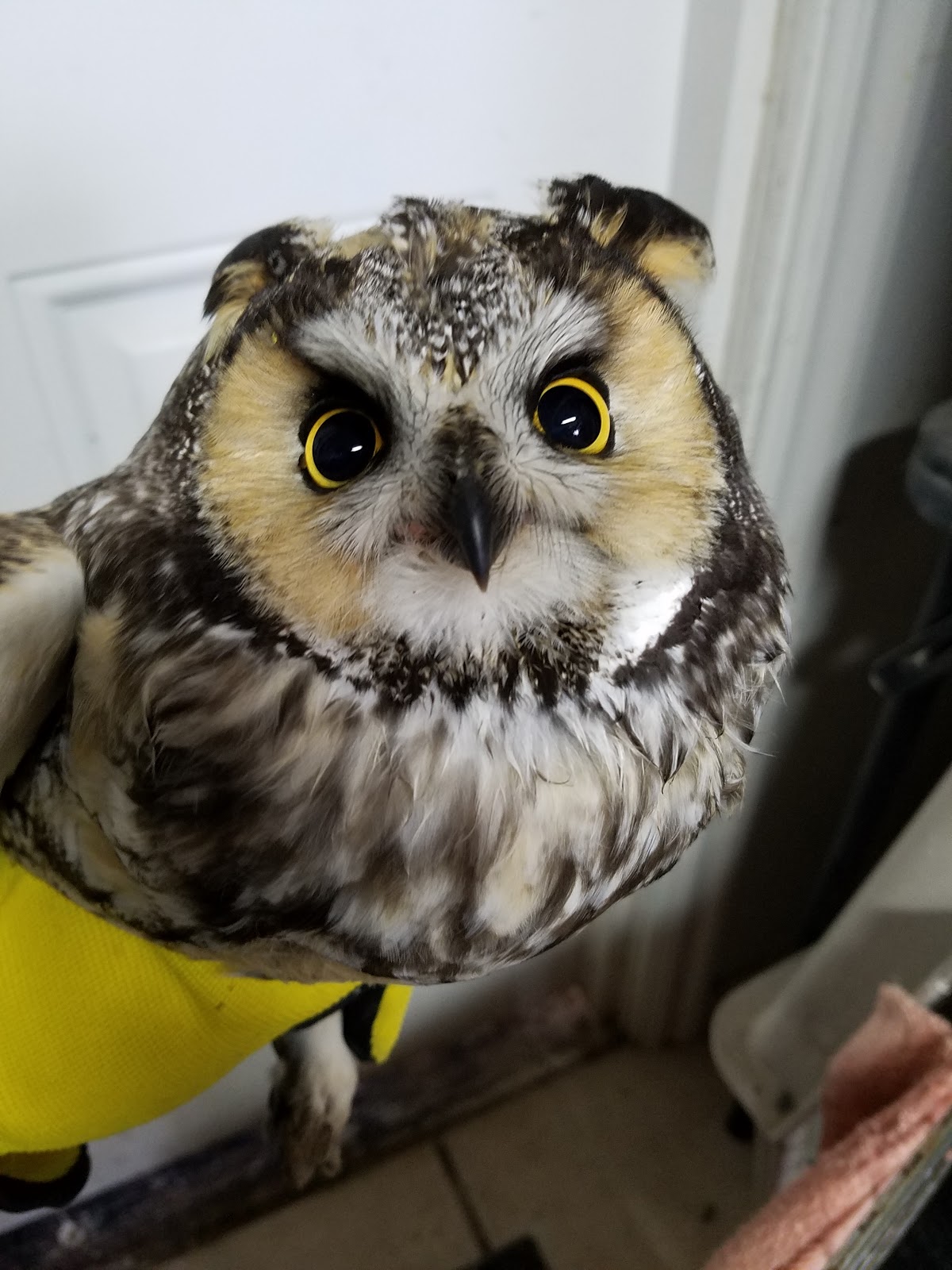
I was looking for raptors in some of my favorite winter birding locations a couple of weeks ago when I noticed several ravens gathered around something that appeared half buried in deep snow near the road ahead. The ravens flew from the scene as my truck approached so I naturally wondered what caused the them to gather at that particular spot. I glanced sideways as I drove by at normal speed and was quite surprised when I realized I was making eye contact with a Long-eared Owl. The image of a petite owl face with those long "ear" tufts is still visible in my mind's eye weeks after the encounter. I drove to where I could make a u-turn and then returned to the owl's location. A gentleman in another vehicle pulled up next to the owl right in front of me. It turned out that he had discovered the owl earlier. He had made some calls to ask friends what he should do. They advised him to wrap the owl in a blanket and take it to a wildlife rescue faciliy so he had just returned from buying an inexpensive fleece blanket at a local store.
As I assessed the situation I figured the owl must have collided with a car or clipped a nearby barbed wire fence as it was hunting or flying low to the ground the night before. Long-eared Owls are generally nocturnal. However, the harsh winter conditions with heavy snowfall we'd been experiencing may have forced the owl to hunt during twilight hours in order to consume enough food. It's difficult to determine how long the owl had been injured. I captured a few images of the owl before actually attempting to secure it in the blanket. It became apparent that the bird's left wing had suffered a major injury near the wrist. You can see some blood at the wrist of the bird's left wing below.
The owl began snapping its bill as I approached so I knew it was feeling threatened. We gently covered the owl's head with the blanket to help keep it calm. I then tucked and wrapped the wings to secure them. I left the blanket loose enough to allow the owl to breath comfortably. Once secured I put the owl in the floorboard on the passenger's side of my Tacoma.
I called my wife to let her know I had an injured Long-eared Owl in tow and was going to take it to Great Basin Wildlife Rescue in Mapleton, Utah. My Saturday morning errands took a back seat to the owl in the front seat, so to speak.
Soon after arriving at Great Basin I assisted the rehabilitator with some triage care. She checked the owl's crop and general condition. Beyond the injured wing, the owl appeared to be healthy. We gave the owl some meat combined with an anti-inflammatory.
I continued to hold the owl in my left hand as the rehabilitator cleaned the wound area. I captured some video of this process with my phone in my right hand. Be sure to watch the video in HD for best resolution.
Finally, the injured wing was wrapped to prevent movement that might result in further injury.
I began to have a real interest in the owl's healing process after helping with the initial care. I imagined how thrilling it would be to release the owl back into the wild once it had healed sufficiently.
The rehabilitator told me she would arrange for a veterinarian to do an x-ray to determine whether or not the wound could be effectively treated. If the break was in the joint it would likely mean the bird would never fly. And because Long-eared Owl's have more of a wild, high-strung temperament than many other raptors they do not make good candidates for educational birds. They do not like to be handled and get anxious when approached by humans so they don't make good candidates for a static display--they'd likely get anxious and agitated each time someone tried to feed them. In other words, if the bird cannot fly and live on its own it would likely end up being euthanized. That is not the outcome anyone wants for such an amazing creature.
I took one last photo with my phone and then placed the bird inside a kennel with hopes of seeing it again in a healthier state.
About a week after taking the owl in for treatment I was in Montreal, Quebec on a business trip. I made a call to check on the owl's condition and was excited to learn that only a single bone was broken and that there was hope the bird would be able to recover and fly again. I was told to check back in another week to see how things were healing. I'm looking forward to that next check up.