Saturday, January 31, 2015

Can't Sleep? Go Look For Owls

I had the chance to sleep in this morning, but my internal clock didn't care that it was Saturday. I tossed in bed a bit and then decided to use the early morning hours to look for an owl species I hadn't seen since last summer. While my most normal people were sleeping in their warm beds I drove to a nearby canyon and began to call for a Northern Saw-whet Owl. The area was perfect habitat for the species, but I wondered if the mild northern Utah winter allowed the tiny owls to stay higher in the mountains. I was delighted when a Saw-whet responded almost immediately to my call. Standing alone in the dark I looked in the direction of the call. I saw the silhouette of the owl as it flew across the moonlit sky above me. I followed the silhouette and relocated the owl as it gave its "toot, toot, toot..." call from its perch slightly down the hillside from me. I quietly moved down the hillside until I was able to see the silhouette on a large branch above me.


Saw-whets are about eight inches tall and are strictly nocturnal. They feed most actively just after dark and just before dawn. Knowing that Saw-whets are meat eaters I began to wonder if Screech-owls and Saw-whets shared territories. I wondered about this because Screech-owls are about the same size and also eat meat. My brief wondering came to an end when I heard a Screech-owl start calling from some trees just twenty feet away from where I just encountered the Saw-whet. I focused my attention on Screech-owl and listened to it call for several minutes.

I didn't get a photo of the Screech-owl this morning, but I did capture an image of a Screech-owl in the same area a month or so ago. The Screech-owl was a bit more camera friendly and allowed a much closer approach.


As I was about to leave the area to head home I heard the faint call of a Great Horned Owl coming down from the hillside up the canyon above me. I walked up the canyon to get closer to the owl. I then realized that a pair of owls were calling to each other. It is mating season, after all, for the Great Horned Owls. I was feeling quite fortunate after encountering three owl species within an hour, an hour during which most normal people in the state of Utah were sleeping.

Thursday, January 1, 2015

A Treasure Among Juncos: Female Slate-colored

My last post highlighted the Pink-sided variety of Dark-eyed Juncos because I was intrigued by the soft coloring of that subspecies as a few foraged beneath my backyard feeders in the freshly fallen Christmas Day snow. As I continued my Junco treasure hunt from the warmth of my kitchen I noticed one bird that stood out a little from the others. The tiny little bird lacked the definite hood of the other Juncos and the coloring on the sides was mostly gray with slight touches of brown. The color of the sides matched the color of the head and chest. I studied the bird for a while and referenced a few field guides before identifying it as a female Slate-colored Junco.


Monday, December 29, 2014

Steppin' Out For Juncos of the Pink-Sided Sort

I enjoy watching birds visit my backyard feeders during the winter, especially after freshly fallen snow has blanketed the ground and the feeders present easy pickins for hungry birds. Woodpeckers and chickadees like the suet feeder while Lesser and American Goldfinches prefer the sock feeders loaded with thistle seeds. House Finches, House Sparrows, doves, Scrub-jays, and Magpies gravitate toward the feeders with larger seeds and nuts. They tend to take what they want and toss to the ground below what they don't want. Robins and Cedar Waxwings enjoy the fruit of the flowering pear and choke cherry trees around the yard. While most bird species are feeding at the hanging feeders and in the trees there are small birds scurrying around on the ground beneath the feeders. I jokingly refer to them as the bottom feeders, but in truth I find this little group to be quite interesting because they present a bit of a small bird treasure hunt. While they may appear to all be the same at first glance there are subspecies among this group of birds called Dark-eyed Juncos. The subspecies typically seen where I live in northern Utah are primarily Oregon with a dash of Pink-sided. Even less common than Pink-sided is the Slate-colored. Continuing in a much less common direction we sometimes see Cassiar, a subspecies that has the appearance of an Oregon by Slate-colored mix. During one hard winter we actually had a few Gray-headed move down from our mountains to the valleys and our backyard.

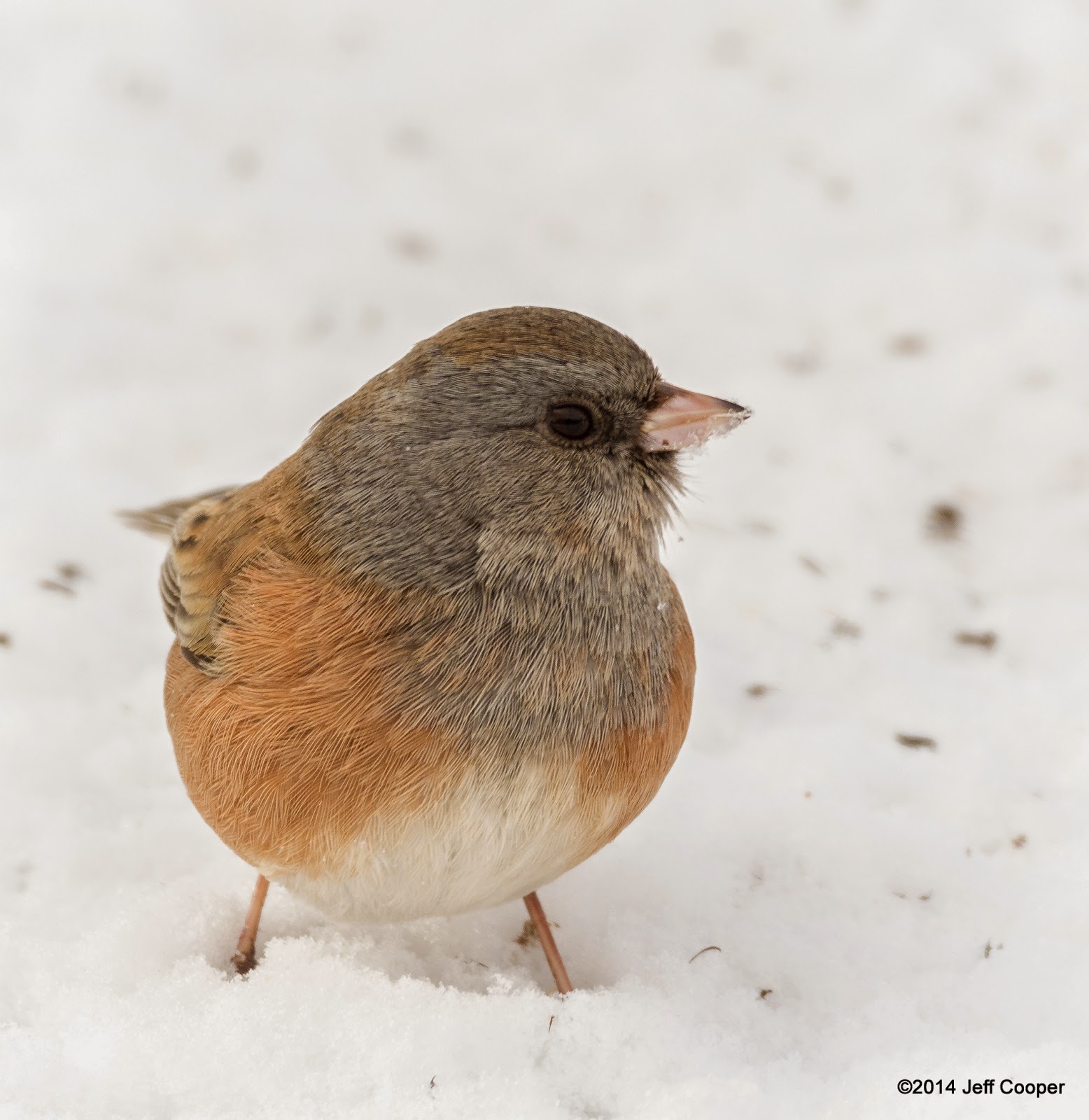
Well we got our first snow fall to speak of on Christmas Day so the feeders were swarming with birds the day after Christmas. Looking out the kitchen window I noticed and then became intrigued by the smooth, muted colors of several Pink-sided Juncos. I decided to "step out" into the yard and watch these cute/handsome little birds for a while. I made an attempt to capture the plumage that appeared simple but beautiful. I don't know if the images capture what I so enjoyed with the naked eye, but here's a try.


The Pink-sided population of Dark-eyed Juncos is characterized by a pale hood and dark lores (the area between the eye and the bill). Additionally, their sides are more heavily colored than the more-common Oregon population. Hence the name, Pink-sided.


The next image simply attempts to show the pattern on the top side of a Pink-sided, including the soft brown crown and nape. That is an Oregon in the background with the dark hood.


The lores aren't quite as dark on the bird below, but it is definitely a Pink-sided with the pale hood and broadly colored sides.


Last but not least is a nice looking Junco with some dirty looking feet. These little birds spend a lot of time scratching at the ground to uncover seeds and other food sources. I'll continue my small bird treasure hunt in the wintry days to come and will share what treasures I uncover with diligent observation.


Sunday, December 28, 2014

Lesser Black-backed Gull: A First for Provo Christmas Bird Count

My First Lesser Black-backed Gull Located Nearly Three Years Ago in Pleasant Grove, UT
I continued a yearly tradition on December 20th when I participated in the 115th annual Audubon Christmas Bird Count (CBC). The Audubon CBC is the longest running Citizen Science survey in the world. This year over 2300 count circles, each with a 15-mile diameter, were organized around the world to conduct bird counts between December 14th and January 5th. That's right people around the world organize themselves to identify and count as many individual birds as they can hear and/or see on a specified day between December 14th and January 5th. The information obtained from these counts provides important data on bird population trends. Learn more about the Audubon Christmas Bird Count by clicking here.

I participated in the Provo, Utah count circle and had the pleasure of introducing two new birders to counting birds. Fifteen-year-old Easton Parkhurst and his dad Ben joined me to count every bird seen or heard in the area that was assigned to us. The area we counted was the same one I counted during my very first CBC about four years ago and runs along an eastern portion of Utah Lake from northwest Orem, through Vineyard, and western parts of Lindon, Utah. It was a real treat to have new birders join me for the count because I relived the excitement of a new birder with each new species observed by Easton and his dad. I also enjoyed helping Easton get photos of some of the birds we discovered. Maybe he'll include some in a future post to his blog, eastonswildlife.

We started about an hour before sunrise with hopes of finding a Screech-Owl and a pair of Great Horned Owls I'd discovered in our count area prior to the CBC. We missed out on the Screech-Owl, but we were able to hear and then locate one Great Horned Owl hooting in the early morning darkness. We also confirmed the presence of two Barn Owls that are on private property. The property owners granted us permission to check for those owls. Secretive Virginia Rails were fun to hear and see. And as I suspected, Easton soon grew tired of counting Starlings and Robins. They numbered in the thousands. Fortunately, we were able to locate some more exciting birds such as Spotted Towhees, Red-tailed Hawks, Cooper's and Sharp-shinned Hawks, and Downy Woodpeckers. We even heard a lone Sora doing its "whinnying" call from a well-hidden location among the phragmite overgrowing the settling ponds south of Lindon Boat Harbor. Soras don't generally winter in northern Utah, but perhaps the warmer-than-usual weather we've had kept it around. The lake is typically frozen during the CBC, but there was not even a thin layer of ice to be found this year.

The biggest surprise and highlight of the day for me was discovering a Lesser Black-backed Gull along Lindon Beach. It was an historic discovery since it was the first-ever Black-backed Gull observed for the Provo CBC. I discovered the gull using a basic technique for sorting species among mixed flocks of gulls. I was comparing the gray shades of their mantles, looking for any that were obviously lighter or darker than the expected Ring-billed and California Gulls. The image below illustrates the differences in color between Utah's more common Ring-billed and California Gulls. The Ring-billed has a more lightly colored mantle. When seen side by side the California is larger and more darkly mantled than Ring-billed. With those two as a frame of reference I was able to notice a gull nearly the same size as the California but more darkly mantled. It is the third gull in from the left. The dark primary feathers of this gull showed almost no white compared to the white marks seen in the dark primary tips of the California Gulls--another indication of Lesser Black-backed Gull.


I suspected we had a Lesser Black-backed Gull based on previous experience with them, but I needed to see the color of the iris to be certain. My scope was out of commission and the binoculars only revealed the detail you see in the image above. I resorted to another technique for identifying distant birds. By carefully approaching the gulls while using phragmite stands as a blind, I was able to capture an image that could be zoomed and later cropped.  The image below was still taken from quite a distance, cropped significantly, and slightly lightened to uncover the light iris of a Lesser Black-backed Gull. Bingo!


By cropping the image even more the light iris becomes more evident. Nearly three years ago when I found my very first Lesser Black-backed Gull it was a species on the Utah state review list. Because it was considered a rare bird for Utah I had to submit photos, including the one at the beginning of this post, and field notes in order for the Utah State Bird Records Committee to validate the observation. The Lesser Black-backed Gull was removed from the state review list shortly after I found my first one, but it still is a very uncommon gull for our state and especially for Utah County. This gull, for me, was an early Christmas gift!


Easton's dad used a phone camera to capture an image of Easton and me at the end of our count. It was a good and memorable day for me. I hope it was the same for Easton and Ben.